
Opinion
Africa’s Farms Are Stuck – and Aid is Not the Cure
Africa is not short of resources, money, or ideas. It is short of execution. The continent’s farms remain trapped in the past while its development industry spins in circles.

By Balbir Singh
Africa is rich in almost everything agriculture requires: fertile land, abundant sunshine, a young and growing workforce, and a seemingly endless stream of foreign money. Non-governmental organizations (NGOs) and international donors have poured funds into the continent for decades. Researchers have produced millions of publications. Development projects now cover every subject from A to Z. Yet on the ground, the picture barely changes.
Travel across the continent and the same scene repeats itself. A farmer stands in a field with a cutlass and a hoe, praying for rain. He may own a mobile phone and watch television in the evening, but his methods are a century old. Africa has joined the digital age everywhere except in its fields. The reasons are not mysterious, and they are not mainly about money. They are about bad rules, borrowed ideas, and misplaced priorities.
When the Law Lags Behind Reality
Start with regulation. A company hoping to introduce a new seed, fertilizer, or agrochemical may have to register with ten or more separate agencies and wade through mountains of paperwork. The intention is to protect farmers. The result is often the opposite. Certified seed turns out to be counterfeit. Fertilizer is adulterated. Agrochemicals sit on shelves long past their expiration dates.
Many of these rules are paper tigers, or “paper horses”: impressive on the page, toothless in practice, and designed for a world that no longer exists. They burden honest businesses while crooks slip through. A regulatory system that makes legitimate innovation slow and expensive, while failing to catch fraud, is not protecting anyone.
The Copy-and-Paste Problem
The second failure is one of imagination. Too many international development programs are templates lifted from Europe or Asia and pasted onto African soil. What worked in a different climate, with different soils, markets, and institutions, is assumed to work everywhere. It rarely does.
These projects often come with inflated budgets and ideas that collapse under scrutiny. Worse, they are built to last only as long as the funding does. When the money stops, the project closes, the consultants fly home, and the farmers are left with nothing but another lesson in not trusting outsiders. Development that cannot survive without its donor is not development. It is a subsidy with a logo.
Graduates without Skills
Education suffers from the same disease. Agricultural universities across the continent turn out graduates whose main ambition is a desk job, and many of whom have never worked a field. Curricula are often borrowed wholesale from foreign institutions and bear little relation to the conditions graduates will actually face. The outcome is a generation with diplomas and few practical skills, and a sector that still lacks the trained people it so badly needs.
The Large-Farm Fixation
Then there is the obsession with scale. Investors and project designers keep returning to large commercial farms, often crop-heavy and light on livestock, as the answer to Africa’s food problem. Yet the evidence suggests that smallholder farms can be at least as productive per acre, and they employ far more people and spread the benefits of growth more widely. Large-scale ventures built on grand promises routinely falter once the subsidies dry up.
The smarter model is the integrated farm. Pair crops with poultry, goats, or cattle, and the by-products of one activity become the inputs of another: manure feeds the soil, crop residue feeds the animals, and every stage adds value. Such farms are more resilient, more profitable, and far better suited to the households that make up the backbone of African agriculture.
Eating what the Continent Grows
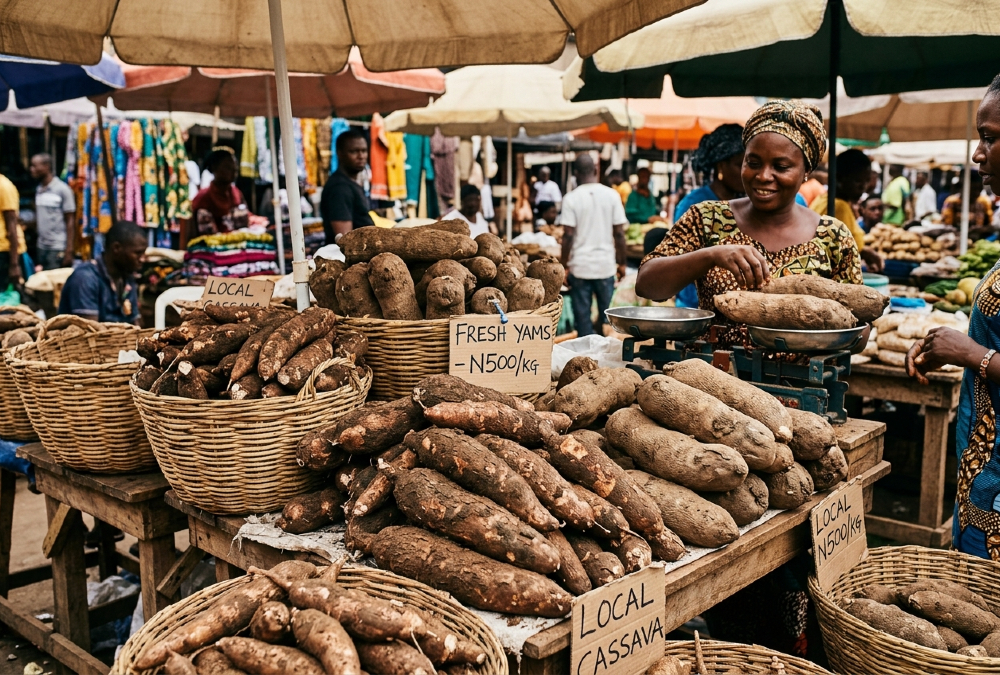
Finally, consider what Africans eat. In countries where wheat is grown, bread is a staple. In much of Africa, by contrast, a loaf of imported-wheat bread often sits within sight of a truck of cassava or yams left to rot. Governments and development programs have done little to encourage people to eat what their own farmers produce. Without demand for local crops, farmers have little reason to grow more of them, and the continent keeps spending scarce foreign exchange on food it could grow itself.
The Way Forward
None of this requires a miracle. It requires a change of direction.
- Modernize the basics. Put affordable tools within farmers’ reach: simple mechanization, small-scale irrigation, improved seeds, and locally produced fertilizer.
- Rewrite outdated laws. Replace slow, duplicative approval systems with streamlined rules that are actually enforced, so that seeds are genuine and inputs are safe.
- End the copy-and-paste approach. Design every project around local needs, with local ownership, and with a plan to survive when the donor leaves.
- Teach skills that work. Make agricultural training practical, hands-on, and rooted in African conditions, so that graduates can farm, advise, and build businesses.
- Back small farms. Support smallholders, and integrate livestock and poultry into every farming project to capture the value of by-products.
- Create demand for local food. Promote the consumption of locally grown produce, so farmers have a market and the continent keeps its money at home.
A Choice, not a Curse
Africa’s farming problem is often described as a puzzle of poverty, climate, or geography. It is better understood as a failure of design. The continent does not lack resources, talent, or goodwill. It lacks rules that serve farmers, projects that fit local realities, and a food culture that rewards those who feed the nation.
Fixing that is within Africa’s own power. The farmer with the hoe is not the problem. He is the opportunity.
Balbir (Shekhawat) Singh, PhD, is a results-driven agribusiness techno-commercial professional with over 18 years of experience in sales, marketing, agronomy, product management, farming, commodity trading, and agri-inputs (fertilizers, seeds, agrochemicals). Passionate about advancing sustainable farming, he currently serves as Director General/CEO of Sodesep SA-Fertilizer Abuja, Nigeria. He has worked across emerging markets including India, Uganda, Kenya, Cameroon, Tanzania, Indonesia, and Nigeria.
