
Opinion
Mastering the Mundane Beats Disruption in African Agribusiness
The most overlooked path to prosperity isn’t disruption – it’s discipline. Until Africa’s entrepreneurs and policymakers learn to love the unglamorous, its grandest ambitions will keep collapsing under their own weight.

By Juwon Akin-Olotu
Every generation of entrepreneurs is tempted by the same mirage: the idea so novel that it announces itself. In African agriculture, the temptation is especially strong. A young founder with a sleek deck and a talent for storytelling can collect applause, reposts and a modest amount of fame long before collecting a single dollar from a paying customer.
Applause is not revenue. Followers are not customers. And a pitch that thrills a conference room is not a business that survives a bad harvest, a delayed shipment or a buyer who demands consistent quality. Far too many ambitious young people are chasing the version of agriculture that feels exciting enough to announce, while neglecting the unglamorous version that actually pays.
The Case for Cassava
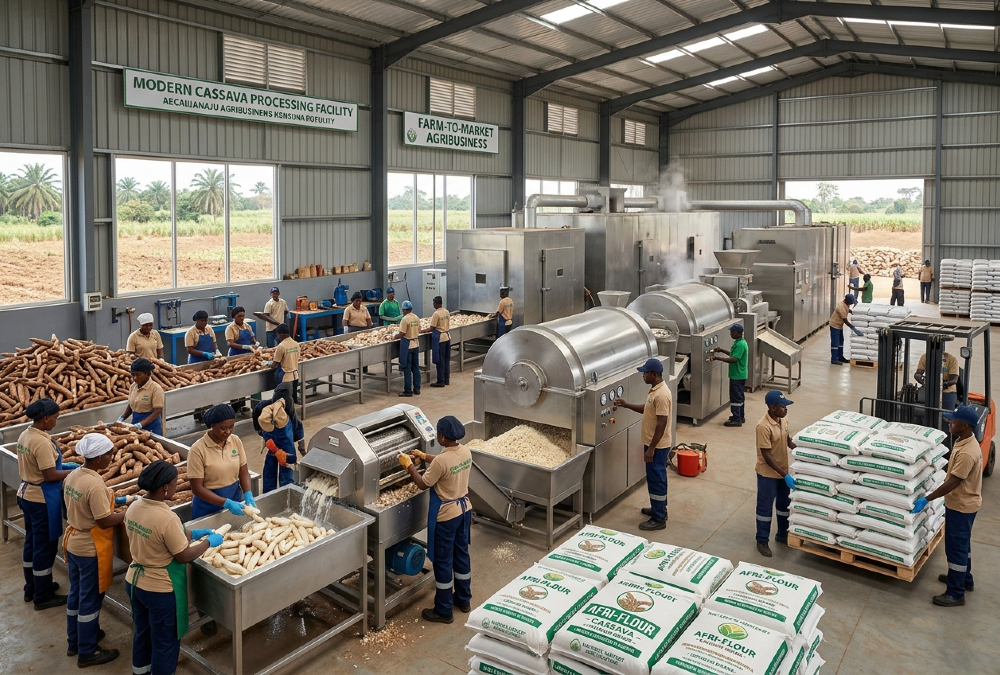
Consider cassava. It is among the continent’s least fashionable crops: neither new nor disruptive, and unlikely to inspire a keynote address. Yet Oluyemisi Iranloye built her processing company, Psaltry International Company Ltd., around this humble root, turning it into starch and other products. The company now generates US$12 million in annual revenue and has counted Nestlé among its customers.
Notice what she did not do. She did not raise a fortune on a slide deck about reinventing cassava. She did not wait for a breakthrough technology or a new category to name. She did the ordinary version of the business, and she did it extremely well: consistent quality, reliable supply, real operations. Those virtues are easy to praise and hard to practice, which is exactly why they are valuable. A multinational buyer does not care how inspiring a supplier’s story is. It cares whether the starch arrives on time, every time, and meets the specification, every time.
Then the numbers compounded. That is the whole secret, and it is less a secret than a discipline. Reliability builds trust, trust wins repeat orders, and repeat orders finance growth. There is nothing viral about it, and nothing fragile either.
The Right Order of Operations
The lesson is about sequence. Master the ordinary first. Run the unglamorous version of the business so well that it becomes dependable. Only then layer the grand ideas on top, once the foundation is strong enough to bear their weight.
Most aspiring founders invert this order. They start with the grand idea, hoping that ambition will substitute for operational skill, and then wonder why nothing sticks. The trouble is not a lack of imagination. It is a lack of foundation. A business built on an untested concept and an unmastered supply chain is a tall building on soft ground. In the meantime, the founder is busy reinventing the wheel while a working wheel sits unused nearby.
Governments Make the Same Mistake
The error is not confined to start-ups. Governments commit it routinely, and on a much larger scale.
Policymakers are drawn to the ambitious: sweeping frameworks, bold transformation agendas, leapfrog strategies that promise to skip the slow stages of development. But the leap presumes a runway. Before any sophisticated agricultural framework can function, farmers need secure and verifiable land records. They need extension services that actually reach the field. They need basic storage so that harvests do not rot, and logistics that carry produce to market at a sensible cost.
These are the cassava of public policy: dull, essential and chronically underfunded. A policy environment without them cannot support a revolutionary framework, just as a company without operational discipline cannot support a revolutionary idea. Announcing the grand strategy is easy, and it earns headlines. Building the foundation earns the harvest.
What Africa Actually Needs
None of this is an argument against ambition. It is an argument for earning it. The continent does not need every young person in agriculture to build something that sounds impressive online. It needs many more who are willing to master cassava, or whatever their own version of cassava may be, and to build something that works: a processing plant that runs reliably, a cooperative that delivers consistently, a logistics operation that gets produce to market fresh.
That work will not go viral. It will, however, pay wages, fill orders and attract the kind of customers who sign long contracts. Real innovation will follow, because it always builds on top of competence. The founders who master the basics will be the ones with the cash flow, the relationships and the credibility to try something genuinely new.
The formula fits on a T-shirt, and it deserves to: Boring is money.
Africa will feed Africa. But it will do so through discipline, not fanfare, by those who stop chasing only the revolutionary and start mastering the ordinary.
Juwon Akin-Olotu is the founder and CEO of Forthwith Global Limited, an agribusiness and consultancy advancing sustainable farming and modern agricultural solutions across Africa. A recognized voice in the continent’s agricultural sector, he champions technology adoption, human-capital development, and leadership grounded in service. Akin-Olotu is also a frequent speaker and moderator at international forums, where he addresses sustainable agriculture, agri-technology, and entrepreneurial education.
