
Opinion
North, Central, Southern: The Divergent Paths of Africa’s Food Economy
From Cairo’s bakeries to Zambia’s overflowing silos, the continent’s food deficits are increasingly created by water, storage and transport rather than by soil. That changes who stands to profit from fixing them – and what India must sell to be taken seriously.

By Ashish Muley
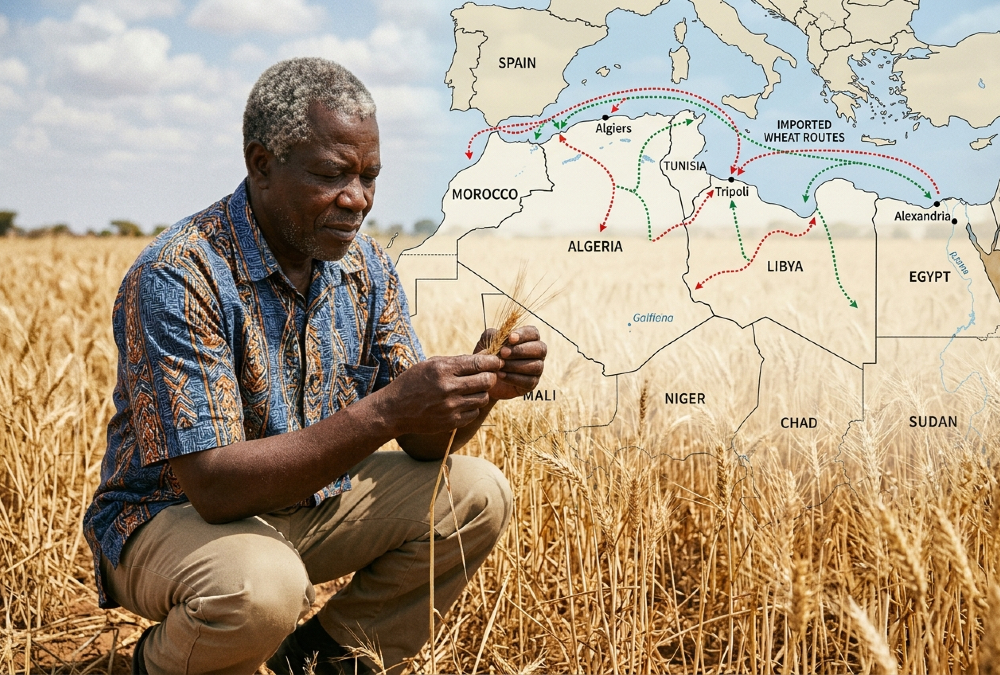
Egypt is expected to import roughly 13.5 million metric tons of wheat in 2026/27, and Algeria about 9.2 million, according to the US Department of Agriculture. Between them, the five countries of North Africa account for something close to 15 percent of all wheat crossing a border anywhere in the world. Read those numbers quickly and they look like an agricultural failure. Read them slowly and they look like something else entirely: a rational decision, taken year after year, by governments that have run out of water.
This is the uncomfortable insight buried in Africa’s food statistics. The continent’s three great importing regions – the north, the center and the south – arrive at their deficits by completely different routes. Only one of them is short of farmland. All three are short of the unglamorous infrastructure that turns a harvest into a meal: canals, cold rooms, silos, ports, railways, credit lines and price information. The policy conversation, and the commercial one, is still stuck on how much Africa grows. It should be about how much Africa moves, stores and processes.
North Africa Imports Grain Because It Lacks Rain
Bread, couscous and pasta anchor North African diets, alongside barley, maize, pulses, dates, olives and dairy. Demand for all of it is rising as populations grow and urbanize. Supply, meanwhile, arrives on the whim of the weather. Morocco’s 2025 cereal harvest came in at only about 4.5 million metric tons, against import requirements the Food and Agriculture Organization put near 11 million. Egypt’s maize imports for 2026/27 are forecast at roughly 9.5 million tons, driven less by what people eat directly than by the feed needed for the chicken and dairy they increasingly want.
The region fills the gap from Russia, Ukraine, the European Union and Canada. Egypt leans heavily on Black Sea wheat; Algeria and Morocco have spread their purchases more widely, having learned in 2022 what concentration risk feels like. But the deeper dependency is not on any particular supplier. It is on the fact that agriculture already consumes around 85 percent of the region’s available freshwater, in what the FAO ranks among the most water-insecure places on earth.
Seen that way, every shipload of wheat entering Alexandria is a shipment of water that North Africa did not have to pump, evaporate or desalinate. Importing grain is the cheapest water policy available. Which is why the serious money in the region is no longer flowing toward growing more, but toward losing less: drip and micro-irrigation, treated wastewater reuse, desalination, drought-tolerant varieties, strategic grain reserves and the port and silo capacity to hold them. North Africa’s food security will be decided by its water engineers.
Central Africa Has the Land but Imports Its Food
Then there is the region that makes no sense at all on paper. The Congo Basin and its neighbors – the Democratic Republic of Congo, Cameroon, Chad, the Central African Republic, the Republic of Congo, Gabon and Equatorial Guinea – enjoy some of the most generous rainfall and soil on the continent. The DR Congo is among Africa’s largest cassava producers. And yet the region runs a maize deficit of more than two million tons, with production estimated by the African Development Bank at about 3.5 million against demand near 5.8 million. It imports roughly 1.5 million tons of rice and 1.2 million tons of wheat a year. Most remarkably, sitting squarely in the world’s palm belt, it imports something like 0.9 million tons of palm oil.
A country in the equatorial rainforest importing palm oil is not suffering from a shortage of land. It is suffering from a shortage of roads, working capital, crushing plants, cold chains, seed systems, agronomic extension and buyers who can be relied on to pay. Conflict and displacement make all of it harder in the places that need it most. The fashionable term is value chains, and for once the jargon is accurate: what breaks in Central Africa is almost never the field. It is every link between the field and the city.
Regional institutions have noticed. The Economic Community of Central African States and the African Development Bank have shifted their emphasis toward agro-industrialization, trade corridors and processing, while programs inside the DR Congo target rice, maize, soybean and cassava as integrated chains rather than as crops. This is the right instinct, and it is being pursued about a decade later than it should have been.
Southern Africa: Glut and Famine in the Same Season
The southern third of the continent teaches the sharpest lesson of the three. The Southern African Development Community’s 16 members do not share a single food situation; they share a border and very little else. South Africa’s 2025/26 maize crop reached roughly 16.8 million tons, a record, while neighbors within a day’s drive of that surplus were rationing.
The 2024 drought showed how fast the arithmetic flips. A region that exports maize in one season is negotiating emergency imports in the next, because production across most of SADC still depends on rain that arrives when it feels like it. The result is a market that is simultaneously oversupplied and starving, separated by weigh-bridges, border paperwork, missing silos and roads that add more to the price of a ton of maize than the farmer received for growing it.
The fix is not to plant more everywhere. It is to plant where the economics work, store what is planted, and let it move: cross-border grain trade, warehouse receipt systems, functioning corridors, irrigation, agro-processing and, unromantically but crucially, honest and timely price data. STOSAR II, the FAO and EU-backed program running across all 16 SADC states, is pointed at exactly this. Its success will be measured less in tons grown than in tons that reach a market before they spoil.
What India Should Actually Be Selling
For Indian exporters, and for the policymakers who cheer them on, the temptation is to read all of the above as a very large order book for rice, pulses, oilseeds and spices. It is. But commodity supply is the least defensible position in the room, because anyone can occupy it, and India has given African buyers reason to doubt it will stay. Sudden export restrictions on rice and wheat in recent years were domestically rational and internationally expensive; a buyer in Dakar or Kinshasa who has been left short once will price that memory into the next contract.
The durable opportunity is in the things Africa’s deficits are actually made of. India is among the world’s most credible suppliers of affordable micro-irrigation, small-horsepower farm machinery, seed and input systems built for smallholders, warehousing and post-harvest handling, food processing and packaging equipment, animal-feed ingredients and the digital agronomy and market-information tools that have spread across Indian villages in the past decade. These are not commodities. They are systems, they come with training and service contracts, and they create the kind of relationship that survives a bad monsoon.
Africa’s food opportunity, in other words, is not a question of what the continent grows. It is a question of whether production, storage, trade and processing are ever connected to one another – and whether the connecting is done by Africans, with partners who supply capability rather than merely cargo. North Africa will be judged on its water. Central Africa on its roads and its factories. Southern Africa on its borders. Everyone selling into those markets should be judged on which of those problems they actually help solve.
Ashish Muley is an independent consultant with Stalwart Management Consulting, with 27+ years in agricultural commodity value chains, export markets, and international trade. He has led projects on business development and capacity building across African countries in partnership with international organizations. Formerly, he spent 15 years in financial services leadership, focusing on sales, marketing, and business development. Based in Pune, India, Ashish advises on agricultural trade, commodity markets, Warehouse Receipt System (WRS) and Asia–Africa economic opportunities, and regularly writes on international trade and logistics.
