
Opinion
Africa’s Biggest IPO Is a Bet on Refining, Not Just Oil
Aliko Dangote wants ordinary Nigerians to own a piece of his $20 billion refinery. The offer is as much a test of Africa’s capital markets as it is of the refinery itself.

By Ratnakar Wagh
Africa’s largest-ever initial public offering just opened its doors to millions of ordinary investors – and the buy-in is smaller than a week’s worth of lunch money in Lagos.
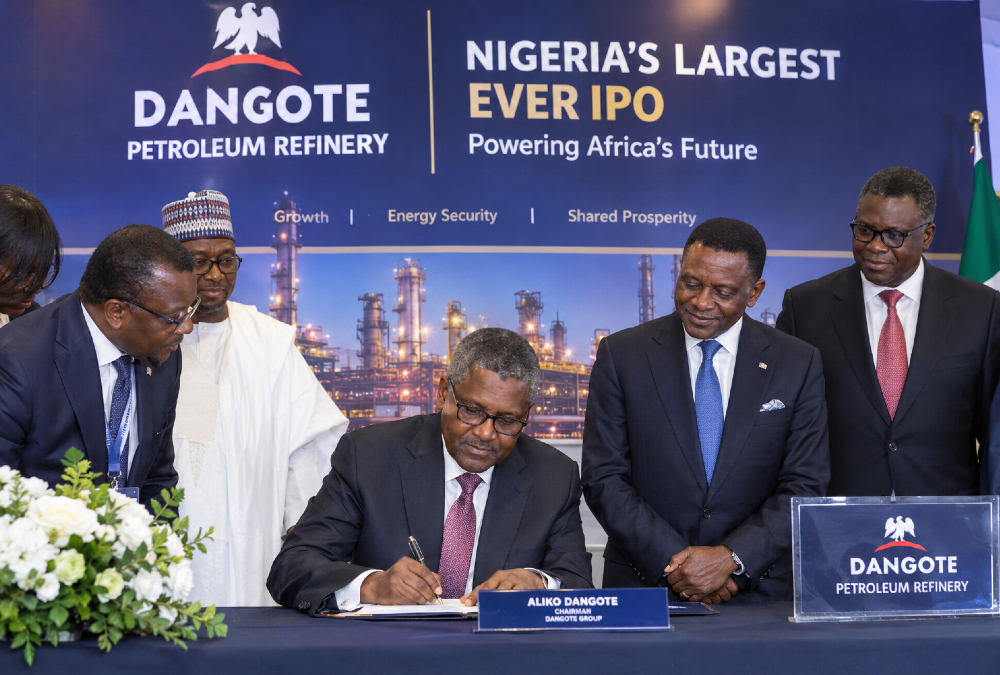
Dangote Petroleum Refinery and Petrochemicals FZE, the flagship venture of Africa’s foremost industrialist, Aliko Dangote, launched its public share offer on September 14, running through October 13. The company is selling 4.1 billion ordinary shares at ₦525 (roughly US$0.40) apiece, aiming to raise approximately ₦2.15 trillion (US$1.6 billion) to fund an ambitious expansion of the refinery’s processing capacity toward 1.4 million barrels per day by 2028, more than double its current output.
For a continent long defined by resource paradoxes, this is a moment worth pausing on.
The Paradox This IPO Is Built to Break
For generations, Africa has lived a peculiar contradiction: pumping crude oil out of the ground by the millions of barrels, then turning around and importing the refined fuel its own citizens need to drive, cook, and power their economies. The continent exported its raw wealth and imported its finished products – along with all the price volatility, currency pressure, and supply-chain fragility that comes with depending on someone else’s refineries.
The Dangote refinery, already Africa’s largest private refining complex, has begun chipping away at that dependency since it started supplying fuel domestically. The expansion this IPO will help finance – pushing capacity toward 1.4 million barrels per day – is designed to deepen that shift. A refinery of this scale, built at a reported cost of around US$20 billion on the outskirts of Lagos, doesn’t just process oil; it anchors a more resilient domestic energy supply chain, insulates African economies from global shocks, and keeps more petrodollars circulating at home rather than flowing out to pay for imported fuel.
Ownership for the Many, Not Just the Few
What sets this offering apart from the mega-IPOs of London or New York is not just its scale, but its accessibility. The minimum subscription has been deliberately set low: just 10 shares, or about ₦5,250 (roughly $4). Paired with digital investment platforms and electronic application channels now common across Nigeria’s capital markets, that threshold puts a stake in Africa’s industrial backbone within reach of market traders, drivers, students, and salaried workers – not just institutional investors and the wealthy.
Dangote himself has framed the offer explicitly in those terms, telling attendees at the signing ceremony that the sale is meant for everyday people, not just Lagos’s financial elite. Whether or not that ambition is more marketing than economics, the structural fact remains: this is one of the more genuinely inclusive large-scale listings the Nigerian Exchange has seen.
More Than a Stock Sale
It would be easy to file this under routine capital-markets news – another company raising money to expand. But that undersells what’s happening. This IPO is a live experiment in whether African-led infrastructure can be financed by African capital, and whether the proceeds of that infrastructure can flow back to African households as shareholders, not just as consumers of the fuel it produces.
It won’t solve Nigeria’s energy challenges overnight, and investors should weigh the real risks – currency exposure, refining margins, execution risk on an expansion this large – before subscribing. But as a signal of intent, the Dangote offering says something important: that the next chapter of Africa’s industrialization doesn’t have to be bankrolled entirely from outside the continent, and that ordinary Africans don’t have to watch that chapter unfold from the sidelines.
The question worth asking now is bigger than this one refinery: if domestic megaprojects like this can be financed – and owned – by the people they serve, what does that mean for Africa’s economic independence over the next decade?
Ratnakar Wagh is an entrepreneur, management professional, and CEO of Tanzania-based Kinglion Investment Company, an investment firm driving industrial development across Africa through initiatives in manufacturing, renewable energy, and logistics infrastructure. He specializes in organizational transformation, sustainability, and leadership, with a strong focus on building high-performing teams and creating long-term value across emerging markets.
