
Alorh’s eye on the Motherland
Some facts about the African Continental Free Trade Area
Wednesday, February 12, 2025

By Mary Alorh
The African Continental Free Trade Area (AfCFTA) is a landmark initiative poised to transform Africa’s economic landscape. Here’s what you need to know about this ambitious trade agreement:
Origins and Vision
- The African Union (AU) first conceptualized the idea of a Continental Free Trade Area (CFTA) in 2012.
- It became a flagship project under the AU’s Agenda 2063, a long-term vision launched in 2015 to drive sustainable development and economic integration across the continent.
- AfCFTA’s primary goal is to create a single, integrated market for goods, services, people, and capital across Africa.
Scope and Economic Potential
- With a combined GDP of approximately US$3.4 trillion, AfCFTA connects 1.3 billion people across diverse regions of the continent.
- It is the largest free trade agreement by membership in the world, aiming to position Africa as a unified, industrialized, and competitive global economic player.
- The agreement goes beyond traditional trade pacts by also liberalizing services trade, which accounts for 60 percent of Africa’s GDP.
Challenges to Trade Integration
- Historically, regional trade in Africa has been constrained by high trade barriers, making it more costly to trade within the continent than with international partners.
- Infrastructural deficits, fragmented transportation networks, and inconsistent regulatory frameworks further hinder seamless trade.
- In 2017, intra-African exports represented only 16.6 percent of total exports – significantly lower than trade within Europe (68.1 percent), Asia (59.4 percent), and the Americas (55 percent), according to UNCTAD’s 2019 report.
Implementation and Milestones
- The AfCFTA agreement officially came into force on May 30, 2019, for the 24 countries that had ratified it by that date.
- The official launch took place on July 7, 2019, in Niamey, Niger.
- Trading under AfCFTA began on January 1, 2021, but progress has been slowed by implementation challenges, particularly in finalizing rules of origin.
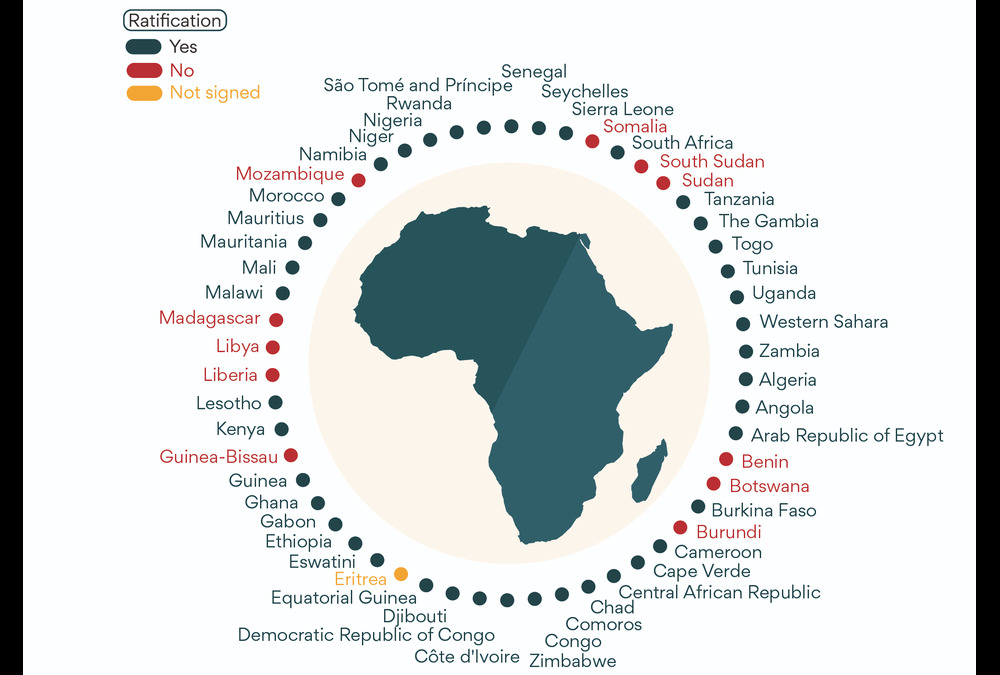
- As of October 2024, 54 out of 55 AU member states have signed the agreement, with 47 countries depositing their instruments of ratification by December 2023.
- Eritrea remains the only AU member state yet to sign, citing challenges such as technological underdevelopment, an isolationist economic approach, and the need for further economic reforms.
Dispute Resolution and Private Sector Involvement
- While the AfCFTA dispute resolution mechanism is in place, it is primarily designed for governments.
- Private businesses – including exporters, importers, and service providers – cannot directly access the mechanism, despite their critical role in the agreement’s success.
A Game Changer for Africa
By reducing trade barriers and opening domestic markets, AfCFTA aims to accelerate regional trade, industrialization, and economic growth, positioning Africa as a competitive force in global commerce.
Mary Alorh is Director of Administration at DefSEC Analytics Africa Ltd., and is an expert in Gender, Youth, and Peace & Security initiatives in West Africa.

Continue Reading