
Opinion
Michael B. Jordan’s Historic Oscar Win and the Academy’s Lingering Equity Problem
His Best Actor win for “Sinners” is a milestone – but the numbers behind it are a sobering reminder of how far Hollywood still has to go.

By Mark-Anthony Johnson
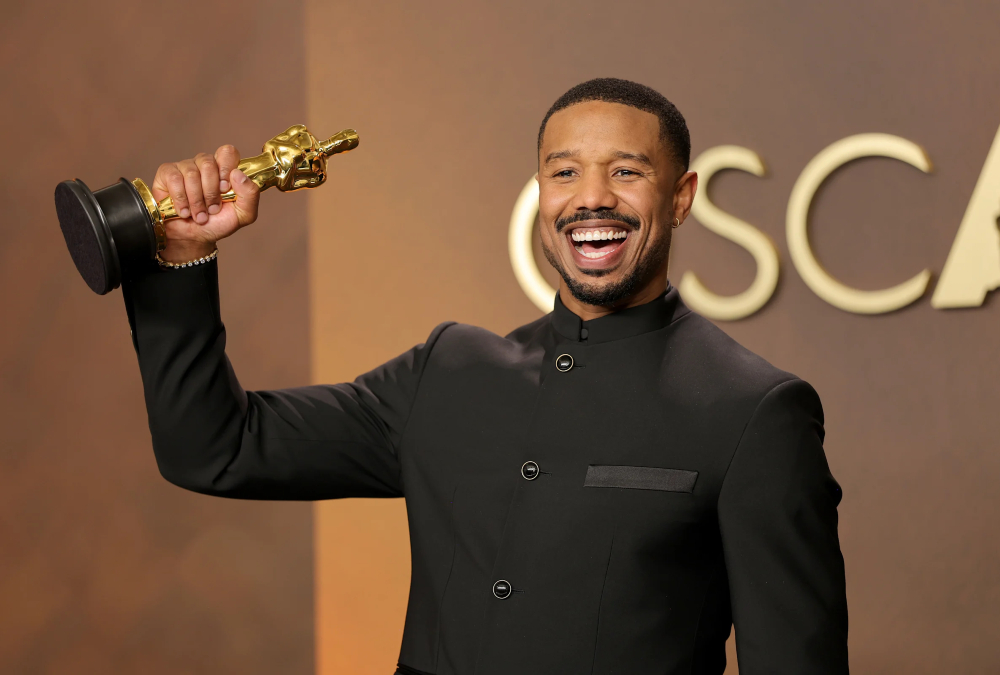
Michael B. Jordan made history at the 2026 Academy Awards, claiming Best Actor for his dual performance as twin brothers Smoke and Stack in the supernatural thriller Sinners. The victory was greeted with a standing ovation – and for good reason.
Jordan becomes only the sixth Black man in the nearly century-long history of the Oscars to win the award for Best Actor.
The moment carries a weight that transcends personal achievement. “I stand here because of the people that came before me,” Jordan told the audience at the Dolby Theatre, before naming his predecessors: Sidney Poitier, Denzel Washington, Jamie Foxx, Forest Whitaker, and Will Smith.
He also honored Halle Berry – the first, and still the only, Black woman to have won Best Actress – and made a moving dedication to the late Chadwick Boseman, whose absence loomed large over the evening.
“To be amongst those giants, those greats, amongst my ancestors, amongst my guides,” Jordan continued. “Thank you everybody in this room and everybody at home for supporting me over my career.
I feel it. I know you guys want me to do well, and I want to do that because you guys bet on me. So thank you for keeping betting on me.”
The Numbers Don’t Lie
Jordan’s win is cause for genuine celebration, but the arithmetic surrounding it is uncomfortable. Since the Academy of Motion Picture Arts and Sciences first handed out its Best Actor award in 1929, the prize has been awarded 96 times.
Of those, a Black actor has taken home the statue just six times. That is a representation rate of roughly six percent – for a community that has shaped American cinema in ways impossible to overstate.
The complete list is startlingly short: Poitier for Lilies of the Field (1964), Washington for Training Day (2002), Foxx for Ray (2005), Whitaker for The Last King of Scotland (2007), Smith for King Richard (2022), and now Jordan for Sinners (2026). Decades elapsed between several of these wins.
The 38-year gap between Poitier and Washington remains particularly striking.
The Best Actress category offers an even starker picture. Berry’s win for Monster’s Ball in 2002 remains singular – unrepeated in the 24 years since.
A Historic Performance
Jordan’s recognition is notable for more than its place in a statistical ledger. He is the first actor in Oscar history to win the award for portraying twins – a technically and emotionally demanding feat that required him to differentiate two characters while sharing every scene with himself.
The performance in Sinners, directed by Ryan Coogler, has been widely described as a career-defining turn, one that finally gave the Academy an unmistakable case it could not overlook.
Jordan, 39, has long been considered one of the most compelling actors of his generation – celebrated for Fruitvale Station, Creed, and Black Panther – yet repeatedly passed over at awards season. His win, in that sense, feels both overdue and timely.
What Progress Really Looks Like
There is a risk, in moments like these, of letting the emotion of the occasion obscure the structural analysis the moment demands. Six winners in 96 years is not evidence of a solved problem; it is evidence of a slowly shifting one.
The industry has made genuine strides – in casting, in financing, in the range of stories it is willing to tell – but the Oscars remain, as they always have, a lagging indicator of those changes rather than a leading one.
Jordan himself seemed aware of the duality. His acceptance speech was gracious and generous, but it was also, unmistakably, a speech about inheritance and obligation – about receiving something that was made possible by the sacrifices of those who came before, and about the responsibility that attaches to that gift.
That is a fitting note on which to mark this milestone: with gratitude, with historical perspective, and with the clear-eyed understanding that the list of six should, by now, have been considerably longer.
Mark-Anthony Johnson is the founder and CEO of JIC Holdings, a global asset and investment management firm founded in 2009. With over 30 years of experience and strong ties to Africa, his investments span mining, infrastructure, power, shipping, commodities, agriculture, and fisheries. He is currently focused on developing farms across Africa, aiming to position the continent as the world’s breadbasket.
