
A Diaspora View of Africa
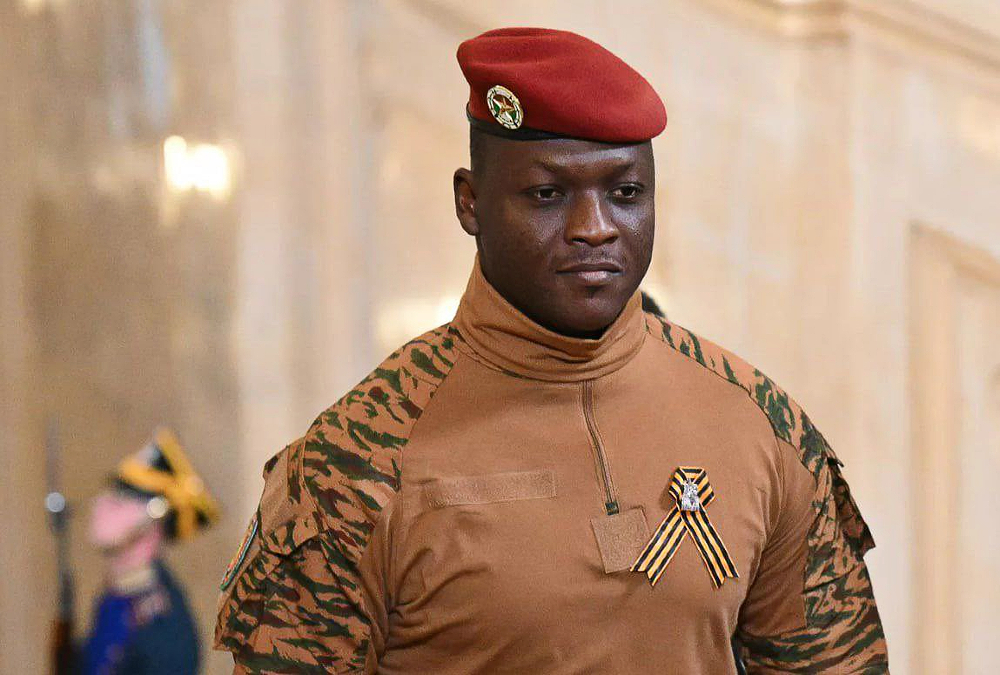
Ibrahim Traoré: Africa’s Newest Luminary

By Gregory Simpkins
South Africa’s Nelson Mandela (Madiba – clan name of respect in the Xhosa language), Ghana’s Kwame Nkrumah (Osagyefo – redeemer in the Akan language), and Tanzania’s Julius Nyerere (Mwalimu – teacher in the Swahili language). These are among Africa’s most admired and celebrated post-independence leaders.
Now there is a new one: Ibrahim Traoré of Burkina Faso.
Traoré’s standing among many in Africa has risen significantly since seizing power in a coup in 2022. Traoré’s regime ditched former colonial power France in favor of a strong alliance with Russia, that has included the deployment of a Russian paramilitary brigade, and adopted left-wing economic policies, according to a May 12 article in The Africa Report.
“Traoré’s impact is huge. I have even heard politicians and authors in countries like Kenya [in East Africa] say: ‘This is it. He is the man’,” Beverly Ochieng, a senior researcher at global consultancy firm Control Risks, told the BBC, as quoted in The Africa Report article.
Traoré was part of the wave of Francophone African countries that expelled the French in recent years. Rather than switching to the United States or other Western nations for alliances, Burkina Faso has chosen Russia.
Niger, which also expelled the French, ordered the United States to withdraw all of its military forces as of August 2024. The US left behind a US$100 million military base built to help in the effort to combat Islamist extremists.
That base is now occupied by Russian forces.
Economic Nationalism and Anti-Colonial Rhetoric
The Burkinabé leader has successfully promoted his anti-neocolonialist stance and his determination to deliver genuine independence to his country. For example, The Africa Report article stated that as part of what Traoré calls a “revolution” to ensure Burkina Faso benefits from its mineral wealth, the junta is building a gold refinery and establishing national gold reserves for the first time in the nation’s history.
However, Western-owned firms appear to be facing a tough time being involved, with Australia-headquartered Sarama Resources launching arbitration proceedings against Burkina Faso in late 2024 following the withdrawal of an exploration licence. The junta has also nationalized two gold mines previously owned by a London-listed firm, and said last month that it planned to take control of more foreign-owned mines.
Enoch Randy Aikins, a researcher at South Africa’s Institute for Security Studies, told the BBC that Traoré’s radical reforms had increased his popularity in Africa. “He is now arguably Africa’s most popular, if not favorite, president,” Aikins said.
A Hero Across Borders
Indeed, demonstrations throughout the African Diaspora have lionized Traoré as today’s leading pan-Africanist. For example, Julius Malema, head of South Africa’s Economic Freedom Fighters party, recently gave an impassioned speech to his supporters in favor of Traoré and the symbol of his leadership of African independence.
In Burkina Faso, youth have turned out to show support for Traoré by the thousands with the popular refrain – “Africa for the Africans” – being heard. The 37-year-old captain appears to have captured not only the anti-imperialist sentiments in Africa, but also galvanized the frustration of youth who don’t see the progress they believe is being denied to them, and Traoré appears to be just the man to provide that advancement.
Traoré continues to be lionized, and Diaspora supporters warn of plots to remove the newest pan-Africa hero. They point to the removals by force of DR Congo’s Patrice Lumumba and Libya’s Muammar Gadaffi, who both espoused pan-Africanist views.
Social media is transmitting the sentiment of pan-African pride that they see the Burkinabé leader championing. His heroic image appears on posters and other media from the Burkina Faso capital of Ouagadougou to London and beyond – as far away as Montego Bay, Jamaica.
Online, AI-generated images depicted fictional demonstrations in Nairobi, Harare, Kampala and even New York’s Times Square. Deepfake audio tracks mimicking the voices of global pop stars like Rihanna and Beyoncé singing praises of Traoré circulated widely, blurring the line between digital propaganda and fan-driven mythmaking, according to The Africa Report.
What Does Traoré’s Leadership Mean for Democracy?
In the 2024 Freedom in the World report by international human and civil rights organization Freedom House, lists Burkina Faso as Not Free with a rating of 24 out of 100. “Two separate coups organized by the military in 2022 plunged Burkina Faso into political crisis, eliminating many of the significant political reforms implemented after the 2014–15 political transition.
While civil society and organized labor remain strong forces for democracy, Burkinabè face continued insecurity and violence from armed militant groups, militias, and government forces, causing widespread internal displacement,” the Freedom House report states.
“Though the military’s justification for its two illegal seizures of power was to address growing security and humanitarian crises, insecurity has dramatically worsened following the takeovers. The junta has also acted unilaterally to entrench itself in power, postponing elections indefinitely.”
The early days of his reign, when ‘IB’ – as he is known to his countrymen – told anyone who would listen that he had no intention of staying in power, are long gone, stated The Africa Report on May 14. A year and a half later, he is still managing the country’s day-to-day affairs – a task that he promised, at the time, to “expedite”.
No longer talking about leaving his position, let alone organizing elections, Traoré has firmly installed loyalists in his junta and imposed his authority.
Traoré reportedly was long disgusted by the country’s higher military leaders who sent their men out to fight and die in interminable battles with extremist groups while they stayed safe and comfortable in air conditioned offices in the capital. For their part, these senior officers, obliged to stand to attention before a captain in his thirties and obey his orders, are said to have found this to be a hard pill to swallow.
Many would be delighted to see him fall – not least those close to of Lieutenant-Colonel Paul-Henri Sandaogo Damiba, the original coup leader, who was overthrown following a mutiny of junior officers.
At the end of September 2023, Traoré reportedly was on the brink of being overthrown before the first anniversary of his own seizure of power. An attempted coup was foiled at the last minute, and several elite officers – including many from Special Forces and the Special Intervention Unit of the National Gendarmerie – were arrested.
Another, Major Ismaël Touhogobou, was killed during an attempted arrest at his home in Ouagadougou.
Much of Traoré’s appeal rests on rhetoric and not institutional reform. But that has not slowed his meteoric rise on social platforms.
It’s algorithmic populism; emotional, visual, anti-Western and hyper-shareable.
The Africa Report interviewed a former civil servant who felt that the Burkinabè people were misled by Traoré. “From the very first weeks, we realised that he was a great manipulator. He told everyone what they wanted to hear.
Then, when people finally understood, it was already too late,” the unidentified man said.
Challenges and Controversies
Russian interests seem to benefit from what reforms have been made. The government established a state-owned mining company, requiring foreign firms to give it a 15 percent stake in their local operations and to transfer skills to Burkinabé people.
The rule also applied to Russian miner Nordgold, but the company was given a licence in late April for its latest investment in Burkina Faso’s gold industry while other foreign interests were denied.
But as in other countries that have cast off the Western presence in favor of Russian support, the presence of Russian forces don’t seem to be making much headway in combating jihadist elements. Members of al-Qaeda-linked Group for the Support of Islam and Muslims, (JNIM), carried out simultaneous attacks recently on a military detachment and police posts in the northern town of Djibo, as well as other towns in the north of the country.
Assailants reportedly arrived by the hundreds on motorcycles and vehicles, encircling the town, security and local sources told the French news agency AFP. While there is no official death toll, witnesses told RFI that the attack was of an extreme violence, and several dozen people were killed.
At least twenty civilians were buried on one day, and others were to be buried the following day.
The jihadists took over the camp and looted it, and attacked parts of the town, burning houses and parading through the streets. How long until Burkinabè people become frustrated with foreign forces who seem more intent on protecting the government and their economic interests than protecting citizens or enabling a genuine sharing of the benefits of the country’s resources?
Still, for the moment, Traoré continues to be lionized, and Diaspora supporters warn of plots to remove the newest pan-Africa hero. They point to the removals by force of DR Congo’s Patrice Lumumba and Libya’s Muammar Gadaffi, who both espoused pan-Africanist views.
Of course, one need look no further than Thomas Sankara, a Burkinabè pan-Africanist leader who also was removed in a coup. These removals are seen as being fomented by Western interests who either replaced these leaders with more cooperative ones or allowed chaos to reign.
Whether Western interests play any role in the removal of Traoré or not, they likely would be blamed, and that would ratchet up the growing opposition to the Western influence in Africa and elsewhere in the Diaspora.
Gregory Simpkins, a longtime specialist in African policy development, is the Principal of 21st Century Solutions. He consults with organizations on African policy issues generally, especially in relating to the U.S. Government. He further acts as a consultant to the African Merchants Association, where he advises the Association in its efforts to stimulate an increase in trade between several hundred African Diaspora small and medium enterprises and their African partners.
