
Opinion
Europe Is Learning What Africa Already Knows
As the post-war international order fractures and a multipolar world takes shape, the most consequential strategic alliance of the 21st century may be the one that Europe has been slowest to recognize.

By Farhia Noor
I am African. And when Ursula von der Leyen, President of the European Commission, speaks of the urgent need for Europe to achieve strategic independence, she is articulating something that much of the developing world grasped long ago: that the liberal international order is not a permanent condition – it is a historical moment, and that moment is passing.
What we are witnessing today is not merely a realignment of alliances. It is the slow, structural rebalancing of global power – a shift as consequential as any in the past century.
The rise of China, India’s surging economic momentum, and the growing collective voice of the Global South are redrawing the geopolitical map. We are entering a multipolar world, and the rules that once governed international relations are being renegotiated in real time.
In this context, Europe faces a strategic question of the first order: Who will be its most important partner in the century ahead? The answer may lie closer than many European policymakers have yet been willing to accept.
Africa Is Not Europe’s Neighbor. It Is Europe’s Horizon.
By 2050, one in four people on earth will live in Africa. The continent holds critical reserves of the minerals essential to the global energy transition – cobalt, lithium, manganese, and rare earths – as well as arguably the world’s greatest untapped potential for solar power and green hydrogen.
These are not peripheral assets. They are the building blocks of the next industrial age.
But beyond resources lies Africa’s most consequential strength: its youth. The African workforce is set to become the largest on the planet within a generation.
Meanwhile, Europe confronts an aging population, a shrinking labor force, and the long-term fiscal pressures that follow. These two demographic realities – one of surplus, one of scarcity – are not simply problems to be managed. They are a historic complement, if the political will exists to act on it.
Imagine a Europe–Africa partnership structured not around aid and dependence, but around genuine economic integration. Joint skills academies that train African workers to the highest international standards.
Minerals processed not in Rotterdam or Hamburg, but within African manufacturing corridors that capture value where it originates. Digital infrastructure connecting African talent to global markets. Solar installations and green hydrogen facilities across the Sahel powering both African cities and European clean-energy targets. Innovation hubs from Nairobi to Lagos producing the next generation of global technology companies.
Such a partnership would not be charity. It would be strategy.
Mutual Necessity, Not Benevolent Largesse
Europe needs resilient supply chains, diversified energy sources, and new markets for its goods and services. Africa needs industrial development, technology transfer, and long-term investment that builds institutions rather than extraction corridors.
The alignment of these interests is not incidental – it is structural. And it creates the foundation for what could become one of the most powerful economic corridors in the history of global trade.
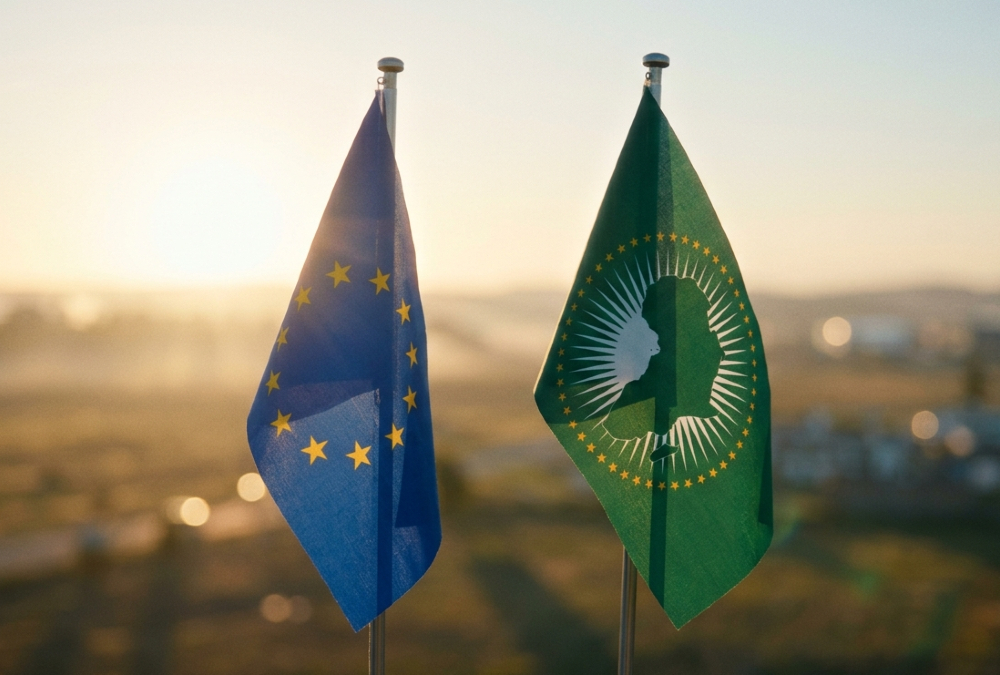
Yet for this partnership to succeed – and to endure – it must be built on a principle that European foreign policy has not always honored: the full equality of the European Union and the African Union as sovereign partners.
Africa is not a frontier to be developed by external actors with the best of intentions. It is a continent of 54 nations with its own institutions, its own democratic traditions, and its own strategic vision.
Africa will engage constructively with many partners – China, the Gulf states, the United States, India – but the terms of those engagements must always serve African development first. Any European approach that treats Africa as a passive recipient of investment, migration policy, or security arrangements will fail – not because Africans are ungrateful, but because the world has changed.
African governments today have options, and they know it.
The Window Is Open. It Will Not Remain So.
The real question for Europe is no longer whether Africa matters. That case has been made, and increasingly it is understood in Brussels, Berlin, and Paris.
The question now is one of urgency and sincerity: Will Europe commit to helping build Africa’s transformation on African terms – or will it hesitate, hedge, and watch others move first?
Others are not waiting. China’s infrastructure investment across the continent, while increasingly scrutinized, has demonstrated what decisive strategic commitment looks like.
The Gulf states are acquiring agricultural land and forging security partnerships at a pace that commands attention. Even within the Global South, new coalitions – accelerated by BRICS expansion – are creating frameworks that deliberately exclude traditional Western intermediaries.
Europe still has distinctive advantages in this competition: a long shared history with Africa, deep institutional networks, geographical proximity, and – when it chooses to deploy them – genuine strengths in governance, education, and rule-of-law frameworks that China and others cannot easily replicate. But advantages are not destiny. They expire if they are not acted upon.
The Future Belongs to Those Who Grow Together
The 21st century will not favor the powers that seek dominance. It will favor those with the wisdom to build durable partnerships – partnerships grounded in mutual respect, shared prosperity, and a clear-eyed understanding of what each party needs from the other.
Africa’s rise is no longer a projection. It is underway. The continent’s economic growth rates, its expanding middle class, its extraordinary entrepreneurial energy, and the ambitions of its young people are not future possibilities – they are present realities, visible to anyone paying attention.
The defining geopolitical question of our era, therefore, is not whether Africa will rise. It will. The question – for Europe, and for the world – is who will have the vision and the courage to rise with it.
Europe already knows the answer. Von der Leyen’s language of strategic independence signals a leadership class that understands the old certainties are gone. The question now is whether that understanding will translate into the kind of bold, equitable, long-term engagement that this moment demands – and that Africa deserves.
Farhia Noor is a seasoned business consultant based in Dar es Salaam, Tanzania. With a proven track record in developing enterprises and executing turnkey projects across both government and private sectors, she brings deep expertise to the table. Farhia is also a committed advocate for community-led development and is passionate about advancing sustainable, intra-African growth.
