
Opinion
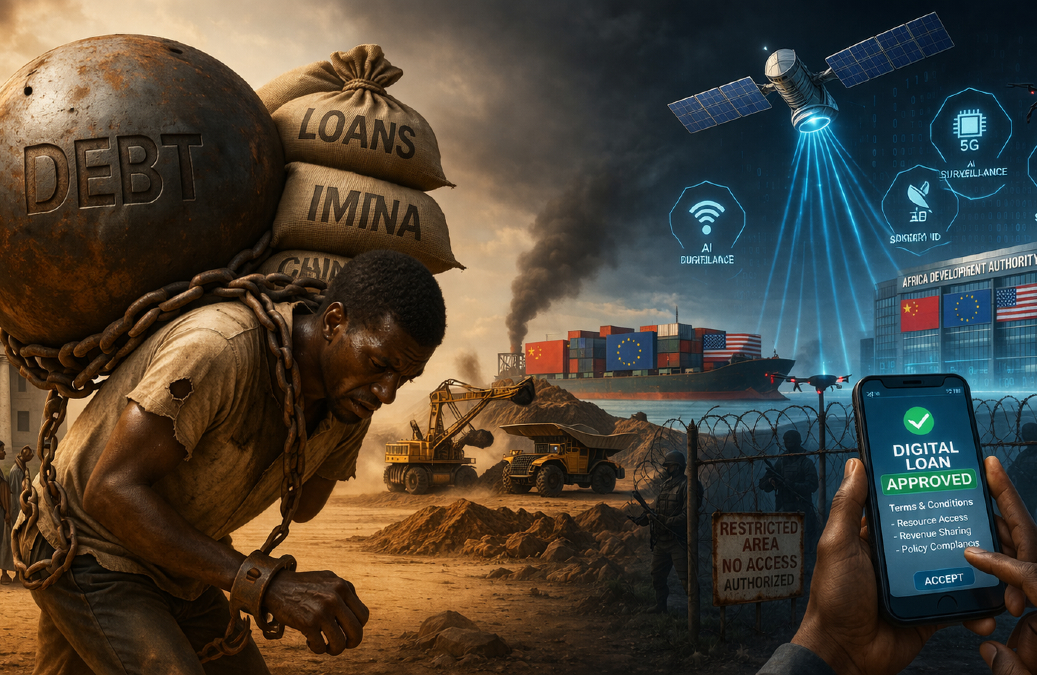
Debt, Dependency, and the New Instruments of Control
Why modern influence wears a suit, not a uniform – and what Africa must do about it.

By Daki Nkanyane
Control has changed its appearance. It no longer arrives primarily through flags, uniforms, or overt military occupation. It arrives through contracts, financing terms, procurement rules, and what diplomats have learned to call “technical assistance.”
It comes packaged in impeccable language – development, partnership, support, capacity-building – and it often feels, at first, like relief. But history has always had a quiet method: it replaces old chains with new ones, and then calls them opportunity.
Africa is entering a global era in which influence is being pursued aggressively – but subtly. Power today is financial, infrastructural, technological, legal, and narrative.
It is embedded in systems that appear neutral yet behave strategically. The question is no longer whether Africa will engage the world – it must. The question is whether it can do so without signing away its future in the fine print.
How does Africa avoid a modern dependence that is signed voluntarily, celebrated publicly, and regretted privately?
The New Colonialism Does Not Announce Itself
The most effective systems of control do not announce themselves as such. They arrive as solutions to urgent needs: roads and ports, electricity generation, broadband infrastructure, payroll stabilization, budget support, emergency loans, security assistance, trade preferences.
These are real needs. The danger is not the need itself – it is what gets attached to the need, quietly, contractually, and structurally.
Modern influence increasingly takes a recognizable form: “We will finance it, but…” “We will build it, but…” “We will secure it, but…” “We will connect you, but…” And in the “but” lives the future. That subordinate clause – understated, legalistic, often buried in an annex – is where sovereignty is quietly redistributed.
Debt as a Tool of Direction, Not Just Finance
Debt is not inherently bad. Many nations have developed by borrowing. The moral question is not whether to borrow; it is what borrowing creates. The strategic question is sharper still: does the debt expand productive capacity, or does it deepen dependence?
Debt becomes an instrument of control when repayment burdens reduce policy freedom; when revenue is pre-committed to servicing loans rather than financing development; when refinancing becomes perpetual; when assets are mortgaged – formally or through leverage – to creditors; when procurement locks countries into external suppliers; and when project designs prioritize the lender’s interests over local value creation.
Debt, in short, is not only about money. It is about who gets to decide.
When national budgets are shaped primarily by repayment schedules, sovereignty is quietly bargained away – not in a single dramatic moment, but across dozens of mundane quarterly reviews.
The Trap of “Urgency Economics”
Africa’s greatest vulnerability in modern negotiations is urgency. Urgency makes bad terms feel acceptable. It makes transparency feel inconvenient. It makes long-term consequences feel distant and abstract.
Many of the continent’s dependency structures were not created because leaders were ignorant – they were created because leaders were under pressure: political, social, fiscal, and crisis-driven.
Under urgency, deals are signed that would never survive calm scrutiny. The continent must learn a difficult discipline: never negotiate your long-term future from a short-term emergency.
That principle is easier to state than to live by – but it may be the single most important rule of statecraft for the current generation of African policymakers.
Infrastructure That Does Not Build Sovereignty
Infrastructure is routinely celebrated as development. Not all of it deserves the label. There is infrastructure that connects a country to its future – building local capacity, improving productivity, strengthening domestic industry. And there is infrastructure that connects a country to external dependency – built primarily to extract value outward, with minimal local industrial development, negligible skills transfer, and permanent maintenance dependence.
The questions Africa must ask in every major infrastructure agreement are straightforward but frequently unasked: Who owns the knowledge embedded in this infrastructure? Who maintains it? Who supplies parts and upgrades? Who controls critical operations? What local industries are being developed around it?
If infrastructure is built without simultaneously building local capability, the country becomes a customer forever. That is not development. That is dependency poured in concrete.
Procurement: The Quiet Lock-In
One of the least discussed instruments of modern control is procurement. It determines who wins contracts, where money circulates, which firms grow, which skills develop, and whose technical standards become embedded as the default.
Many external financing packages carry procurement conditions that ensure value flows back to external contractors, suppliers, consultants, project managers, and standards frameworks – regardless of what the headline investment figures suggest.
The project looks like investment; the value travels outward. Africa must treat procurement as a sovereignty issue, not an administrative detail. A continent cannot industrialize while permanently outsourcing its most valuable contracts to foreign firms.
“Expertise” as Dependence
A subtler instrument of modern control is the permanent importation of expertise. Consultants are not the enemy; external support can be genuinely valuable.
But when expertise becomes a permanent substitute for local capacity rather than a bridge toward it, it manufactures intellectual dependence. Societies begin to believe that solutions must come from elsewhere, that thinking must be validated externally, that strategy is not local work.
This is how sovereignty erodes at the level of the mind.
Every major project must leave behind trained people, local technical knowledge, institutional learning, and African-owned competence. The test is simple: when the consultants pack up, does the capability remain? If not, the project has not served development – it has served the consultants.
Technology Stacks as Modern Borders
Dependence today is increasingly digital. Technology ecosystems can quietly lock countries into specific vendors, proprietary systems, foreign cloud infrastructure, external data governance frameworks, and platform rules that cannot be renegotiated locally.
In this sense, technology stacks have become modern borders – invisible, technically complex, and remarkably durable.
A country may be politically sovereign yet digitally dependent – unable to control its own data, unable to secure its own infrastructure, unable to innovate beyond a vendor’s limitations. This is why digital infrastructure is now strategic infrastructure.
Africa’s sovereignty is increasingly tied to data ownership, cybersecurity competence, local software ecosystems, interoperability standards, and platform bargaining power. A continent that fails to treat technology as a sovereignty question will inherit dependence at the speed of innovation.
Security Partnerships and the Risk of Permanent Reliance
Security deals are among the most consequential modern instruments of control. They often begin as reasonable crisis responses – counter-terrorism cooperation, training and equipment support, intelligence partnerships, protection of trade corridors.
These arrangements can be necessary and legitimate. The risk emerges when they become permanent reliance, particularly when domestic institutions remain underdeveloped.
Security dependence shapes far more than military capability. It shapes political leverage, constraining how leaders vote in multilateral forums, which alliances they are free to choose, and what they can refuse.
A continent that cannot secure itself eventually cannot negotiate freely. Security cooperation must never become security captivity.
The Hidden Cost: Policy Space
The most valuable asset a sovereign nation possesses is policy space – the freedom to choose its own economic and social direction. Dependency erodes that space gradually and, for much of the process, invisibly: debt limits spending choices; donor conditions shape reforms; trade agreements constrain industrial policy; currency pressures mandate austerity; investors demand favorable regulation as the price of entry.
Over time, a country may retain elections, a flag, and a national anthem – yet find its real options quietly narrowed to a menu designed elsewhere. The tragedy of modern dependency is that it does not always resemble oppression. It resembles realism. That is precisely what makes it so dangerous.
In this era, the most important question is not who is investing in Africa. It is what kind of Africa is being built by the investments Africa accepts.
What Strategic Sovereignty Requires Now
Africa does not need to retreat from the world. It needs to engage the world with far greater discipline. Strategic sovereignty in this era demands five non-negotiable commitments.
First, transparency as an absolute standard. No hidden terms. No private commitments disguised as national policy. No agreements the public must pay for but cannot see.
Second, debt discipline anchored in productivity. Borrow only where borrowing clearly expands productive capacity – industry, value creation, human capability – rather than prestige projects or short-term political relief.
Third, local value creation in every deal. No project should be celebrated unless it builds local firms, local jobs, local skills, local ownership, and local maintenance capability.
Fourth, continental standards where it counts. Africa’s collective leverage rises substantially when standards are shared across countries – on procurement, minerals, data governance, and debt transparency. Fragmentation is expensive. Alignment is power.
Fifth, internal capacity as the ultimate defense. No sovereignty can be defended permanently from the outside. Technical, institutional, and ethical capacity is the real shield against modern instruments of control.
The Moral Dimension: Dependence Is Also Psychological
Dependency is not only material. It is psychological. When a society becomes accustomed to rescue, it loses the habit of self-creation. When it believes that solutions can only come from elsewhere, it forgets its own intelligence. When it becomes permanently cast as “in need,” it risks internalizing that condition as identity.
Africa’s greatest protection against modern instruments of control is not anger – though anger at exploitative terms is both understandable and appropriate. It is self-respect expressed through strategy.
A Final Reflection
Influence today rarely arrives through conquest. It arrives through contracts, through debt, through infrastructure designs, through procurement conditions, through technology platforms, through security agreements, through narratives that quietly define what is possible and what is not.
That is why Africa must grow strategically, not merely economically.
The new colonialism wears a suit. It speaks politely. It offers solutions. And then it quietly reduces freedom.
Africa’s task in the emerging world order is not to reject partnership – it is to insist on sovereignty within partnership: terms that build capacity, preserve policy space, and translate geopolitical relevance into long-term advantage.
Daki Nkanyane is a South African – born Pan-African thought leader, entrepreneur, keynote speaker, and strategist with over 25 years of experience driving innovation, identity, and development across Africa. He is the Founder & CEO of Interflex Capital, AfrisoftLive, QonnectedAfrica, and iThinkAfrica, where he focuses on youth empowerment, entrepreneurial ecosystems, and Africa’s economic and ideological renewal. His work spans technology, digital transformation, major international events, and strategic advisory for future-ready African institutions. As a contributing writer for The Habari Network, Daki covers African innovation, leadership, human capital, economics, entrepreneurship, and Africa–Caribbean relations through cultural, philosophical, and developmental perspectives. His mission is to help shape a new African consciousness rooted in pride, possibility, and self-determination for Africans on the continent and in the diaspora. He can also be reached on Facebook and X.
