
Opinion
Corridors, Not Countries, Will Decide Africa’s Industrial Fate
The old assumption – that industrialization is engineered within national borders – has expired. Africa’s economic future will be shaped not by the walls that divide nations, but by the arteries that connect them.

By Danilo Desiderio
For decades, African governments have operated on a foundational conviction: that industrialization is an act of national will. Ministries drafted five-year plans, carved out special economic zones, and painstakingly engineered conditions for domestic value chains to take root.
The logic was tidy and intuitive – if you build the policy, industry will come. And it will come here, within these borders, under this flag.
That assumption is now obsolete.
New research makes the case in stark terms: economic production across Africa is reorganizing itself not within countries, but along transnational corridors – vast axes of connectivity that stitch together ports, logistics hubs, processing facilities, and industrial clusters across national frontiers. The implication for policy is profound.
A purely national industrial strategy is no longer just insufficient; it is increasingly irrelevant.
In the 21st century, corridors – not borders – will determine where Africa industrializes and who controls its strategic wealth.
The Architecture Of A New Industrialism
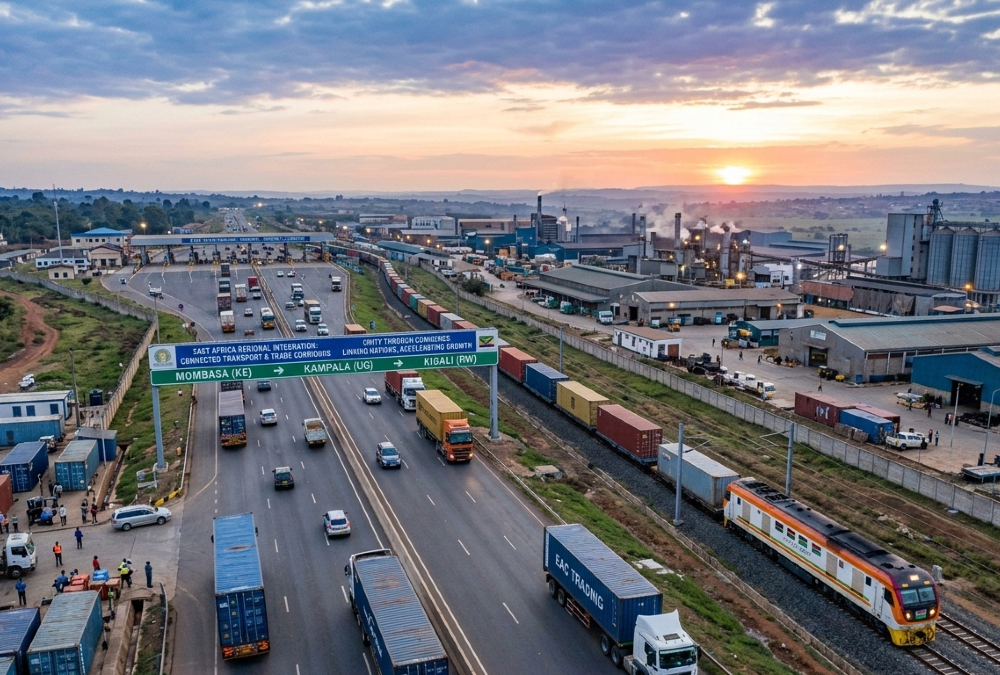
Consider the geography of Africa’s most dynamic economic zones. From the Djibouti–Addis Ababa rail axis to the Northern and Central Corridors linking the Port of Mombasa and Dar es Salaam to the Great Lakes region; from the Abidjan–Lagos corridor threading through West Africa’s coastal economies to the emerging LAPSSET corridor cutting through East Africa; and from the revitalized Lobito Corridor to the North–South Corridor connecting Southern African ports to the landlocked wealth of Zambia and the Democratic Republic of Congo (DR Congo) – a new map is taking shape.
These are not merely transport corridors. They are emerging industrial ecosystems. Within each axis, ports, logistics networks, and manufacturing clusters integrate into a single economic organism.
Firms cluster along these routes precisely because they offer what isolated national markets cannot: connectivity at scale, compressed logistics costs, and supply chains that move seamlessly across borders. The corridor, in short, delivers what no single country can manufacture alone.
From a geoeconomic perspective, the stakes are even higher. Infrastructure and trade routes are not neutral economic assets – they are instruments of strategic power.
Whoever designs, finances, and governs these corridors will guide the direction of African industrialization for a generation. Corridors are, in this sense, Africa’s industrial DNA: they determine where production takes root, where investment flows, and how regional value chains are ultimately wired together.
The AfCFTA Multiplier
The African Continental Free Trade Area (AfCFTA) is poised to accelerate this transformation dramatically. As tariffs fall, border procedures are streamlined, and transit systems become more efficient, production networks will extend far beyond national markets.
Industrial clusters will increasingly serve entire regions. Infrastructure that was once conceived as a collection of fragmented national projects will – over time – function as a continuous continental economic system.
In practical terms, this means the factory of the future in Africa will not be confined to a single state.
Consider a plausible scenario along the Northern Corridor: agricultural produce grown in the DR Congo is transported to Uganda for processing, moves to Kenya for packaging, and is then exported through the Port of Mombasa to regional markets via maritime routes. Production, processing, and logistics follow the logic of the corridor.
The borders remain, but they are waypoints – not walls.
This is not a hypothetical abstraction. It is an emerging reality, and it demands a vocabulary – and an institutional architecture – that African policymakers have not yet fully developed.
The future African factory will not be confined to a single state. Borders will remain, but corridors will render them economically permeable.
A Lesson From Europe’s Blue Banana
History offers a useful analogy. Europe’s so-called Blue Banana corridor – named for the color of the EU flag and the arc it traces from northwest England through the Benelux countries, the Rhine–Ruhr industrial heartland, and on to northern Italy – did not become the continent’s industrial spine by accident.
Roads, railways, navigable rivers, and deepwater ports created a circulatory system through which goods, capital, and talent could flow with minimal friction.
Specialization emerged naturally. Regional value chains formed organically. The corridor, in effect, became the unit of European industrialization.
Africa now has the opportunity – and the imperative – to build its own version. Call it the Green Banana: corridors inspired by the colors of the African Union flag that link production, processing, investment, and innovation across multiple nations.
The enabling ingredients – coordinated logistics, harmonized customs, digital border infrastructure, and smart physical connectivity – are neither utopian nor beyond reach. They require coordination, yes. But above all, they require a new kind of statecraft.
A Manifesto For Corridor-Era Statecraft
The central policy challenge is this: traditional industrial policy asks how a country can build its own industries. Corridor-based industrialization asks a far more consequential question – how can multiple nations co-design shared industrial ecosystems along strategic trade arteries?
The answer demands institutions that do not yet fully exist. Technocrats skilled not merely in national economic management, but in cross-border systems design.
Regional bodies with genuine coordination authority. Customs regimes harmonized not in aspiration, but in practice. Digital infrastructure that makes borders legible and efficient rather than opaque and costly.
The message for African policymakers and regional bodies is unambiguous: treat corridors as industrial systems, not infrastructure projects. Design the institutions that govern them – not just the roads and ports.
Coordinate customs procedures, harmonize transit regulations, and integrate logistics networks end-to-end. That is how geographic potential is converted into durable economic power.
Who Builds The Operating System?
There is an urgency to this question that goes beyond economics. Global powers – including China through its Belt and Road Initiative, the European Union through its Global Gateway, and the United States through the Lobito Corridor partnership – are already positioning themselves along Africa’s most strategic axes.
The corridors are being built. The question is who will govern them, and in whose interest.
If African states approach these corridors as passive recipients of external infrastructure financing, the geoeconomic logic of the corridor will serve external interests rather than continental ones. If, instead, African governments and regional institutions approach corridors as the fundamental unit of industrial policy – designing governance frameworks, negotiating strategically, and building the technocratic capacity to manage complex cross-border systems – the outcome will be different.
The corridors are being laid down now. The institutions that will govern them are still being formed. The decisions made in the next decade will determine whether Africa’s industrial geography is shaped by African hands or by the financing terms of external partners.
The corridors are Africa’s operating system. The question is not whether they will run – but who will write the code.
In Africa’s emerging geoeconomic landscape, borders no longer define industrial destiny. Corridors do. They are the operating systems of Africa’s industrial future – determining where production clusters, where investment concentrates, and which regions emerge as the continent’s next economic powerhouses.
The old industrial policy playbook was written for a world of national economies. Africa’s industrialization will be written in the language of corridors.
Danilo Desiderio serves as the CEO of Desiderio Consultants Ltd in Nairobi, Kenya, specializing in African customs, trade, and transport policies. He is a customs and trade expert at the World Bank and a senior associate to the Horn Economic and Social Policy Institute (HESPI).
