
Opinion
COP27: Why “Africa’s COP” is crucial, but doesn’t guarantee strong African outcomes
By Ovigwe Eguegu and Hannah Ryder
The 27th Climate Change Conference of Parties (COP27) has officially opened. 44,000 people including 90 heads of state have registered to attend, which means this COP, casually referred to as ‘Africa’s COP’, is likely to be the largest COP ever – COP26 holds the current record of just under 35,000 delegates.
However, the general size isn’t unusual. Since the first COP summit held in Berlin in 1995, hundreds of delegations of politicians, relevant experts and negotiators have used the two-week long forum to assess and advance ideas and solutions towards addressing climate change, with one eye on the interests of their countries. The growing impact of climate change, security and geo-economic considerations, and the difference between rhetoric and reality when it comes to climate finance have made both the negotiation at COP fiercer, and the outcomes increasingly important. Hence, participant numbers have regularly doubled for COPs where new treaties were expected – such as Kyoto (1997), Copenhagen (2009) and Paris (2015).
At COP27, there is already much controversy and debate about ensuring strong “African outcomes” by tackling climate change through loss and damage as well as adaptation, ensuring a just energy transition, as well as scaling public finance and carbon markets.
However, it is only African delegates at the table that can translate these concerns into outcomes – which begs the question – how well are African countries typically represented during COP negotiations?
Unsurprisingly, in the past, it has often been host countries with the largest delegations at COP summits, with Peru for instance at COP20 in Lima fielding 269 delegates. Morocco had a huge delegation of 1,591 people at COP22 in Marrakech. However, the UK delegation for COP26 was 10th largest at 230, a similar number to the EU Commission – the region’s coordination body – with 122 delegates. In fact, analysis by Carbon Brief shows that Brazil has consistently fielded the largest delegations – reaching a record 479 at COP26, with France, Canada and Japan also well represented on average. Most recently at COP26, Turkey, the Democratic Republic of the Congo, Ghana, and Russia all sent over 300 delegates each.
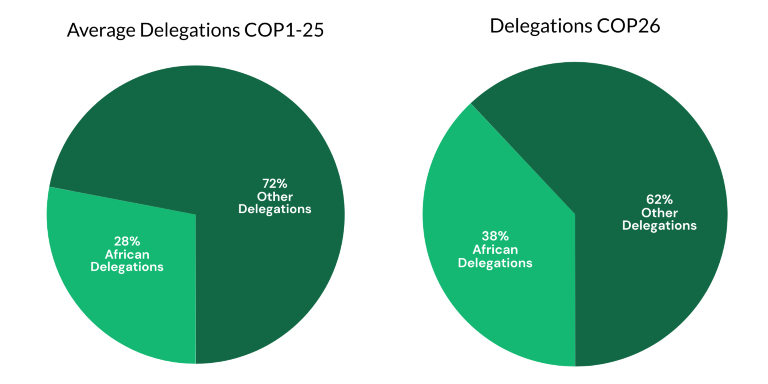
However, this means that at COP26, some African delegations were very well represented indeed. Yet, this is not particularly unusual. The figure below shows how African delegations have been represented since COP1 – and the difference with COP26. Yes, COP26 saw an overall increase in African delegations, but prior to this African delegations have made up on average 28 percent of all delegates. Given that African people represent 17 percent of the world, this seems a fairly strong result.
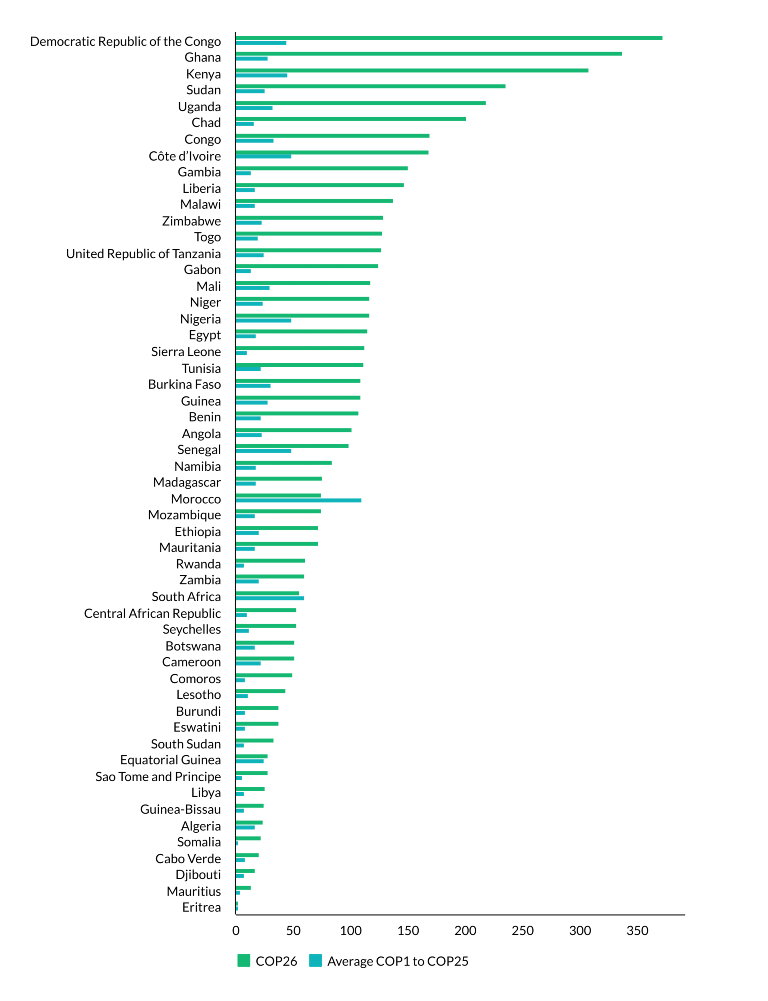
However, of course this masks major differences across countries. COP26 saw some of the largest African delegations ever, as the figure below demonstrates. Over the years, Morocco, South Africa, Côte d’Ivoire, Nigeria, and Senegal have sent the largest African delegations to COPs. COP26 had a markedly different top 5, featuring the Democratic Republic of Congo (DR Congo), Ghana, Kenya, Sudan, and Uganda. That said, the Top 20 participating countries have consistently accounted for around 65 percent of total African delegations, and almost all African countries sent more delegates to COP26 than ever-shifting the average delegation size from 22 since 1995 (quite similar to the non-african average delegation size at 21), to an average 101 delegates at COP26. Infact, there were only two African countries that effectively reduced their delegation size for COP26 versus their historic average – South Africa and Morocco. That meant each African delegation – on average – outsized each other country delegation – by 40 negotiators. That’s a very strong margin.
In all likelihood, Egypt will host even larger African delegations than COP26. Aside from being thought of as “Africa’s COP”, suggesting more interest by Africans in attending, COVID-19 barriers are all but lifted globally now, accommodation was also expensive and limited in Glasgow, and while Egypt has some visa restrictions, arguably the UK also had challenges with this issue.
Constraints
However, more African delegates may not mean better outcomes for African countries for four key reasons.
First, the numbers above only represent official “government” delegations or “parties”. It does not include private sector or NGO representatives. This creates complexity. Carbon Brief posits that some countries allocate some of their “party badges” to other types of delegates, which can artificially inflate the size of official delegations. This could have been the case for some of the African delegations at COP26, for instance. Moreover, richer, often non-African countries, have huge resources through much larger, separate non-governmental and private sector representation at the COPs. These delegates – even though most are at best allowed to observe formal negotiations – can themselves play important “outside the negotiation room” functions to support their own government positions, including the gathering of intelligence or influencing publicly by both convening and participating in side-events. Their positions may well be oppositional to African countries’ interests.
Second, as revealed earlier, there remain many African countries – including those with major climate vulnerabilities as well as potential for action – who consistently have very small delegations. Research has shown that smaller delegations are a key factor compounding issues of inequalities during negotiations. Smaller delegations must prioritize issues to follow – facing hard trade-offs and missed opportunities to promote their interests, a problem compounded by the addition of agenda items over time at COPs. At COPs, negotiating sessions regularly run for long hours into the night leading to so-called ‘negotiation by exhaustion’. Smaller delegations suffer versus other teams who can effectively “pass the baton” between colleagues during the two-week marathon. And, smaller delegations’ representation and visibility in side events are often low, meaning their views are less well understood by others or even mentioned in the media. This is a very real challenge for numerous African countries.
Third, negotiating strategies and experience are other means that play into achieving desired outcomes, meaning that while a delegation size might be enough to scale the so-called ‘negotiation by exhaustion’ barrier, the quality of the team matters when it comes to bargaining power in terms of hard/soft approaches, value-claiming/creating positions, and negotiating skills. COP26 saw African countries jointly utilize the African Group of Negotiators and the Africa Pavilion as vessels through which important wins were attained. The outcomes included a reaffirmation for increased climate funding with a pledge of US$100 billion towards developing countries, there were also clarifications around carbon markets and more attention was brought to the issue of loss and damage. Yet, it was South Africa, a country that featured as the 35th largest African delegation, with just 56 delegates, that arguably went away with the best – albeit stretching – African financial package from COP26.
Fourth, a key challenge that government delegates in particular have to manage is having views and positions on other countries and regions. Much of the work that has been done to date by hundreds of African and non-African experts, African and non-African organizations who have been working to prepare various African positions for COP27 – tends to focus on African demands for what should be done to/with Africa. What very few analyses do is explore what African negotiators – from a wholly-African interest perspective – should and could demand of others – e.g. whether net-zero commitments by non-African countries are sufficient to generate a global carbon price; what scenarios by the US, China, and others generate sufficient demand for a carbon market, etc. This “red-line”, outward-facing analysis can be done and is crucial, but few African governments have such detailed positions, if at all.
So what more could be done, if African official delegates accounting for 38 percent or more of record numbers of COP27 participants does not turn out to be enough?
Certainly, beyond COP27, to rectify and manage the inequities and complexities of representation for African countries, it will be worth the entire UN membership considering other measures such as capping all delegate sizes and numbers of organizations – both government and non-governmental. Also, within Africa, the African Union Commission could also be encouraged to play a more prominent role in coordination, similar to the role played by the European Union Commission at COPs, such that African delegations – from DR Congo to South Africa to Eritrea – work together for better outcomes not just directly for Africa but also indirectly through commitments by others.
Finally, it is also critical that African governments leverage their populations and continue to train skilled professionals who are vested in promoting and effectively negotiating for the interests of concerned African countries or the continent.
There are certainly signs of hope that COP27 will be Africa’s COP. Egypt has made its commitment to that clear, as have African leaders. But the challenges around delegates and logistics may yet pose too large a barrier. Only the next two weeks will tell.
Ovigwe Eguegu is a Policy Analyst at Development Reimagined a pioneering international development consultancy and the first Kenyan wholly foreign-owned enterprise in Beijing, China. He specializes in geopolitics with particular reference to Africa in a changing Global Order. His work includes research, and providing strategic advice on geoeconomics and security in Africa.
Hannah Ryder is the Founder & CEO of Development Reimagined. She is a former diplomat and economist with 20 years of experience, named one of 100 most influential Africans in 2021, she is also Senior Associate for the Africa Program of the Center for Strategic International Studies (CSIS), sits on the Board of the Environmental Defence Fund, and is a member of UAE’s International Advisory Council on the New Economy.
