
Opinion
Capital Is not Loud in Africa. It’s Embedded.
The new wave of foreign direct investment is abandoning megaprojects for distributed, structural bets that are harder to unwind – and smarter to hold.

By Michele Moscaritoli
The most consequential financial moves rarely announce themselves.
In the span of just a few months, a pattern has emerged across European institutional capital flows into Africa – one that deserves closer scrutiny than the headlines it has so far failed to generate.
Consider the recent transactions: €170 million (US$196 million) directed into Lagos transport infrastructure; €108 million (US$125 million) financing a rail corridor in Mauritania; €220 million (US$254 million) committed to Conakry’s municipal water system; €75 million (US$86 million) seeding vaccine manufacturing capacity in South Africa; and €200 million (US$231 million) earmarked for green and digital small-to-medium enterprises in Nigeria.
Different countries. Different sectors. Strikingly similar logic.
What distinguishes this deployment of capital is not its volume – though that is considerable – but its architecture. This is not the era of the flagship megaproject, the ribbon-cutting corridor designed to dominate a development agenda and photograph well at multilateral summits.
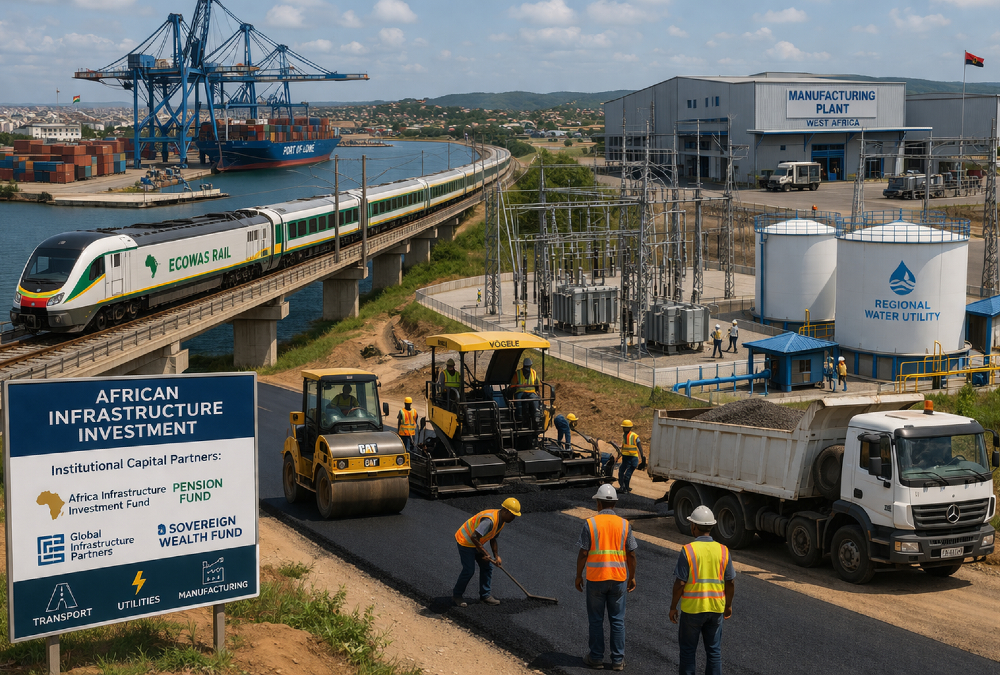
This is something more deliberate and, arguably, more durable: capital layered methodically across transport, utilities, manufacturing, and credit systems simultaneously.
Diversification as a Design Principle
For analysts willing to read infrastructure investment as economic signal rather than political theater, the dispersion of these flows carries a clear message. When funding is distributed across multiple nodes, so is exposure.
Economic capacity builds in parallel rather than in sequence. No single corridor, port, or power grid bears the full weight of a broader investment thesis.
This matters enormously for any enterprise whose revenue is geographically concentrated. A business anchored to a single logistics route, a single regulatory environment, or a single market cycle is structurally dependent on a form of stability it cannot control and cannot hedge.
Margin, in that configuration, is borrowed – not owned.
Contrast that with what deepening cross-regional infrastructure actually produces: optionality. As connectivity expands across multiple markets, some economies accelerate while others consolidate.
Capital can follow momentum or absorb disruption, depending on conditions. The investor who is present across the system is never fully exposed to any one part of it.
Structural Embedding, Not Symbolic Commitment
The instinct to interpret large-scale infrastructure investment through a geopolitical lens is understandable but limiting. European capital flowing into West and Southern Africa is not simply a diplomatic gesture, a response to Chinese Belt and Road competition, or a legacy of development finance orthodoxy.
Viewed through a purely political frame, these transactions become noise – subject to electoral cycles, policy reversals, and bilateral tensions that may or may not materialize.
The more analytically useful frame is structural embedding. Capital that enters a system across multiple sectors and sovereign jurisdictions does not exit cleanly.
It becomes load-bearing. Supply chains are reorganized around it. Regulatory frameworks adapt to accommodate it. Local enterprises build dependencies on the credit and logistics infrastructure it underwrites.
Unwinding embedded capital is not a political decision – it is an economic disruption, and the costs accrue to all parties.
That is precisely what makes these flows significant. Their staying power is not guaranteed by treaty or rhetoric. It is enforced by complexity.
What Consistent Capital Reveals
Loud capital – the announced megaproject, the headline-grabbing bilateral fund, the sovereign wealth initiative unveiled at Davos – attracts attention but not necessarily confidence. It signals intent.
Consistent capital, by contrast, signals commitment. It shows up in the operational details: the utility concession, the manufacturing joint venture, the SME credit facility that requires quarterly reporting and carries real default risk.
The investors allocating across Lagos, Mauritania, Conakry, Johannesburg, and Lagos again are not making a statement. They are building a position – one that is difficult to replicate quickly and difficult to dislodge quietly.
For any serious operator or capital allocator with African market exposure, this is the pattern worth tracking: not where money is loudest, but where it is most consistently present. Infrastructure depth creates the conditions under which commercial optionality compounds.
The markets that attract layered, multi-sector investment today are the markets that will be structurally harder to ignore tomorrow.
The signal is not in the announcement. It is in the architecture.
Michele Moscaritoli is the Founder of Callaborade, a platform connecting high-potential talent from underserved regions with European entrepreneurs while enabling companies to expand into new markets through structured, data-driven sales operations. A tech and services sales professional specializing in market entry strategy, he is driven by a belief in collaboration and building bridges where barriers exist.
