
A Diaspora View of Africa
Black History Must Be Taught Better

By Gregory Simpkins
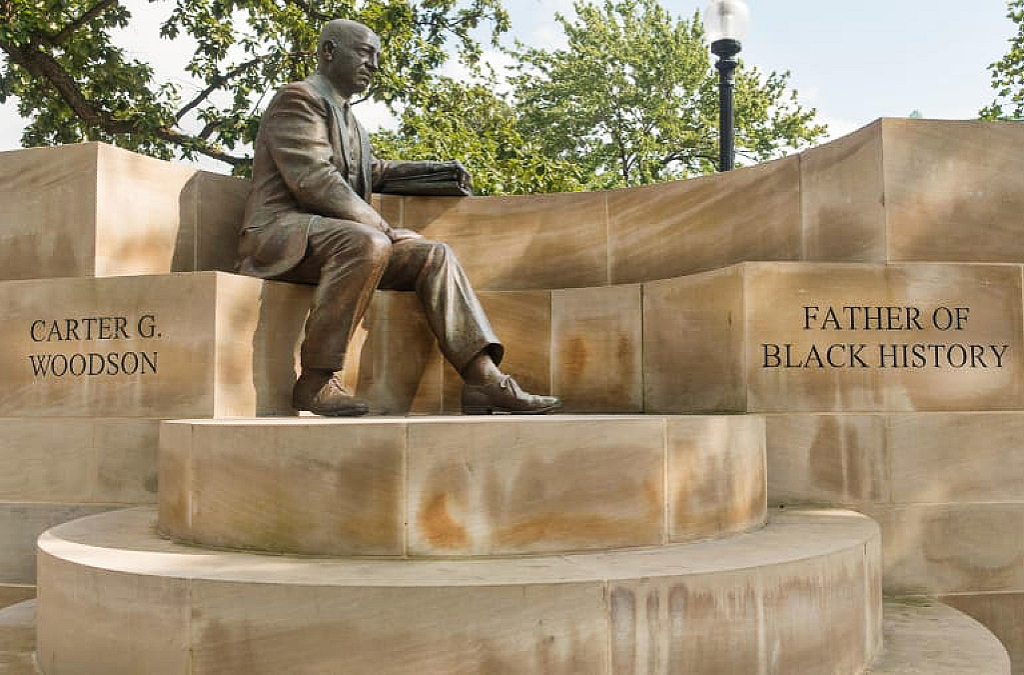
For more than half a century now, Black History Month has been celebrated in the United States each February. This celebration can be traced back to Chicago during the summer of 1915 when renowned scholar Carter G. Woodson traveled from Washington, D.C., to participate in a national celebration of the 50th anniversary of emancipation sponsored by the state of Illinois.
Thousands of African Americans also came from across the country to witness exhibits highlighting the progress their people had made since the destruction of slavery. As a result of the observance that year, Woodson decided to form an organization to promote the scientific study of black life and history, and on September 9th of that year, Woodson and others formed the Association for the Study of Negro Life and History (ASNLH).
Daryl Michael Scott of ASNLH chronicled the development of what became Black History Month. He said Woodson hoped that others would popularize the findings that he and other black intellectuals would publish in The Journal of Negro History, which he established in 1916. In the next few years, Woodson began urging black civic organizations to promote the achievements that researchers were uncovering.
By 1924, through his fraternity Omega Psi Phi, Woodson was able to create Negro History and Literature Week, which they renamed Negro Achievement Week. Their outreach was significant, but Woodson desired greater impact. In February 1926, he sent out a press release renaming it Negro History Week.
February
Woodson chose February for reasons of tradition and reform, Scott wrote. The common belief is that Woodson selected February to encompass the birthdays of two great Americans who played a prominent role in shaping black history – Abraham Lincoln, who signed the Emancipation Proclamation, and noted abolitionist Frederick Douglass, whose birthdays are the 12th and the 14th, respectively. More importantly, he chose them for reasons of tradition. Since Lincoln’s assassination in 1865, the Black community, along with other Republicans at that time, had been celebrating the fallen President’s birthday.
And since the late 1890s, black communities across the country had been celebrating Douglass’ birthday. Building on these traditional days of commemorating significant personages in the black past, Woodson built Negro History Week around them. He was asking the public to extend their study of black history, not to create a new tradition. In doing so, he increased his chances for success. However, Scott said he aimed to do more than confirm traditions. He aimed to reform it from the study of two great men to the examination of a great race.
There was progress and concern early on in Woodson’s efforts. The 1920s was the declared the decade of the New Negro, a name given to the post-War I generation because of its rising racial pride and consciousness. The Harlem Renaissance took place in the 1920s and 1930s in New York; its artists had an impact nationwide. But as early as the 1930s, Woodson complained about the intellectual charlatans, black and white, seeking to take advantage of the growing public interest in black history, and he warned teachers not to invite speakers who had less knowledge than the students themselves.
Black History Month began in the early 1940s in West Virginia; Black teachers would incorporate black history into their lessons on American history throughout the civil rights movement. In the 1960s, Black college students broadened their interest in black history to Africa. By 1976, Black History Month was institutionalized and has been proclaimed by American presidents ever since.
Rich history
Unfortunately, those who continued Woodson’s vision saw it narrowly as the study and celebration of Black progress since the end of slavery in the United States, but that ignores the rich history of the people of Africa on the continent and their descendants elsewhere that predated the Transatlantic Slave Trade. This is why even many Africans see African Americans merely as the descendants of slavery – that seems to be how many of us see ourselves as well, and that’s just unnecessarily limiting.
Martin Luther King, scientist George Washington Carver, entrepreneur Madam C.J. Walker and educator Booker T. Washington were notable black people whose legacies deserve to be remembered, in addition to the great black people in the African Diaspora, such as Caribbean Pan-African leaders Marcus Garvey and George Padmore, black Russian writer Alexander Pushkin and black French writer Alexandre Dumas. Yet people of Africa and African descent pre-date them by quite a wide expanse of history without receiving due consideration during Black History Month.
If you reach back far enough into African history, you will find Imhotep. You may remember the name from the 1999 film The Mummy, but Imhotep was a real person. The details of his background are somewhat uncertain, but he was reportedly chancellor to the Pharoah Djoser and was believed to have been instrumental in the Pharoah’s step pyramid in Saqqara. Imhotep also left behind well-regarded writings and was believed to have been a physician. Whatever roles Imhotep played during his life, he was one of fewer than a dozen non-royal people in Egypt to be venerated after his death. In fact, a cult was built up around Imhotep in Memphis (not the one in Tennessee) after he died. That cult sounds a lot like the movie actually.
There are numerous African men who were powerful rulers, even presumably mythical African rulers such as Prester John. Europeans, seeking an alliance against the Muslims they were fighting during the Crusades and finding no one who matched the glorified description of an emperor over kings, began to plunder Africa for its resources – including people.
However, much less is known about women who ruled in Africa.
Black history did not begin with slavery. The Western Hemisphere branch of the Diaspora may have begun our existence for the most part under slavery, but our history as a people demonstrates that we were capable of much greater achievements then as we are now.
In the Bible, there is the story of the apostle Philip, who encounters an Ethiopian eunuch whom he teaches about Jesus (Acts 8:27). The ruler this eunuch served was a woman, by then a tradition in the Kingdom of Kush, later referred to as Ethiopia and Abyssinia, ruled from its capital in Meroë. In fact, there were several female rulers in the land of Kush, which lies south of Egypt in what is now Sudan.
The royal title “Kandake” means great woman. It has been Anglicized to Candace. Scholar Carolyn Fluehr-Lobban has written, “Meroë claims at least 10 regnant queens during the 500-year period between 260 BC and 320 AD, and no fewer than 6 during the 140-year period between 60 BC and 80 AD.” The Ethiopian Eunuch in Acts may have been in charge of the treasury of Kandake Amantitere who ruled in 25 – 41 AD. So formidable was the rule of the Kandake queens that they prevented the Romans, who attacked from Egypt, which they had conquered, from assuming control over Kush. In fact, Kandake Amanirenas was able to negotiate a peace treaty with Rome that lasted for 3 centuries.
The last Pharoah of Egypt – Cleopatra VII – was part of the Ptolemy line that ruled Egypt for about 3 centuries, covering lands that included not only Egypt but also Cyprus, part of modern-day Libya, and other territories in the Middle East. She was not actually Egyptian but was a Greek descendant of Alexander the Great’s General Ptolemy. Of course, this woman portrayed in films by actresses such as Elizabeth Taylor and Leonor Varela was only one of seven female pharaohs in Egypt, who included Hatshepsut, Nefertiti, Khentkawes I, Sobeknefru, Arsinoe II and Merneith, who was originally thought to be male. More scholarship needs to be done around these powerful women, and one hopes African history scholar Emmanuel Kulu can shed some light on these Ancient Egyptian female rulers.
We talk about the super-rich today, but Musa I, Mansa of the Mali Empire, was believed by many to have been the wealthiest person who ever lived, based on vast reserves of gold, ivory, salt, and, unfortunately, slaves. In fact, on his way to the hajj in Mecca in 1324, Mansa Musa spent time in Cairo, Egypt, and his lavish spending changed the value of gold in Egypt and attracted the attention of the entire Muslim world. His name increasingly comes up these days, but most people – even most Black people – still don’t understand the enormity of this man’s legacy, which included expanding his empire to include what is now Guinea-Conakry, Senegal, Mauritania, The Gambia, and, of course, Mali. He ruled at the peak of his empire’s history, and the city of Timbuktu was regarded as a center of Islamic scholarship.
Then there was Nzinga Ana de Sousa Mbande, more popularly known as Queen Nzinga, ruler of the Ambundu Kingdoms of Ndongo (1624–1663) and Mtamba (1631–1663), located in present-day northern Angola. She ruled in the 1600s during a period of expansion of the slave trade. Nzinga battled the encroachment of the Portuguese to whom she had been an ambassador before becoming queen upon the death of her father and brother. Her warfare against the Portuguese was not to end the slave trade, though, but rather to confine it and allow Nzinga’s government to reap a major share of it. As distasteful as this is in today’s context, that was the world Nzinga dealt with during her time. The account of her that I recall most vividly was the occasion in which she went to negotiate with the Portuguese, and when they refused to provide a seat for her to put her in her place, one of her servants made himself her seat as she sat on his back during the peace talks.
Good and bad
African history has its good and bad points. Nevertheless, it should be taught in its entirety. Africans in countries such as Ghana and Benin have acknowledged the regrettable role their ancestors played in the slave trade. So must we today accept that history, lamenting that part of our people’s past while celebrating their glories. It is our failure – and sometimes our refusal – to admit that white people did not conduct the slave trade alone. We too often approach slavery in America as a purely white phenomenon that convinces black people that it was invented by white people and that Africans were powerless to resist it. White slavers would never have been able to plunder the human resources of Africa without the help of Africans. People in Benin and Ghana have sent representatives to apologize for their the role their ancestors played in slavery. Do we accept those apologies, or do we pretend that it was only evil white people who stole away millions from the continent, all the while with Africans unable to resist?
Of course, the concept of slavery in Africa was not tainted by the racial constructs created to justify slavery in the West – they were merely defeated people serving their conquerors. Slaves in Africa were not considered sub-human and could rise from the status of slave. It was a miscalculation by some of our ancestors to participate in the slave trade. Had they realized the toll it would take on the continent, perhaps they would have refused to go into the slavery business with Europeans.
As I stated earlier, Black history did not begin with slavery. The Western Hemisphere branch of the Diaspora may have begun our existence for the most part under slavery, but our history as a people demonstrates that we were capable of much greater achievements then as we are now. We have had a president, senators, congresspersons, governors, mayors, scholars, scientists, artists and successful businesspeople in our recent history. They all deserve to be commemorated during Black History Month and all year long, and perhaps if African history was successfully integrated into the world and American history, whites and other non-black people would understand that we are not merely a victim race.
If we overly focus on slavery in America as the beginning of our history, we do an injustice to Carter G. Woodson and others who knew there was a rich history dating back many centuries to the continent from which our ancestors came long before the Transatlantic Slave Trade. We cannot and must not ignore the phenomenon of slavery, nor of Jim Crow, lynchings, the destruction of Black towns and businesses, and segregation, not to mention ongoing examples of racial bias against us. However, confining our historical examinations to our victimhood robs our children of their agency to become great as our ancestors were able to do.
Gregory Simpkins, a longtime specialist in African policy development, is the Principal of 21st Century Solutions. He consults with organizations on African policy issues generally, especially in relating to the U.S. Government. He also serves as Managing Director for the Morganthau Stirling consulting firm, where he oversees program development and implementation. He further acts as a consultant to the African Merchants Association, where he advises the Association in its efforts to stimulate an increase in trade between several hundred African Diaspora small and medium enterprises and their African partners.
