
Opinion
Agenda 2063 vs. The EU: Africa Must Stop Borrowing Dreams and Start Building Systems
Africa must stop treating its most ambitious development blueprint as ceremonial scripture – and start deploying it as a binding contract with the world.

By Franco Bonghan
The scene is telling. African heads of state sit in a European hall and are informed by the President of the European Commission that the EU maintains coherent policies toward the United States, Latin America, Asia, and Eastern Europe – but has no real policy toward Africa.
The admission was extraordinary. The implications were worse.
This is the structural trap that Agenda 2063 was designed to break. But the framework will only fulfill that purpose if African governments stop treating it as a holy book to be quoted at summits and start using it as a warehouse of bankable, trackable projects demanding concrete accountability from all parties.
The numbers expose a dangerous gap between rhetoric and reality
The scale of the challenge is not abstract. African governments require an estimated US$130 billion to US$170 billion annually for infrastructure investment alone, yet currently mobilize only around US$80 billion – leaving a financing gap that shaves roughly two percentage points off annual GDP growth.
Simultaneously, the continent hemorrhages approximately US$88.6 billion each year through illicit financial flows, a figure that exceeds the combined value of foreign aid and foreign direct investment it receives. In net terms, Africa is a creditor to a world that refuses to finance its own development.
These figures are not incidental; they are the product of structural arrangements that Agenda 2063 was explicitly designed to dismantle.
This is precisely why Africa must reject external frameworks that endlessly repackage conditionality and donor-defined priorities while sidelining continental blueprints.
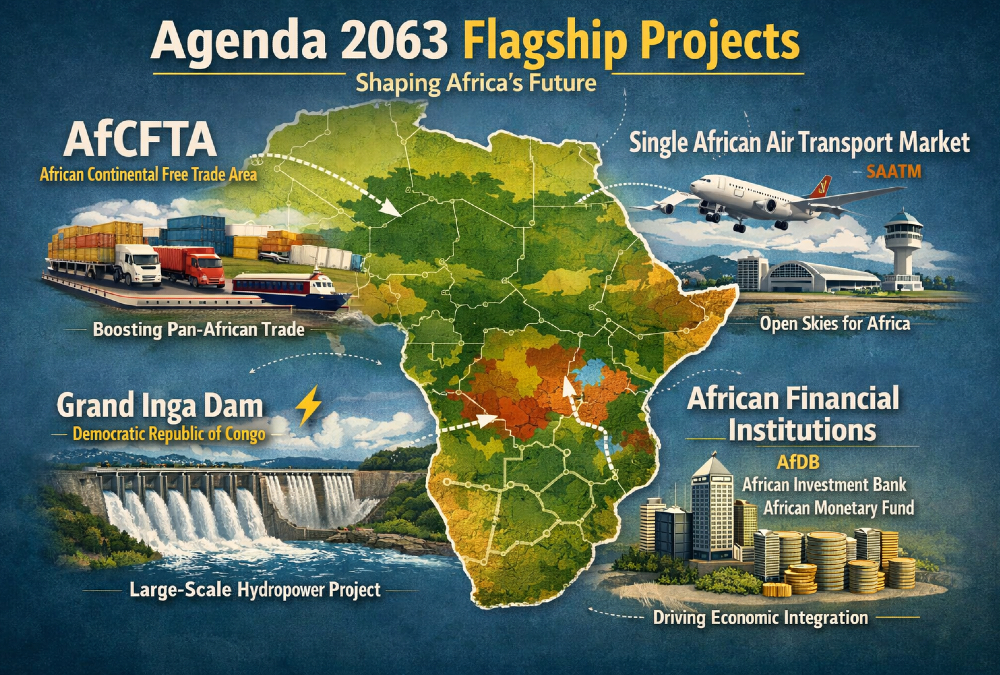
Agenda 2063’s 15 flagship projects – spanning the African Continental Free Trade Area, the Grand Inga hydroelectric dam, the Single African Air Transport Market, an African Commodities Strategy, continental financial institutions, and even an African Outer Space Strategy – are not aspirational slogans. They are the architectural spine of a genuine economies-of-scale strategy for a continent of 1.4 billion people.
The problem is not a shortage of vision. It is that Africa keeps defaulting to EU, G7, and Bretton Woods templates that lock the continent into fragmented, low-value roles, while Agenda 2063 is invoked in preambles and forgotten in budgets.
NEPAD’s cautionary lesson must not be repeated
When Thabo Mbeki and his peers crafted the New Partnership for Africa’s Development (NEPAD) in the early 2000s, they approached the G8 and the European Council with a deceptively simple demand: Africa has a development plan – align your Africa policies with it, and submit to mutual accountability. It was a reasonable request. It was also a request that quietly disappeared from the G8 agenda as developed countries flatly rejected the notion of being held accountable alongside their African counterparts.
Mbeki now acknowledges the consequence directly: what passes for an “Africa policy” in Brussels today is not a negotiated framework that respects African agency. It is, in practice, a menu of conditions Africans must comply with.
The language of partnership conceals a fundamentally asymmetric arrangement.
That history carries an urgent warning. Agenda 2063 must not become another NEPAD – celebrated in speeches, erased from budgets, and quietly sidelined the moment African governments ask for reciprocal accountability and genuine policy alignment from their partners.
The choreography of continental blueprints being showcased while real decision-making authority remains lodged in EU or G7 country strategies is a pattern Africa can no longer afford to repeat.
Agenda 2063 must be non-negotiable
The paradigm shift required is straightforward, if politically demanding. Agenda 2063 must be operationalized as a warehouse of concrete, costed, and time-bound projects against which every external “Africa strategy” – whether from Brussels, Washington, Beijing, or the Gulf – must demonstrate alignment or be formally rejected as incompatible with the Africa that the continent’s own institutions have defined.
This means African Union member states must stop treating flagship projects as aspirational long-term goals and begin presenting them as the minimum threshold for partnership. It means finance ministries must embed Agenda 2063 deliverables in national budgets rather than in parallel development plans designed for donor consumption.
And it means African negotiators must arrive at EU-Africa summits, G20 meetings, and Bretton Woods institutions not as supplicants seeking access to frameworks designed elsewhere, but as representatives of a continent with its own architecture, its own investment pipeline, and its own terms of engagement.
The European Union, for its part, faces a choice. It can continue offering Africa a relationship built on conditionality and compliance – a dynamic that, as the Commission President’s candid admission suggests, does not even rise to the level of a coherent policy.
Or it can engage seriously with Agenda 2063 as the legitimate framework it is: one that offers European businesses, institutions, and governments a far more durable and equitable partnership than any unilaterally designed “Africa strategy” could provide.
Sixty years after independence, the structural relationship between Africa and its external partners remains largely unreformed. Agenda 2063 is the most comprehensive attempt yet to change that. The question is no longer whether the blueprint is adequate. The question is whether African governments – and their partners – possess the political will to use it.
Franco Bonghan is an international development strategist and Co-Founder/Co-Chair of the African and Caribbean Energy Network (ACEN) and Founder of Bright Light Projects (BLP). He curates the LinkedIn newsletter Global Pulse Africa, unpacking Africa’s economic challenges and showcasing innovative solutions for a sustainable future. He can be reached on X via https://x.com/Francobonghan
