
Opinion
Africa’s Invisible Trade Wall – And the Digital Key That Could Tear It Down
A new payment partnership between PAPSS and Kenya’s PesaLink is doing what roads and railways alone never could: making intra-African trade genuinely frictionless.

By Ziad Hamoui
According to estimates from the African Export-Import Bank (Afreximbank), a single institutional reform could save African businesses as much as US$5 billion every year. That figure, striking in its precision, refers not to a new highway, a mega-port, or a regional free-trade agreement – but to fixing how money moves between African countries.
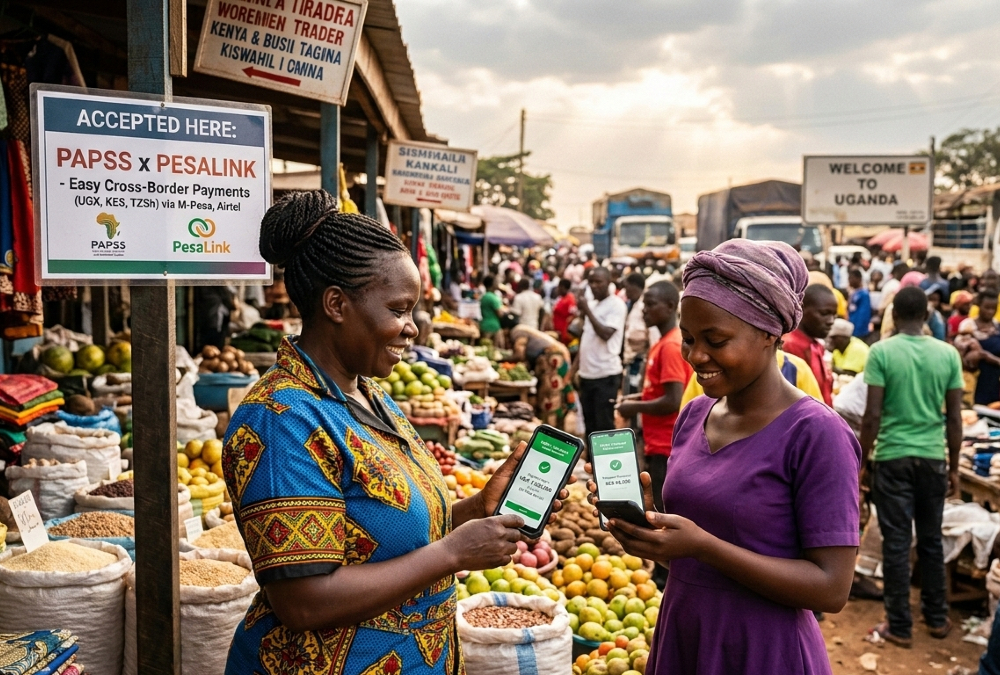
Last week, that reform took a meaningful step forward when the Pan-African Payment and Settlement System (PAPSS) announced a landmark partnership with Kenya’s PesaLink, one of the continent’s most trusted interbank payment platforms.
The announcement deserves far more attention than it has received.
Africa’s most stubborn trade barrier is not a tariff. It is a wire transfer.
For decades, the prevailing theory of African integration has been one of concrete and steel. Build the roads. Lay the rail. Expand the ports.
That logic is not wrong – infrastructure deficits remain acute across the continent – but it is dangerously incomplete. A truck can cross a border in hours.
The payment for the goods on board may take days. Correspondent banking, the system by which most cross-border transactions are currently routed, imposes foreign-exchange losses of between 5 and 8 percent while holding up settlement for three to seven business days.
For large corporations, this is a manageable inconvenience. For the small-and-medium-sized enterprises (SMEs) and informal traders – disproportionately women – who constitute the backbone of regional commerce, it is a structural barrier that determines whether a business survives.
This is not a peripheral problem. It is, in effect, a non-tariff trade barrier embedded in the financial system itself, one that the African Continental Free Trade Area (AfCFTA) cannot negotiate away at the policy table because it lives in the plumbing of global banking infrastructure.
What PAPSS Changes – and Why It Matters Now
The PAPSS-PesaLink integration now connects more than 240 financial institutions across Africa in a network designed explicitly to route intra-African payments in local currencies, bypassing the dollar-denominated correspondent banking system altogether.
In practical terms, a Kenyan exporter selling goods to a buyer in Côte d’Ivoire (Ivory Coast) no longer needs to convert shillings to dollars and then dollars to CFA francs, absorbing exchange losses and waiting days for confirmation. The transaction can settle instantly, in local currencies, between institutions that are now directly linked.
The implications for working capital are significant.
Consider a trader operating along the Abidjan-Lagos corridor – one of the busiest commercial routes in West Africa. Where a three-to-five-day settlement delay once constrained her to completing perhaps two market cycles per week, instant settlement means she can turn her capital over far more frequently.
The math is simple; the impact is transformative. Liquidity constraints that once forced SMEs to either forgo transactions or absorb punishing borrowing costs simply dissolve.
This is what modern financial infrastructure looks like: not glamorous, not visible from a satellite image, but as consequential as any road ever built.
The Test Now Falls to West Africa
Kenya’s adoption is a proof of concept. The harder challenge is scale.
This week, an Economic Community of West African States (ECOWAS) seminar convened in Accra to examine precisely this question: how do member states translate market access commitments on paper into genuine, frictionless commerce on the ground? The conversation was timely.
West Africa – with its dense network of cross-border trade relationships, its large informal sector, and its heterogeneous currency landscape spanning both the CFA franc zone and currencies such as the Nigerian naira and the Ghanaian cedi – stands to gain disproportionately from a well-functioning PAPSS rollout.
But the region must move with urgency. Three priorities stand out.
- First, ECOWAS member states must accelerate the formal onboarding of domestic financial institutions onto the PAPSS network – a process that requires regulatory coordination as much as technical integration.
- Second, PAPSS connectivity must be paired with secure, standardized trader identification systems that allow small businesses to participate in formal digital payments without confronting prohibitive compliance burdens.
- Third, and perhaps most critically, governments and private-sector associations must invest in business education. The technology is only as powerful as the traders who know how to use it.
A payment network that reaches Abidjan and Accra but not the market vendors of Sokoto or the commodity brokers of Kumasi will have fallen short of its promise.
The technology is only as powerful as the traders who know how to use it.
None of this is technically beyond reach. Kenya’s experience demonstrates that the architecture works.
PesaLink itself was built incrementally, through patient coordination between the Central Bank of Kenya and commercial banks, over nearly a decade. The lesson is not that the process is quick – it is that it is achievable, and that the returns justify the investment many times over.
Hard Infrastructure Needs a Soft Foundation
There is a tendency in development discourse to treat financial infrastructure as secondary – as the “soft” complement to the “hard” work of building physical connectivity. That framing is misleading.
A six-lane highway between Lagos and Abidjan that moves goods efficiently but settles payments slowly is not a complete corridor. It is half a corridor.
The commercial logic of regional integration only fully closes when goods, information, and money all move freely. PAPSS addresses the third leg of that triad.
The AfCFTA secretariat, regional development banks, and bilateral donors who have invested heavily in physical trade corridors would do well to match that investment with a concerted push for payment system interoperability. The returns are quantifiable, the technology is mature, and the institutional frameworks – however imperfect – are already in place.
What remains is the political will to accelerate adoption and the administrative capacity to execute it well.
Afreximbank’s US$5 billion estimate is not a ceiling. It is a floor. As more institutions connect, as more corridors come online, and as African businesses learn to route around the inefficiencies of legacy correspondent banking, the savings will compound. So, too, will the confidence of intra-African traders that the system is working for them rather than against them.
The question is not whether Africa can build a continental payment system worthy of its ambitions. Kenya has already shown that it can. The question is whether the continent’s policymakers will move quickly enough to ensure that no trader – in Abidjan, Accra, Sokoto, or anywhere else – is left waiting while the opportunity passes.
Ziad Hamoui is the Co-Founder and Past President of the Borderless Alliance, a leading private-sector advocacy group promoting economic integration and removing trade and transport barriers in West Africa. With extensive experience in Ghana’s road transport, logistics, and shipping sectors, he currently serves as Executive Director of Tarzan Enterprise Ltd., a long-established family business. He is a former Co-Chair of the Africa Food Trade Coalition, Co-Founder of the Trade Facilitation Coalition for Ghana, and serves on multiple high-level advisory committees on trade, transport, agriculture, and security. A Chartered Fellow of the Chartered Institute of Logistics and Transport (CILT) Ghana, he is also a former member of its Governing Council.
