
Opinion
America’s Africa Policy Is About to Get Much More Local
Washington writes the rules of U.S.–Africa commerce. The states close the deals. After the midterms, Africa has a rare chance to work both.

By Michael Sudarkasa
For decades, African ministries have treated the United States as a single address. Lobbyists were hired on K Street, delegations queued on Capitol Hill, and communiqués were drafted for the State Department. That made sense when American trade policy was a federal monopoly. It is a costly habit now that voters have rearranged power in places Africa’s capitals rarely look.
The November 3 midterms were a verdict on Donald Trump’s Washington. They were also a verdict on America’s states. Democrats won a majority of governorships for the first time in 16 years, flipping Georgia, Iowa, Nevada, Ohio and Texas. Four new Black governors will join the reelected Wes Moore of Maryland, making five, and Georgia’s Keisha Lance Bottoms became the first Black woman elected governor of any state. One of the four, Byron Donalds of Florida, is the first Black Republican elected governor. The shift in the diaspora’s political standing crossed party lines.
Congress matters too, and Democrats made large gains in both chambers. President Trump remains in the White House, so the next two years will be a period of divided government, with Congress holding more sway over legislation, appropriations and oversight. For Africa, that touches everything from the African Growth and Opportunity Act (AGOA) to development finance, global health, energy and critical minerals.
But there is a trap here. A divided Washington is a slower Washington. Africa’s agenda cannot wait on it.
The Unfinished Business of AGOA
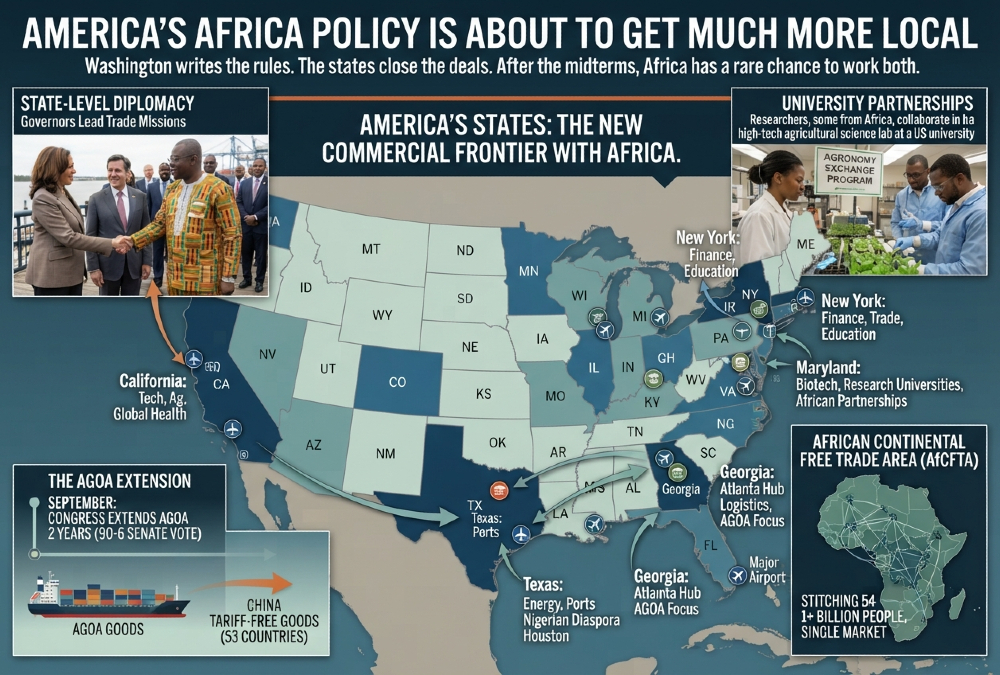
Consider AGOA, the keystone of U.S.–Africa trade for a quarter-century. In September, Congress extended it for two years, with the Senate voting 90-6 and the House 370-48. That is a striking show of bipartisan loyalty to a program that Trump’s tariff agenda might have been expected to bury. Yet two years is a short runway. A factory in Nairobi or Lagos cannot be financed against a deadline that expires before the machinery is paid off. As one Brookings analysis notes, Congress sidestepped the harder question of how to modernize the program.
The stakes of that delay are visible in the numbers. Two-way U.S.–Africa trade is still less than half its 2008 peak of US$105 billion, and China’s trade with the continent is roughly four times America’s. On May 1, Beijing also began offering zero tariffs on goods from 53 African countries, while AGOA covers just 33. The United States is not losing Africa to a rival’s charm. It is losing by default, through short deadlines and an offer that is hard to plan around.
Why the States Matter
This is where the governors come in. American states are not foreign-policy actors, and they cannot set tariffs or rewrite AGOA. But they are the closest thing the American system has to commercial matchmakers. They run economic-development agencies and export-promotion offices. They oversee ports, highways and industrial parks. They fund public universities that train engineers, agronomists and physicians, many of them African. And governors can fly to Accra, Nairobi or Johannesburg with a delegation of manufacturers, farmers and investors, which a Senate committee cannot do.
The geography is promising. Georgia has Atlanta’s airport and logistics hubs. Texas has the Gulf Coast’s energy and port economy, and large Nigerian and other African communities in Houston. Maryland, Michigan, Illinois, Massachusetts, New York and California have research universities, medical complexes and technology clusters. Few of these states have yet built serious commercial ties to Africa. Each has something Africa’s industrializing economies want: capital, technology, and customers who are tired of buying the same goods from the same few suppliers.
Africa has something to offer in return that is larger than rhetoric about partnership. The African Continental Free Trade Area is stitching 54 economies into a single market of more than a billion people. A state that wins a foothold in that market early will be better placed than one that waits for Washington to produce a continental strategy.
The Case for Caution
Honesty requires some skepticism. State trade missions have a reputation for producing memoranda of understanding rather than money. Governors have political incentives to chase headlines, and most have little staff capacity for Africa. Diaspora ties are an asset, but a thin foundation if they stand alone: shared heritage opens doors, while only returns on investment keep them open. And federal power still decides the terms, since tariffs, sanctions, visas and AGOA eligibility all remain in Washington’s hands. Nothing at the state level can compensate for a president who treats trade as a weapon.
Nor should Africa treat this as a partisan bet. Republican-led states, with their agricultural exporters, energy producers and manufacturers, are natural trading partners too, as Mr. Donalds’s election in Florida reminds. The lesson is not “back the blue states.” It is to stop treating America as one customer.
A Practical Agenda
For African governments and businesses, that implies a handful of concrete moves.
First, build a state-level map alongside the federal one. Identify the ten or fifteen states where trade, universities, ports and diaspora communities overlap, and assign dedicated envoys to them.
Second, connect African firms directly to state economic-development agencies, which can provide introductions, site selection and sometimes incentives that a federal program cannot.
Third, pair universities. Joint research, agricultural extension, medical training and technology incubators create the human networks on which later investment depends.
Fourth, pursue city-to-city and port-to-port partnerships, which link logistics and municipal services to commercial opportunity.
Fifth, use all this to strengthen the federal case, not replace it. Governors who profit from African trade become lobbyists for a longer, better AGOA, and for the development-finance tools that make African processing and manufacturing bankable. In a Senate that voted 90-6 for AGOA, a few more constituencies at home would not hurt.
Think State By State
Africa has spent decades courting an America that does not quite exist: a unitary power with a single will. The real America is a federation of fifty economies, each with its own universities, ports, producers and ambitions. The midterms have put new people in charge of many of them. African leaders can wait to see what Washington decides, or they can start building, state by state and city by city, the relationships that will make the next AGOA debate easier to win.
Michael Sudarkasa is a commercial attorney and African economic development expert. He is the CEO and founder of Africa Business Group, a South Africa-based consultancy focused on business development, agriculture, renewable energy, and capacity building. With extensive experience in private sector growth, trade, investment, and corporate finance across Africa, he has authored publications on African trade and investment and previously led the African Fertilizer and Agribusiness Partnership (AFAP). He also serves on multiple boards and advisory panels in the economic development and impact investment sectors.
