
Opinion
From Mines to Factories: China’s Africa Strategy Enters a New Phase
Beijing’s presence on the continent was once defined by pits and pipelines. Now it is defined by production lines. Whether Africa profits depends less on Chinese capital than on African policy.

By Djoomart Otorbaev
For two decades, the standard picture of China in Africa came with hard hats and state financing: railways cutting across savannas, container ports rising from coastlines, highways funded by policy banks in Beijing. Critics saw a scramble for resources. Admirers saw overdue development finance. Both camps shared an assumption: that China’s interest in Africa was, at heart, about what lay beneath the ground and how to get it out.
That assumption is now out of date.
The Numbers Behind the Pivot
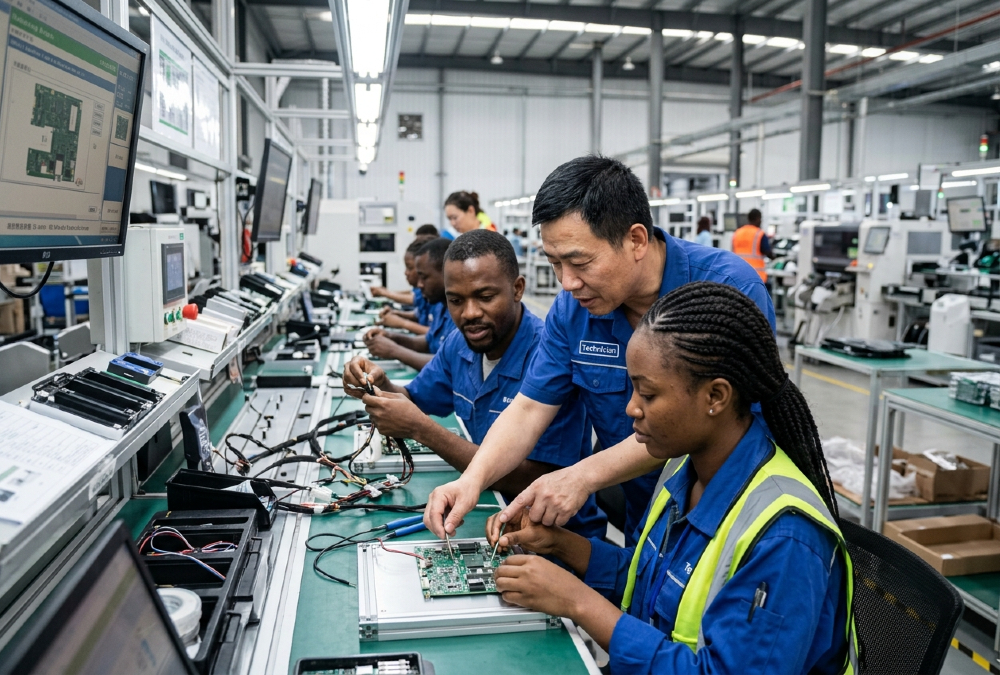
According to independent research firm Rhodium Group, Chinese investment in African manufacturing and processing reached US$7.7 billion last year – comfortably surpassing the US$4.8 billion directed toward extractive industries. Data from China’s Ministry of Commerce reflects a similar long-term shift, projecting cumulative manufacturing investment to reach nearly US$8 billion by 2025, a more than 50 percent increase from 2016 levels. Simply put, the region’s economic center of gravity has shifted from the mine to the factory.
The pattern is clearest in East Africa. Kenya now hosts more than 350 Chinese companies with declared projects worth US$11 billion, over half of it in manufacturing. Tanzania has drawn US$12.5 billion in Chinese capital since 2017, roughly two-thirds of it directed toward making things. By the count of Tanzania’s own investment authorities, Chinese manufacturers have created around 150,000 jobs there.
Those are not the statistics of a continent being stripped for parts. They describe something closer to industrial migration.
Why East Africa, and Why Now?
The logic is not mysterious. East Africa offers relatively affordable labor, fast-growing cities that supply both workers and consumers, improving transport links, and access to regional and international markets. Many of those transport links were, ironically, built with the earlier wave of Chinese infrastructure lending. The railways and ports of the first phase are now carrying the goods of the second.
Geopolitics is pushing in the same direction. Tariff disputes are forcing manufacturers worldwide to rethink where they build things, and African economies are a beneficiary of that reshuffling. Trade between China and Africa reached US$348 billion in 2025, up 17.7 percent on the year before. When factories and trade volumes grow together, the relationship has stopped being merely extractive and started to look like an ecosystem: suppliers, logistics firms, and local labor markets organized around production rather than export of raw cargo.
A Challenge to Western Assumptions
This should unsettle some comfortable Western narratives. The story that China simply takes resources and leaves debt behind was never the whole truth, and it fits the new evidence poorly. Private Chinese firms, not state-backed lenders, are increasingly the protagonists, and they are putting capital into local production, not just shipping ore home. Policymakers in Washington and Brussels who treat Africa as a stage for strategic competition might ask a more humbling question: why are Chinese manufacturers, rather than their own, building the factories?
The Obstacles are Real
Nothing here is guaranteed. Electricity in much of Africa remains costly and unreliable, which erodes the cost advantage that attracts manufacturers in the first place. Markets remain fragmented by borders, tariffs, and incompatible standards, denying factories the scale they need. Regulatory uncertainty deters long-term planning, and gaps in infrastructure raise costs at every stage. Capital can build a factory. It cannot, on its own, build an industrial economy.
The Real Contest
That is where the decisive question lies. Will African governments convert incoming investment into durable domestic capability? The test is not how many factories open but what remains when the ribbon-cutting is over: technology that local firms can absorb, workers trained for skilled roles, supplier networks anchored in domestic companies, and exports that climb toward higher value.
Africa’s danger is not exploitation in the old, colonial sense. It is a quieter outcome: becoming a cheaper address for somebody else’s production. Assembly plants that import components, employ workers at the bottom of the value chain, and relocate when wages rise elsewhere would deliver jobs for a decade and little else. Economies that stay in that position are not industrializing. They are hosting.
Avoiding that fate requires industrial policy with teeth: local-content requirements that are enforced rather than waived, serious investment in vocational training, incentives tied to technology transfer, and regional integration that lets a factory in Nairobi sell as easily in Kigali or Lusaka as at home. It also requires patience, because capabilities compound slowly and investors’ time horizons are short.
Opportunity, Not Destiny
China’s manufacturing expansion hands Africa a rare opportunity, and an opportunity is not a result. If African governments seize it, the relationship can mature beyond commodities and concrete into a genuinely productive partnership. If they do not, the continent could end up with a skyline of new factories and an economy no less dependent than before.
The question that will define the next decade is therefore not who brings the capital. It is who builds the capacity to turn that capital into lasting prosperity.
Djoomart Otorbaev is a Former Prime Minister of the Kyrgyz Republic
