
Opinion
After the Tech Conference: How the Church Can Bridge the AI Literacy Gap
AFROTECH has pledged to train one million people in AI. Here’s a community delivery model that could actually get the job done – one Sunday at a time.

By Carter Rankin
Every technology conference sells the same thing: momentum. The keynotes soar, the hallways hum, the badges are scanned, the photographs are posted. Then the lights go down, the crowd disperses, and a harder question arrives. Who is still teaching on a rainy Tuesday in February?
It is the question that decides whether a pledge becomes a program. Earlier this year, AFROTECH committed to training one million people in artificial intelligence, with expert instruction, online learning and community partnerships. It is an ambitious goal, and it deserves a delivery system as serious as the promise. Ambition is easy to announce. Habit is harder to build.
Here is a proposal: call it Sunday School.
The Most Underused Infrastructure in America
Consider what a learning network needs. It needs trusted places. It needs weekly rhythm. It needs people who show up, and a culture in which asking for help is not a mark of weakness. Few institutions in American life have all of these in such abundance as the Black church. Black churches have long served as classrooms, organizing halls, credit unions of the spirit and, often, the first place a community turns when something new arrives and nobody is sure what to make of it.
Artificial intelligence is such a thing. It is arriving in study habits, workplaces, small businesses and family group chats faster than the institutions meant to explain it. The people most likely to be told to “figure it out” are the least likely to be handed the tools, the time or the patience to do so. A website will not close that gap. A room full of neighbors might.
How it Would Work
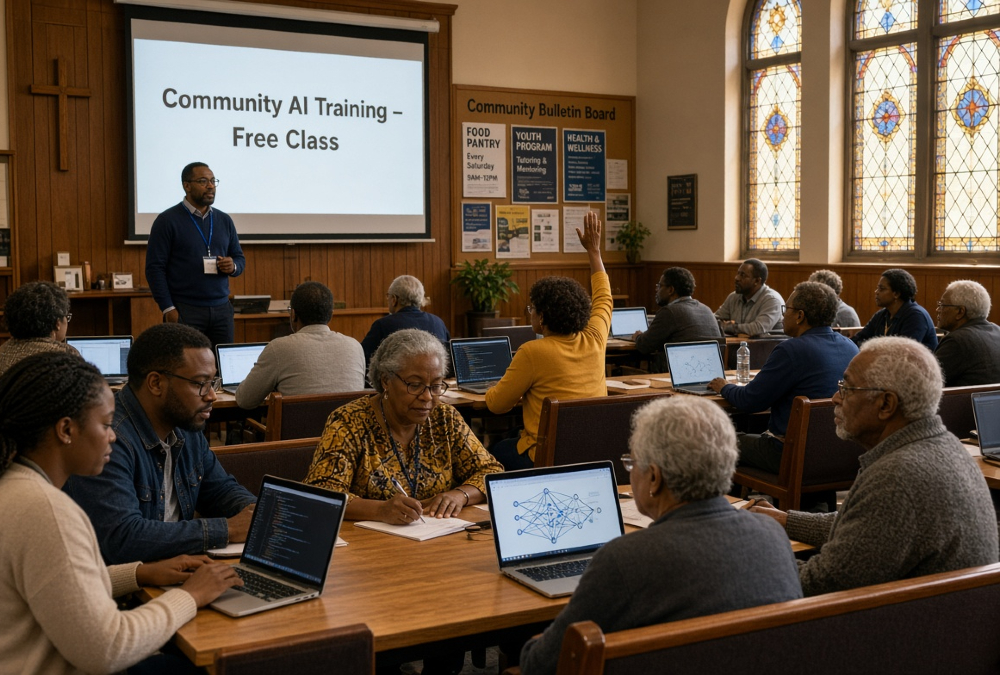
The design is deliberately plain. Every Sunday, from 2 to 5 p.m., participating churches would open their doors for free, practical AI classes for community residents. Each site would need a large screen, reliable internet, access to devices, and a qualified, paid instructor. It would also need what online courses rarely provide: time to practice, and permission to ask questions out loud.
The instructors are the heart of the model. College students and church members would be recruited and trained to teach, earning US$25 an hour with four hours guaranteed, or US$100 per Sunday, preparation included. The pay matters. Volunteer enthusiasm is precious, but it is not a business model, and it burns out. A paid role turns teaching into a credible first job, a résumé line and a stake in the outcome. It also keeps the expertise local, which is where the trust is.
What would the classes cover? Whatever the room needs:
- Students could learn better ways to study, and, crucially, how to verify what a machine tells them.
- Workers could practice the skills that employers increasingly expect.
- Business owners could streamline everyday operations, from invoices to customer messages.
- Seniors could gain confidence with a technology their grandchildren already take for granted.
- Pastors and church staff could learn alongside their members, which may be the most persuasive lesson of all.
Who Pays, and Who Helps
Corporate and philanthropic sponsors would fund the program, an arrangement that gives companies eager to be seen supporting AI literacy something concrete to support. Participating Divine Nine chapters, with their deep traditions of service and alumni networks, could help recruit instructors, organize locations and provide mentors. Selected lessons and stories, recorded with permission, could feed a Sunday School YouTube channel, and any revenue would supplement sponsorships rather than replace them.
Start Small, Measure Honestly
The sensible first step is modest: a twelve-week pilot in ten churches. Instructor wages would total US$12,000, and a complete operating budget would be developed before launch. That is a small sum for a serious test.
Then comes the part that most initiatives skip. By 2028, the program would evaluate what matters: demonstrated skills, continued use, cost and community benefit. Not attendance alone, and not enthusiasm alone, but whether people can do something they could not do before, and whether they keep doing it. Those results would shape a four-year plan through 2032.
The long-term ambition is 50,000 participating locations. To be clear, that is a proposed goal. It is not a claim about current enrollment, nor about the national count of churches. It is a measure of how big the idea could become if the pilot earns the right to grow.
An Invitation, Not a Claim
One clarification is in order. This is an invitation to explore a partnership. No AFROTECH affiliation or sponsor commitment is being claimed. The proposal is offered in good faith, to be tested, challenged and improved.
So the request is simple. Morgan DeBaun and the AFROTECH team: would you consider a conversation about testing Sunday School as a community partner for your AI education commitment?
The great risk of any technological moment is that its benefits arrive first, and most fully, for those who were already ahead. Conferences announce the future. Communities decide who gets to live in it. A pledge to train a million people will be judged not by the applause at its launch but by the number of seats filled on ordinary afternoons, long after the cameras have gone.
We can give people a place to keep learning every Sunday of the year.
Playing Offense.
Carter Rankin is a retired serial entrepreneur, author, and independent business strategist in Northern California. He writes about economic ownership, wealth creation, entrepreneurship, emerging opportunities in Africa, and institution-building for lasting generational value. He shares his perspectives on LinkedIn under the theme “Playing Offense.”
