
Opinion
When the Wounded Blame the Displaced
When xenophobia serves the powerful, the wounds of history are weaponized against the wrong enemy.

By Farhia Noor
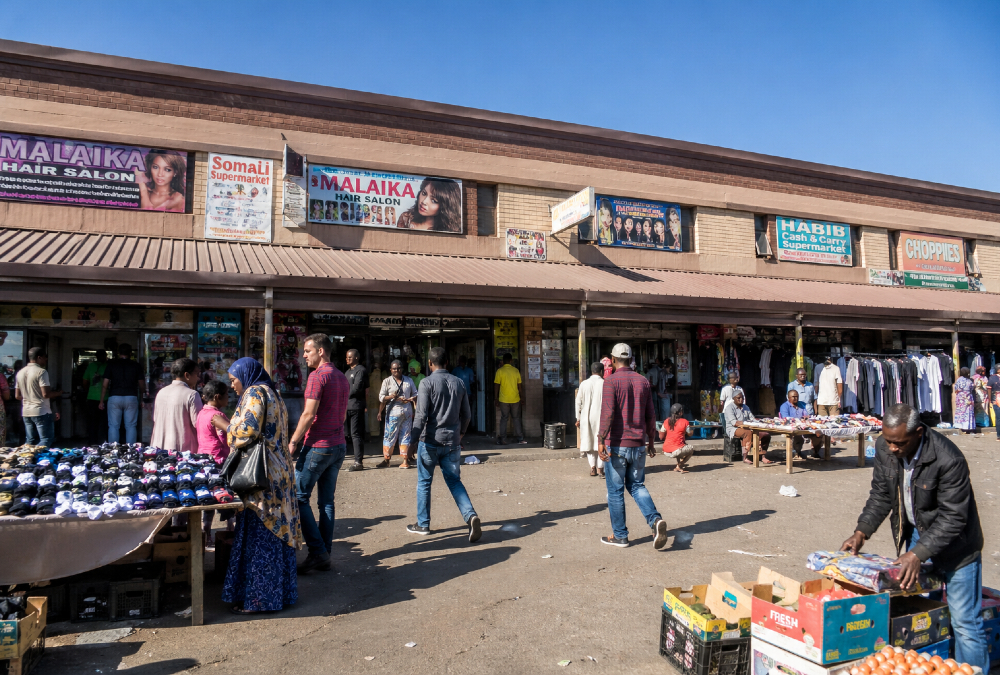
Across South Africa’s townships, a familiar and devastating pattern repeats itself. A Ghanaian trader is humiliated. A Zimbabwean mother shutters her shop out of fear. A Somali merchant is threatened. A Malawian farm hand is driven from his workplace by insult and intimidation. A Nigerian entrepreneur is scapegoated for structural failures he had no hand in creating.
Again and again, an African is told to “go home” – on the soil of the same continent that bore him.
Every sovereign nation retains both the right and the obligation to manage its borders and enforce its immigration laws. That is not in dispute. What is in dispute – and what demands urgent moral reckoning – is the systematic conversion of poverty into hatred, and of grief into violence directed at the wrong people.
The central question is one of political economy, not sentiment: who benefits when the anger of poor Black South Africans is redirected toward poor foreign Africans, while the underlying architecture of inequality remains structurally undisturbed?
The Misattribution of Blame
The Ghanaian trader did not design apartheid. The Somali shopkeeper did not steal the land. The Malawian farmworker does not own the farm on which he labors. The Nigerian entrepreneur did not engineer South Africa’s unemployment crisis.
Yet each of them has been made to serve as the human face of a pain whose true architects remain insulated, prosperous, and largely invisible to public outrage.
South African suffering is real, and it deserves to be acknowledged without qualification. Decades of land dispossession, deliberately broken public education, entrenched township poverty, chronic unemployment, and the compounding psychological trauma of apartheid have left a society structurally wounded in ways that a single generation of democracy cannot fully repair.
To tell a people dispossessed across generations that they need only “work harder” is not wisdom – it is cruelty dressed as advice.
But pain, however legitimate, does not become justice when it is discharged onto another poor African who shares the same continent, the same historical subjugation, and the same economic precarity.
The Migrant’s Visibility and the System’s Invisibility
Much of the resentment directed at foreign nationals rests on a perception of economic competition. And it is true that many migrants arrive in South Africa with nothing – and build something.
This is misread as superiority. It is not. It is the specific psychology of migration: no safety net, no local protection network, no fallback, no margin for failure. That is not a virtue; it is a condition imposed by necessity.
Meanwhile, foreign African workers are, in large measure, workers inside someone else’s economy – employed in farms, restaurants, factories, hotels, construction sites, and retail chains.
When such a worker is attacked or expelled, who benefits? Not the unemployed South African who rarely steps into the ownership role vacated.
The beneficiaries are the employer who maintained artificially suppressed wages, the structure that keeps labor cheap and interchangeable, and the capital holders whose names do not appear in any newspaper headline about xenophobic violence.
The township burns. The boardroom does not sweat.
The Oldest Colonial Playbook
This is not an accident of history – it is a continuation of it. Divide the wounded. Confuse the oppressed. Convince the poor that another poor person is the source of their suffering.
This was the logic of colonial labor policy, and it finds new expression in the political rhetoric that stokes xenophobia while carefully avoiding any structural critique of land ownership, wage floors, or capital concentration.
Ubuntu – the Southern African philosophical principle that translates, roughly, as “I am because we are” – stands in direct contradiction to this logic. The Nguni proverb umuntu ngumuntu ngabantu does not distinguish between the person born in Soweto and the one born in Harare.
It recognizes human dignity as inherently relational and inherently continental. Xenophobia inverts this entirely: I survive because you disappear.
What Justice Actually Requires
The path forward is not to delegitimize South Africa’s genuine and profound economic grievances. Those grievances are real, and any political movement that dismisses them will fail.
The path forward is to insist, with clarity and consistency, that those grievances are aimed at the correct targets: the land question, the quality of public education, the structure of the labor market, the concentration of private wealth, and the political failures of the post-apartheid state.
Foreign Africans are not the authors of South Africa’s inequality. They are, at most, a symptom of a regional economic order that produces mass migration – and that order, too, is worth interrogating.
Before the continent raises another stone against one of its own, it is worth pausing to ask the one question that reframes everything: who benefits when the wounded are taught to hate the displaced? The answer to that question points, with uncomfortable precision, toward the people who are never in the streets when the violence starts – and are always still in their offices when it ends.
Farhia Noor is a seasoned business consultant based in Dar es Salaam, Tanzania. With a proven track record in developing enterprises and executing turnkey projects across both government and private sectors, she brings deep expertise to the table. Farhia is also a committed advocate for community-led development and is passionate about advancing sustainable, intra-African growth.
