
Editorial
Towards a New U.S. – Africa Policy
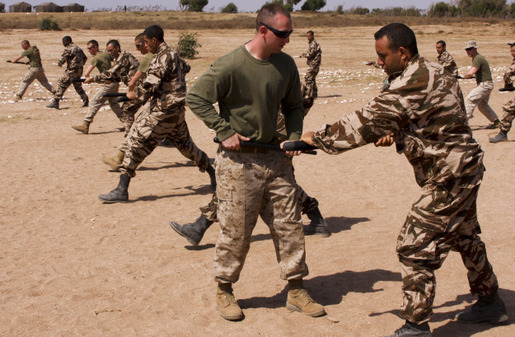
U.S. Cpl. Mark Stickney assists Moroccan Army personnel to correctly apply riot control baton techniques during a period of instruction on non-lethal weapon techniques presented on Tifnit military base, Morocco. PHOTO/USMC photo by Army Sgt. Whitney Houston
The United States needs an African policy that calls for partnership, dialogue on how to advance democracy, human rights, trade and energy production. More importantly, Africa requires policy that will outlast the Chinese in Africa. However, the U.S. – Africa policy thus far, from the African Growth and Opportunity Act (AGOA) to the United States Africa Command (AFRICOM) is, ostensibly, reactive to the presence of third countries in Africa and not necessarily to the needs of the Africans themselves. Of course, AGOA has a whole host of good in its market access provisions for African goods and services; and the 2012 Presidential Directive on Africa is developmental at the very least. The U.S. also spends more than 70 percent of its Africa budgets on social services – and that is all a good thing. But the last thing Africa needs is a foreign military in its backyard.
In the late 1950s and 1960s, during the anti-colonial movements throughout Africa, the U.S. played a pivotal role in contributing to the independence struggles of many an African country. In those years, U.S policy towards Africa meant working with the United Nations to help African peoples achieve their liberty, or even surreptitiously funding the Non Aligned Movement. That was a policy directed at the Africans. Things changed with the increased presence of the Soviet Union on the continent, and by the late 1960s, policy was, essentially, on the basis of how to limit the Soviets from obtaining the continent’s resources. This may have delayed Namibia’s independence, perhaps contributed to the civil war in Angola and even postponed the death of Apartheid South Africa until 1994.
When the Soviet Union finally fell apart in the early 1990s, America also packed its bags and went home. The events in Somalia, Liberia and Rwanda in the 1990s elicited only a little finger from the U.S. However, the Chinese, who had, since the 1960s, provided military and financial assistance to various African countries, stayed. When things calmed down a bit, the Chinese signed trade deals, loan agreements as well as education and cultural exchange programs with Africa. While America was embroiled in all other parts of the world, the Chinese heard calls for infrastructure assistance and have, for a long time, been building roads, railways, ports and bridges across the continent. As a result, by the time China surpassed the U.S. as Africa’s largest trading partner in 2009, the Middle Kingdom’s foreign direct investment in Africa – which was $100 million in 2003 – had grown to more than $ 30 billion in 2013. And they should: China, Asia’s economic superpower, is hungry for natural resources, energy, food and markets for its products. Africa can offer all of these things: about 40 percent of global reserves of natural resources, 60 percent of uncultivated agricultural land, a billion people with rising purchasing power and a potential army of low-wage workers.
Conversely, AFRICOM has a presence in 49 African countries and is currently flying drones on each corner of the continent. AFRICOM commander David Rodriguez noted that the increased presence is only an attempt to help African countries hedge against radical Islam. Africa has 54 countries; radical Islamic groups are active in less than 6.
It’s not that Africa is marginalized in U.S foreign policy formulation; rather U.S views Africa as a continent that it needs to protect from countries like China, so that they do not gain access to its resources and the strategic position it holds as the center of the world transport and trade routes. It also does not help that a large country like the U.S. needs a more comprehensive and more coherent policy towards Africa. Any such policy must incorporate AGOA, the Presidential Directive, Doing Business in Africa, Trade Africa, Power Africa – all of those great initiatives the U.S. seems to come up to benefit its relationship with the fastest growing region in the world!
The point here is very simple: Africa may still be in some sort of mess. South Sudan may not solve its issues next week; South Africa’s economic disparity may keep on growing asunder. But all this will end one day, and just like the opportunistic Chinese did in the 1960s and 1970s, third countries will eat the American lunch. Hence, the increase U.S military presence in Africa is an attempt to challenge and if possible eliminated the Chinese economic hegemony on the continent. Thus, in spite of the Young African Leaders Initiative, the Trade Africa and Power Africa initiatives of the Obama administration, the old U.S policy of limiting the political and economic clout of its global competitor on the continent remains in place. It was the Soviet Union before, now it is China.
The problem with this policy is that it does not address Africans, but the Chinese. Former Secretary of State, Hillary Clinton noted African countries should be aware of China, because China is only interested in exploiting Africans. It’s almost as if she forgot that Africans are aware of the Chinese activities on the continent. They did not need the Secretary to remind them. And Africans are also quite capable of deciding whether or not China is good for Africa. The question is what does the U.S have to offer?
The Habari Network Editorial Board
January 20 – 27, 2013
