
Editorial
The Real Value of Obama’s Trip to Africa
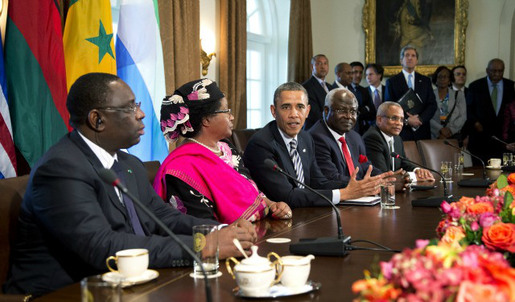
From left to right, President Macky Sall of Senegal, President Joyce Banda of Malawi, U.S. President Barack Obama, President Ernest Bai Koroma of Sierra Leone, and Prime Minister José Maria Pereira Neves of Cape Verde.
On his 3-nation, 5-day visit to Africa, U.S. President Barack Obama, undoubtedly, re-energized the U.S. – Africa commercial relationship. Unlike past visits by American leaders, Obama neither dwelled on HIV/AIDS, political instability nor the inadequacy of governance. Instead, trade and investment were front and center; economic challenges were addressed through Power Africa, an initiative that is expected to increase access to low cost energy, and via Trade Africa, an upbeat approach to regional integration. But on the African Growth and Opportunity Act, AGOA, President Obama could not have been clearer: He affirmed his zeal at making the 12-year old program more effective at generating jobs and trade in the U.S. and on the continent, placing onus on his closest international economic issues confidant, Michael Froman, the new USTR to ensure AGOA efficacy.
This is not only momentous but opportune: Dr. Froman is largely responsible for the much lauded 2012 Presidential Directive on Sub Saharan Africa, has a firm grasp on the region, and with his good connections in Congress, the Obama Administration and the 113th Congress may even pass a more comprehensive AGOA than the one Bill Clinton signed into law in 2000.
This new AGOA could include currently excluded agricultural products like sweetened cocoa, groundnuts, tobacco and sugar; perhaps even provide for a perpetual duty-free program in the context where a more integrated Africa assumes more responsibilities in the global trading system. Ideally, an enhanced AGOA would go beyond current trade provisions, promote U.S. investment in Africa, support regional integration and be the conduit for a U.S. – Africa relationship that’s as significant as that one between U.S. and the European Union under the Trans-Atlantic Trade and Investment Partnership (T-TIP). Simply, the U.S. has allies not just in the North but the South Atlantic as well – the basis for a new Transatlantic South Partnership, so to speak.
But of course, AGOA aficionados have a great many fears: They see a U.S. Congress increasingly calcified into partisan rancor and wonder if any changes to AGOA will pass the deeply divided bicameral body. However, John Dickerson of Slate captures the heart of the matter by suggesting that Africa-centric legislation is always treated with a semi-reverence in the U.S. especially because it represents one of the last genuine venues for bipartisanship. Secondly, as of June 27, 2013 – even at a time of intense debate between Republicans and Democrats, a bipartisan bill H.R. 2548 to establish a comprehensive policy to assist African countries develop an appropriate mix of power solutions was introduced in the House.
Besides, entities like the Corporate Council on Africa, the U.S. Chamber of Commerce, Heritage Foundation, Wilson Center and the Brookings Institution all agree with this premise, making a case for a large U.S. – Africa initiative that would, simply, surmount what China is doing to endear itself to Africa. All parties also hope that Obama’s unique presidency will build on the history of American support to the region and especially unleash the entrepreneurial force of the American private sector.
Conversely, like Obama specifically pointed out, AGOA cannot be a one-way street: African countries have to market and brand themselves and their products not just to policy makers but to the world’s largest markets in North America. Today, U.S. exports to an entire continent of Africa are almost as valuable as the total amount of money Americans spend on teeth whitening products. This could all change if the Obama Administration effectively leveraged agencies like Ex-Im Bank, US Trade Development Agency (USTDA), OPIC, and the Small Business Administration and the Minority Business Development Authority to facilitate corporations, SMEs and the Africa Diaspora investment in Africa.
In the same vein, if U.S. companies are to optimally participate in Africa’s commercial renaissance, Africa itself must ensure the seamless flow of goods and services through borders and allow investors to operate global supply chains and distribution networks with bigger markets. Obama’s Trade Africa was supportive of the East African Community, and, ostensibly, endorsed regional agreements that would culminate in a continental free trade area (FTA).
