
Opinion
Strategy, Not Suitors: How Africa Must Leverage its Geopolitical Partners
The Russia-Africa summit has put a lopsided trade relationship in the spotlight. What matters now is whether Africa can turn foreign interest into factories, jobs and exports.

By Michael Sudarkasa
Every summit produces a communiqué, a family photograph and a flurry of memorandums of understanding. Very few produce a smokestack, a processing plant or a payroll. The third Russia-Africa Summit will be judged by which of those it resembles.
Consider the number that best captures the relationship. Goods trade between Russia and Africa reached roughly US$27.1 billion in 2025. Of that, about US$22.7 billion, or 84 percent, consisted of Russian exports to the continent. African exports to Russia came to only US$4.4 billion. Put plainly, Africa bought about five dollars of Russian goods for every dollar it sold in return.
It is tempting to read this as a complaint. It is better read as a brief. A trade relationship this lopsided has room to grow in only one direction, and the question is who will shape that growth.
The Wrong Question
Debate over Africa’s courtship by outside powers tends to fixate on choosing sides: Moscow or Washington, Beijing or Brussels, Delhi or Ankara. This is the wrong frame, and a faintly condescending one. It treats African states as prizes to be won rather than as governments with agendas of their own.
Africa is not short of partners. Its leaders have no shortage of invitations, and the competition for their attention is the best bargaining position the continent has enjoyed in decades. The real question is what Africa does with the partners it already has.
Russia is a major supplier of grain and fertilizer, two commodities on which African food security leans heavily. It is also widening its engagement in energy, mining, infrastructure and technology, alongside education and security cooperation. All of this is useful. None of it is transformative unless it changes what Africa makes, rather than merely what Africa buys.
From Import to Industry
The test is simple. Every import should be a down payment on domestic capacity. In practice, that means a series of conversions:
- Grain should become agro-processing: milling, packaging and food manufacturing that keep value on the continent.
- Fertilizer should become African production, through blending plants and, eventually, local manufacturing.
- Minerals should become beneficiation. Africa has exported raw ore for a century and has the poverty statistics to show for it. Refining at home is where the margins, and the jobs, are.
- Energy should become industrial capacity, because reliable power is the precondition for everything else.
- Technology should become skills and local enterprise, not a permanent dependency on foreign maintenance contracts.
- Trade should become genuine two-way market access, so that the US$4.4 billion figure starts to climb.
The logic is unglamorous and well worn. It is also how every successful industrializer, from postwar Japan to modern Vietnam, has used foreign capital and expertise: as inputs to a national strategy, not substitutes for one.
The BRICS Wildcard
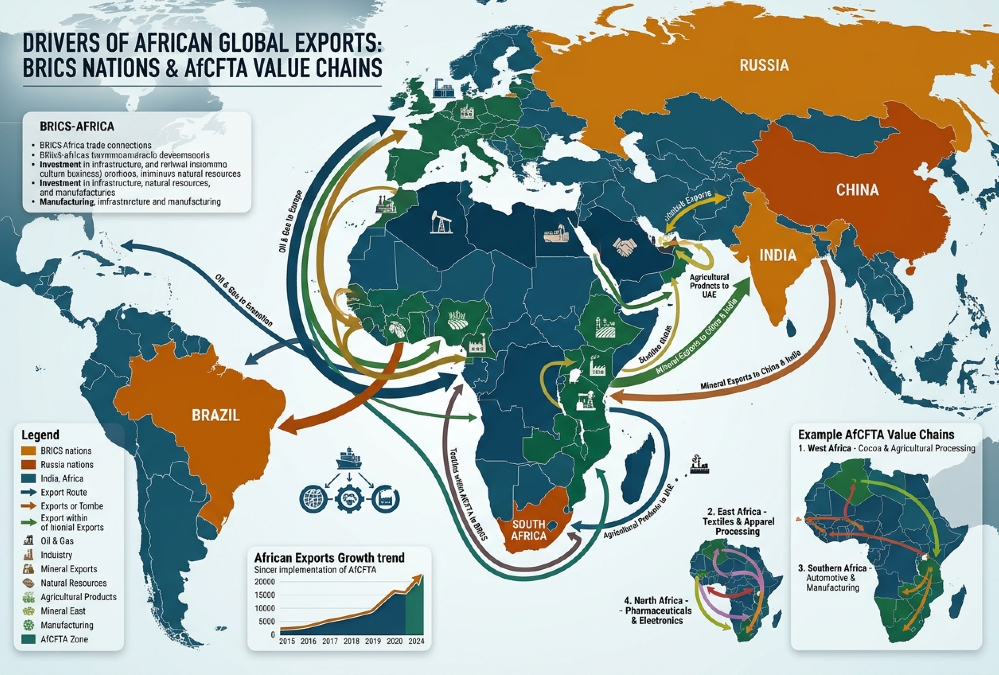
The BRICS grouping adds a second dimension. South Africa, Egypt and Ethiopia are members, while Nigeria and Uganda are partner countries. That gives Africa a meaningful presence in a forum concerned with trade, investment, development finance and cross-border payment mechanisms.
Whether BRICS delivers cheaper capital and workable payment channels remains to be proved. But the opportunity for Africa is not to treat the bloc as a patron. It is to connect the pieces. BRICS capital and technology should flow into African production. That production should plug into the African Continental Free Trade Area (AfCFTA) and its regional value chains, serving a market of more than 1.4 billion people. From there, goods should travel to global markets.
Without that chain, each initiative is an island. A processing plant that cannot sell across borders is a small factory. One that can sell into a continental market is the seed of an industry.
Implementation is the Whole Game
The new AU-Russia Action Plan for 2027-2029 sets out cooperation across 19 areas, an impressive span on paper. But action plans have a way of being admired more than executed. Four questions will decide whether this one is different:
- Can Africa raise its exports to Russia, and not only its imports from it?
- Can Russian investment build productive capacity on African soil?
- Will technology and skills actually transfer?
- Will African businesses participate in the value chains that result?
If the answers are yes, the summit will have mattered. If not, it will join a long list of well-attended gatherings whose chief legacy was the photograph.
What Success Looks Like
The sequence is easy to state and hard to deliver: partnership, then investment, then production, then value addition, then trade, then jobs. Skip a link and the chain breaks. Stop at “partnership” and you have diplomacy. Reach “jobs” and you have development.
Africa’s leverage has rarely been greater, and leverage is a wasting asset. Foreign interest is cyclical, and today’s suitors will move on if the returns disappoint or the terms are weak. The continent’s task is to use this window to negotiate for local content, processing requirements, technology transfer and reciprocal market access, and to hold partners to them.
The question was never whether Africa needs another partner. It is whether Africa can turn the partners it has into production, value addition, intra-African supply chains, exports and employment. That, not the guest list, is the measure of a summit.
Michael Sudarkasa is a commercial attorney and African economic development expert. He is the CEO and founder of Africa Business Group, a South Africa-based consultancy focused on business development, agriculture, renewable energy, and capacity building. With extensive experience in private sector growth, trade, investment, and corporate finance across Africa, he has authored publications on African trade and investment and previously led the African Fertilizer and Agribusiness Partnership (AFAP). He also serves on multiple boards and advisory panels in the economic development and impact investment sectors.
