
A Diaspora View of Africa
South Africa, United States share migrant concerns

By Gregory Simpkins
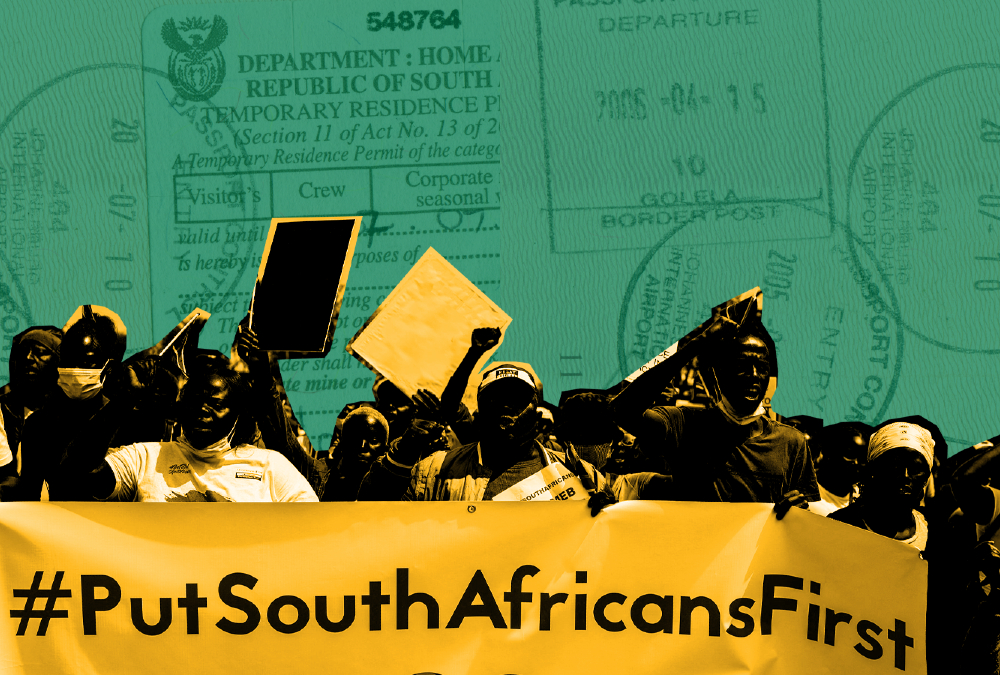
Although half a world apart, lower-income South Africans and Americans are facing increasing challenges to their economic wellbeing due to the influx of foreigners into their country. These often-illegal entrants threaten to diminish not only job opportunities but also drain the already-limited resources on which poor citizens in both countries count on to survive.
In the case of South Africa, the apartheid government long planned to program black citizens for menial labor and discourage, if not prevent, their success in higher endeavors. The 1953 Bantu Education Act brought African education under control of the government and extended apartheid to black schools.
Previously, as stated in the 1986 book My Spirit is Not Banned by Frances Baard and Barbie Schreiner, most African schools were run by missionaries with some state aid, but Bantu education ended the relative autonomy these schools had enjoyed up to that point. Instead, government funding of black schools became conditional on acceptance of a racially discriminatory curriculum administered by a new Department of Bantu Education. Most mission schools for Africans chose to close rather than promote apartheid in education.
Baard and Schreiner wrote that Bantu education served the interests of white supremacy. It denied black people access to the same educational opportunities and resources enjoyed by white South Africans. Bantu education denigrated black people’s history, culture, and identity. It promoted myths and racial stereotypes in its curricula and textbooks. Some of these ideas found expression in the notion of the existence of a separate “Bantu society” and “Bantu economy” which were taught to African students in government-run schools.
This so-called “Bantu culture” was presented in crude and essentialized fashion. African people and communities were portrayed as traditional, rural, and unchanging. Bantu education treated blacks as perpetual children in need of parental supervision by whites, which greatly limited the student’s vision of “her place” in the broader South African society.
In his seminal 1933 book The Mis-Education of the Negro, noted historian and author Carter G. Woodson described a similar plan to under educate black students in the United States. He believed that black people were being taught to become dependent and to seek out inferior places in the greater society of which they were a part.
“When you control a man’s thinking you do not have to worry about his actions. You do not have to tell him not to stand here or go yonder. He will find his ‘proper place’ and will stay in it. You do not need to send him to the back door. He will go without being told. In fact, if there is no back door, he will cut one for his special benefit. His education makes it necessary,” he wrote.
So, in both countries there was a plan to create an underclass, if you will, of blacks and other minorities, to act as a permanent class of servants with no hope or serious ambition to exceed their programmed standing.
Swedish economist and sociologist Gunnar Myrdal is generally credited as the first proponent of the term underclass. Writing in the early 1960s on economic inequality in the U.S., Myrdal’s underclass refers to a “class of unemployed, unemployables, and underemployed, who are more and more hopelessly set apart from the nation at large, and do not share in its life, its ambitions, and its achievements”. However, this general conception of a class or category of people below the core of the working class has a long tradition in the social sciences.
Of course, there always were those who opposed being boxed in like that. In South Africa, there was a vehement struggle to end and replace Bantu education, and it succeeded. Nevertheless, how many millions of black South Africans never received the education they deserved? In America, there remain millions of students turned out of malfunctioning school systems with little hope of rising above the circumstances into which they were born despite the existence of parochial schools and more recently charter schools.
Resentment against foreigners is building in more than just South Africa and the United States, and it is largely caused by the generosity of those wanting to help people in dire need. However, they are seeing part of the picture and not the whole scene.
The cruel irony is that this underclass does not lack people with intelligence. The criminal classes they have spawned are full of innovative people who constantly finds ways to make money illegally and amass ill-gotten gains. How much more would society benefit if these intelligent, creative people could have learned to turn their intellectual abilities toward legal, productive ventures?
Shrinking Opportunities for the Underclass
As technology has increased, many low-level jobs are now being performed by machines. Think of your local supermarket or pharmacy. Increasingly, jobs previously handled by low-skilled clerks are now done by machines. It is described as a convenience for customers, which is true, but each self-serve station represents a low-skilled job that has disappeared for good. The same has been the case on assembly lines in manufacturing plants for decades.
Add to this now the influx of migrants to South Africa and the United States, and you can understand why the so-called underclass would feel threatened. South Africans have seen immigrants from neighboring countries such as Zimbabwe who have greater education and skills. Zimbabweans have come to dominate the South African banking sector, for example, because of that.
Several years ago, when I still worked for the House Subcommittee on Africa, a colleague of mine and I visited both Zimbabwe and South Africa and witnessed the contrast in education and employment prospects. The government of Robert Mugabe was chasing residents out who then were entering South Africa in large numbers, causing concerns among a population not equally prepared to compete. In fact, it seemed that the entire continent was like a board game turned upside down so that all the balls rolled down to the bottom. We saw people from Eritrea to Burundi to Nigeria come to South Africa to pursue greater economic opportunities.
“In the wake of rising migration in the 21st century and very weak economic performance since 2009, immigration of poor people from the African continent has been a rising source of tension. The fact that refugees are not generally held in camps and that there have been no governmental efforts at inclusion has made it easier for politicians to mobilize anti-foreigner sentiment, both as a stick to beat government and as a government ploy to blame migrants for the failures of policy and practice,” according to the third South African Country Study: Migration Trends, Policy, Implementation, and Outcome.
I was told while in South Africa that shopkeepers in town paid thugs to loot and burn stores in the townships operated by migrants to eliminate the competition and not just because they particularly hated foreigners, although there undoubtedly was resentment about newcomers establishing economic footholds in their homeland.
Resentment against foreigners is building in more than just South Africa and the United States, and it is largely caused by the generosity of those wanting to help people in dire need. However, they are seeing part of the picture and not the whole scene. For example, Somalia has been a mess for decades, and there are refugee camps in Kenya in which Somali entrepreneurs have thrived in business even as they receive benefits as refugees. The authorities who provide educational, health and other benefits to these Somali refugees see how they are helping them but not how they are disadvantaging indigenous Kenyans who do not receive such benefits. How do you think Kenyans surrounding these camps feel seeing their government aid often well-to-do foreigners – some who even employ Kenyans?
As for the United States, progressives are eager to demonstrate their caring nature by allowing an open border and providing benefits. There are 26 states make immigrants eligible for state-funded benefit programs. Most of these states either aid families or provide access to healthcare to otherwise uninsured immigrants. Examples of these programs are New York’s Safety Net Assistance, California’s CalFresh Food Assistance Program and California’s Cash Assistance Program for Immigrants (CAPI). Each community center now devoted to these migrants only increases the belief that something is being taken from citizens to be given to foreigners.
Meanwhile, the new entrants are seen as competitors for the menial jobs that still exist. I have heard that blacks and native-born Hispanics do not want to do the menial labor they are all too eager to do. In my life, I have found that not to be the case, although Americans are less likely to accept jobs paying less than they could earn on government assistance. If you have to care for your family with limited funds, every dollar counts.
According to new research by Vanderbilt University professor of law and political science Carol Swain, illegal immigration is hurting African Americans. In her essay in the newly released volume Debating Immigration, which Professor Swain edited, she said that African Americans are losing more jobs to illegal immigrants than to other racial or ethnic groups, yet low-income black workers do not have political input in the debate.
Professor Swain based her comments on a study conducted by the Pew Hispanic Center, which found high unemployment rates among African Americans and Hispanics were partially attributed to the large number of low-skilled immigrants. She added that lax or non-existent immigration rules help businesses get away with hiring illegal immigrants rather than legal workers.
As the developed world uses compassion to design and implement programs to help the many migrants flooding borders globally, consideration must be paid to what will become of the underclasses in all these countries. Discontent could aggregate easily if what meagre benefits citizens receive are diminished by those extended to new entrants. Let us hope that such resentment can be diminished or even reversed by a more equitable division of resources with more care for what the needs of their own citizens are.
Gregory Simpkins, a longtime specialist in African policy development, is the Principal of 21st Century Solutions. He consults with organizations on African policy issues generally, especially in relating to the U.S. Government. He further acts as a consultant to the African Merchants Association, where he advises the Association in its efforts to stimulate an increase in trade between several hundred African Diaspora small and medium enterprises and their African partners.
