
Editorial
Reflecting on African Leadership
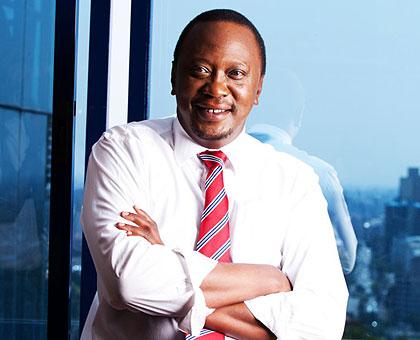
Mr. Uhuru Kenyatta, Kenya’s President-Elect
Tiger Woods could recapture his Number One Golfer position in two weeks if he wins at Bay Hill; Nelson Mandela has just been released from hospital after another series of successful efforts to ensure his longevity, and the Papacy with the trappings of the Petrine throne seems to slip further and further away from Ghana’s Cardinal Peter Turkson.
But the Bahamas has approved its own efforts at off-shore drilling, and Kenya’s 2013 election came to its most logical conclusion.
Kenya was always going to be a mixed basket for everyone: For its neighbors Uganda, Somalia, Ethiopia – and a country or so away – to Rwanda and the Democratic Republic of Congo. If things went well, Kenya was going to continue to attract more investment than the other East African nations, and if they did not, supply chains and distribution networks going through Mombasa, Nairobi, Kisumu and Eldoret would create price spikes in all the other countries. Secondly, going by the recent proclamations from the European Union and the United States, it is ostensibly a bittersweet time for them considering that those most able to run and lead and win democratically are tainted by human rights abuse and scandal. And this epoch is especially dicey for Prime Minister Raila Odinga.
With 50.07 percent of the total vote cast by more than 85 percent of Kenya’s eligible, Uhuru Kenyatta kept the pall of the International Criminal Court hanging over his head, shed his Deputy Prime Minister title and became President – Elect. He goes on to join his father Jomo Kenyatta in leading East Africa’s most stable nation and also the region’s strongest economy. Raila Odinga, on the other hand, took things in his stride, declared that he’d contest the election due to irregularities that his own government should have prepared for and just like his father – Jaramogi Odinga – failed to make Kenya a Luo led nation.
But Uhuru’s is not a pyrrhic victory. In fact, far from it. Historically, like his father, the younger Kenyatta seemed to have the timing quite right. At the age of 51, he was not too young to be seen as a venerable African ruler. That he is extremely wealthy helps a great deal, and although he was tainted by the 2007 scandal, he is very different from Sudan’s Bashir: He presented himself to the International Criminal Court (ICC), and was seen by many Kenyans as a victim since the ICC summonses did not touch President Mwai Kibaki and Prime Minister Raila Odinga, two men who were seen as primaries in the deaths of more than 1,000 people and the displacement of more than 300,000 in the electoral crisis some five years ago.
Nonetheless, like happened in the 1960s, the younger Kenyatta seemed to know how to eke out a victory over a powerful Raila Odinga. Uhuru, who is from Kenya’s largest ethnic group, the Kikuyu, chose a seasoned lawmaker, William Ruto from the small but powerful Kalenjin ethnic group. Jomo Kenyatta also made the sagely calculus to bring in a young Baringo MP called Daniel arap Moi to his Kenya Africa National Union Party, and Moi was to become Vice President and then President in 1978 following Kenyatta’s death until 2002. The Kikuyu were the heart and soul of the infamous Mau Mau rebellion that secured Kenya’s independence, and many in Kenya still ‘owe’ the Kenyattas a debt of gratitude.
With the West seeming to thumb their nose at Uhuru, China has jumped in with a full de jure recognition of the election result. As Africa’s largest trading partner, China seems to understand what is at stake. That they will look beyond the trappings of human rights or what may have happened in the past is not just as cynical as some may think. Real lives are at stake – the Chinese provide valuable infrastructural development and commodity expenditure that brings Kenya lots of money – and unlike the European Union, it does not ‘demand’ for the exclusive economic partnership agreements (EPAs) which would even go as far as jeopardizing Kenya’s benefits under the American Africa Growth Opportunities Act (AGOA).
Whereas this should not necessarily force the West into doing anything haphazard, its important to realize that the people have spoken, whether by a sliver or smidgen. Democracy worked in Kenya, this time around. Uhuru will be the president, and if you want to get to the heart of East Africa – with some of the world’s fastest growing populations – you might want to follow the Chinese.
Editorial Board
The Habari Network
March 11 – March 18, 2013
For comments, follow up and reaction, please write to the Editor, [email protected]
