
Editorial
On the Resignation of a Pope
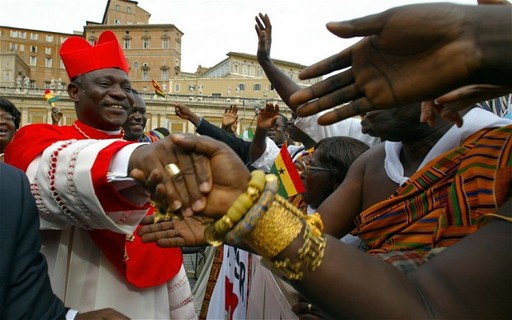
Cardinal Peter Turkson of Ghana. PHOTO/Getty Images
On April 19, 2005, following the death of his predecessor, Joseph Aloysius Ratzinger became Pope Benedict XVI, 264th heir to St. Peter’s throne and head of God’s own Petrine Ministry. By March 1, 2013, Pope Benedict XVI will be no more; and God’s former Rottweiler will retire to live out the rest of his days in an exclusive Vatican residence – in prayer, in dedication, in celibacy, and also, with the arthritis that plagued him at 86 years of age, preventing him from completing his divine duties.
The entire globe is in an immediate quandary: Not only was this February 11, 2013 decision much too sudden and unexpected – the Pope assured the world just last year that he’d serve out his term – it also means that the religious community has to grapple with two very dicey aspects: This is one of the only times that a sitting pope will have the specter of a predecessor that is alive.
Of course, while the Holy Father may retire if he chooses as predicated by the Code of Canon Law, when a pope is elected as the Successor of St. Peter, the Church expects that he will remain in office until his death. In fact, the last time a pope resigned and led to the election of another, was in 1294. Pope Celestine V, a Benedictine monk who was 84, resigned on December 13, 1294, and his successor, Pope Boniface VIII imprisoned him so that no one could try to reinstall him if he was more popular. “Fortunately”, the imprisonment and Boniface’s fears did not last that long as St. Celestine died less than 6 months later.
This leaves us with the bigger issue: Benedict XVI’s successor.
Someone has to provide leadership to the world’s 1.13 billion catholics [Est. 2008 . The Vatican], and according to various media sources, not one but two Africans are among the early contenders to become Pope. This may reflect the reality that Catholics from the developing world are increasingly neither Caucasian nor European: Africa’s Catholics are over 12 percent of the overall total, and Cardinal Peter Turkson of Ghana could join past African popes and become the first ever black pope of the modern era.
If and when this happens, the world may rejoice as much as it did when Nelson Mandela was released from prison 1994, when Ghana’s Kofi A. Annan became Secretary General of the UN in 1997, and when Barack Obama was elected US president first in 2008 and also in 2012.
However, unlike these aforementioned momentous aspects, the election of the Pope is a much different thing. Unlike regular politics where the front runner will, most likely, be the eventual winner, secret committees – especially the Vatican’s conclave – have been notorious for actually not going for the front runner, but for one the cardinals themselves consider God’s chosen servant. In fact, in a post-Benedict-resignation response to queries on a potential black pope, Cardinal Turkson suggested that things were not even about representation, and that such considerations tended to muddy the water.
