
A Diaspora View of Africa
Nigeria’s troubled elections

By Gregory Simpkins
It was predicted that Nigeria’s 2023 elections would demonstrate significant progress in political plurality in the country. It has not thus far. It was said that this election would show how Nigeria uses technology well. That also hasn’t happened. This country, so blessed with human and natural resources, continues to underperform politically when it has every reason to exceed expectations. Now the delays in releasing information – as usually happens in such situations – in addition to other voting and counting irregularities reported have created doubts that will linger in the minds of the Nigerian voting public.
Former two-term Governor of Lagos State Bola Tinubu of the All Progressives Congress (APC) party officially received 37 percent of the vote, former two-term Vice President Atiku Abubakar the People’s Democratic Party (PDP) won 29 percent of the vote and former two-term Anambra State Governor Peter Obi of the Labour Party finished third with 25 percent of the vote. However, the opposition candidates have not accepted the results and are demanding a rerun of the elections.
Tinubu pulled out of the APC nomination even though it was said that he was not favored by the northern establishment. He tried to become the vice-presidential candidate on Muhammadu Buhari’s ticket in 2015, but Buhari kept with recent tradition and added a Christian, Oluyemi Osinbajo. Tinubu’s decision to select a Muslim vice-presidential candidate – Alhaji Kashim Shettima – became an issue for non-northerners, especially Christians because of the numerous attacks they have suffered in Nigeria. Going into the elections, the APC controlled the federal government and 22 of the 36 state governments. However, outgoing President Buhari had become increasingly unpopular due to rampant security concerns, unbridled attacks on Christians, and more recently a currency shortage. Tinubu had to finesse his relationship with Buhari and overcome whatever support Atiku maintained in the north.
Atiku’s party controlled a third of state governments going into the elections but was a minority in the federal government. He ran for president unsuccessfully six times: 1993, 2007, 2011, 2015, 2019, and this year. After he was defeated by Buhari in the 2019 election, he unsuccessfully appealed to the Supreme Court, calling the contest the “worst in Nigeria’s democratic history.”
Atiku was implicated in an international bribery scandal along with then-Congressman William Jefferson, who went to jail, and one of Atiku’s wives, Jennifer Atiku Abubakar. Although he was never officially charged with any crime in the United States, Atiku was unable to visit there, which caused significant reputational damage in Nigeria.
Younger voters were expected to favor Obi because he offered something beyond the status quo that did not serve Nigerian youth well, but that apparently was not enough to counter Tinubu’s advantage of national incumbency, despite heavy use of social media. Obi, whose late surge made these elections a three-party affair as opposed to the usual APC-PDP contest, had been considered a political afterthought at the beginning of the campaign. However, the Labour Party was by far the smallest and had organizational limitations, largely due to a lack of funds and a national profile beyond social media users and southern supporters. Obi surprisingly won Lagos, which is Tinubu’s stronghold. His presence on the ballot also undoubtedly ate into PDP’s appeal among southern voters.
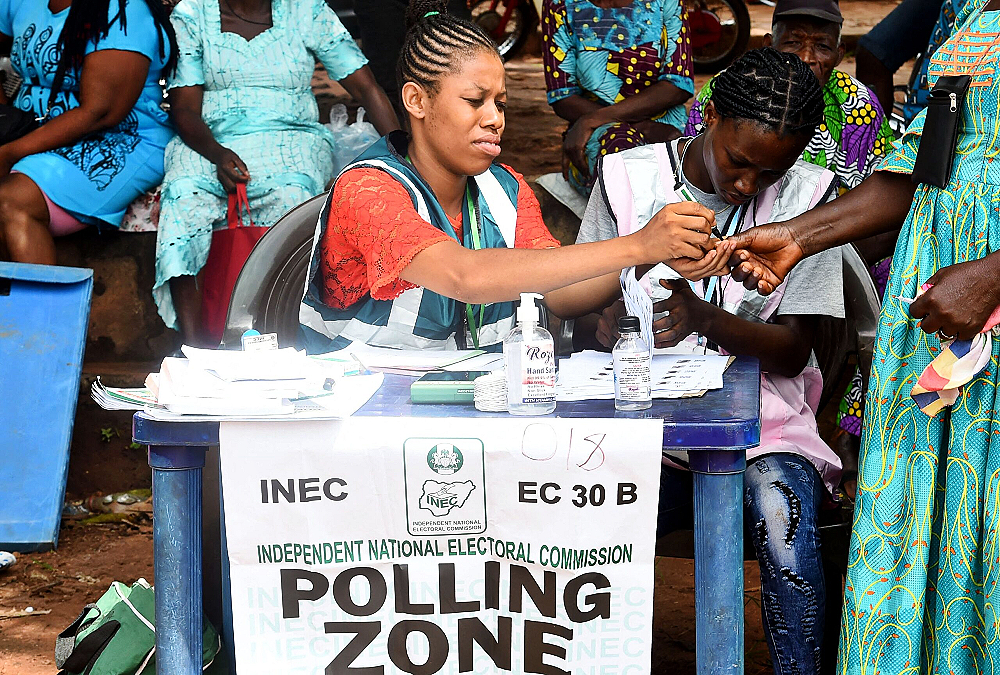
There reportedly were serious issues calling into question the results according to observers. The Africa Report stated that some 87.2 million out of 93.5 million voters’ cards were collected, suggesting real enthusiasm about the elections, and perhaps from a younger demographic. While Tinubu outpaced Abubakar with about 8.8 million votes, he still was the choice of less than 10 percent of the record 93 million+ Nigerians who registered to vote. That was partly due to a significantly divided opposition. But those who collected their voter cards went through an arduous process, involving queuing for hours.
It is more likely that problems on voting day, rather than voter apathy, were responsible for the relatively small number of ballots cast. Many potential voters left polling stations without casting their ballots after voting did not start on time in many places. Some opposition strongholds reported that voting did not take place at all, and there were also accounts of ballot-box snatching and voter intimidation in southern states such as Rivers, Lagos, and Delta. Obi’s Labour Party was not even on the ballot for parliamentary races in some places. Of course, that also may have been due to some disorganization within the party that prevented candidate names from being submitted on time for ballot inclusion.
All this despite a newly introduced electronic voting system that promised the elimination of the ballot-stuffing that happened in the past and help in presenting a more accurate picture of the voting population.
There have been widespread reports of machines failing to accredit voters in some areas of the country due to technical problems, as well as the absence of an internet connection. Several people have said they used hot spots on their own mobile phones to enable election officials to log in some locations. The National Independent Electoral Commission server was inoperative for a significant amount of time during the voting. At the time of this writing, though, there was no proof of deliberate misuse of the electronic voting system provided. A more detailed examination of the results will provide a clearer picture of what transpired on election day and a possible view of Nigeria’s electoral future.
The 2023 election was an important one for several constituencies. Women, for example, were particularly attuned to the security situation throughout Nigeria. There have been several kidnappings of groups of women and girls over more than a decade, including the infamous Chibok schoolgirl kidnapping in 2014. Women and their children are always hardest hit by insecurity, and some describe Buhari’s term in office as the most insecure period in Nigeria since the 1967-70 civil war. According to the International Crisis Group, widespread insecurity has seen armed groups kill more than 10,000 people and abduct more than 5,000 last year alone.
Youth
Yet there were two other constituencies as genuinely excited about the prospects for change through these elections: youth and Christians.
The Washington Post, reporting before the elections, described Nigeria’s youth population as massive, with 70 percent of the country’s population under age 30. People ages 18 to 35 comprise 40 percent of registered voters, and officials estimated that 8.5 million young people had registered to vote for the first time in these elections.
“Already, the country is straining to provide services and opportunity for its youth,” Joseph Siegle, director of research at the Africa Center for Strategic Studies in Washington, told the newspaper. A 2021 World Bank report found that 43 percent of Nigerian youths are unemployed or underemployed, and 52 percent say they want to emigrate.
BBC News has reported that the 2020 EndSARS anti-police brutality protests morphed into calls for good governance, and millions of young people registered as first-time voters.
“If Nigeria continues on this downhill, it will be disastrous, so yes, it’s a defining moment,” Rinu Oduala, a 24-year-old woman who was among the protesters who camped outside the governor’s office in Lagos for weeks two years ago told the news service.
Nigeria has been called the essential African nation because of its people, its resources, and its sheer size. What happens within its borders cannot be contained there.
Though the protests were brutally halted by the army, the disbandment of the SARS police unit notorious for profiling young people was considered a success, according to BBC News. That seems to have galvanized frustrated young Nigerians, and they then targeted the highest office in the land. Their supposed favorite candidate, Obi, is not young at 61 years of age, but he offered a change from the usual two-party contest where the candidates really are chosen by party leaders and not voters. It will be interesting to see how the influence of youth voters manifests for future Nigerian elections.
As for Christians, while they comprise nearly half of Nigeria’s population, mostly Muslim leadership has tried more than once to install Sharia law throughout the north, even affecting Christians. Muslim presidents have allied with Middle Eastern countries and have overlooked a situation in which Christian people and churches have been attacked. As a Congressional staff member, I saw first-hand the result of cruel treatment of Christians by Muslim extremists. It has not been conclusively proven that President Buhari and other Muslim officials directly ordered Fulani attacks on Christians, but neither have they given much effort to end a situation in which Nigeria became the most dangerous place on earth for Christians to live.
In an article in the Vanguard newspaper just before last Christmas, writer Olu Fasan identified several quotes from APC leaders that demonstrated a lack of concern about what the Muslim-Muslim ticket looked like to Christians who have long been traumatized by anti-Christian attacks.
In an interview with BBC Hausa in August, the APC national chairman, Abdullahi Adamu, put it this way: “In our understanding of the politics in Nigeria at the moment, the Muslim-Muslim ticket is the best decision for us because we want to win the election,” adding: “Everyone has his own strategy for winning elections.”
Kayode Fayemi, then Ekiti State governor, put it more bluntly. Speaking to the new executives of the Christian Action Network (CAN), Ekiti State chapter, in July, he said: “The decision (Muslim-Muslim ticket) was not on grounds of competence because we have competent Christians all over Nigeria, but on grounds of strategic political moves.” He added: “we have to look at scenarios and calculate where the votes would come from; it’s a game of numbers!”
Now that the Muslim-Muslim ticket has won, it remains to be seen how this will impact Muslim-Christian relations in Nigeria. Having made the political calculus to win, will APC now try to repair interreligious relations, or will the same old indifference to the dangers faced by Christians continue?
Nigeria has been called the essential African nation because of its people, its resources, and its sheer size. What happens within its borders cannot be contained there, as evidenced by the spread of Boko Haram from a northern Nigerian problem to a regional problem affecting its neighbors. Consequently, these elections will foretell either an advancement for Nigeria and the region or the beginning of an even darker period for the people of Nigeria and those nations it borders. Time and a thorough examination of the events on election day will tell the tale.
Gregory Simpkins, a longtime specialist in African policy development, is the Principal of 21st Century Solutions. He consults with organizations on African policy issues generally, especially in relating to the U.S. Government. He also serves as Managing Director for the Morganthau Stirling consulting firm, where he oversees program development and implementation. He further acts as a consultant to the African Merchants Association, where he advises the Association in its efforts to stimulate an increase in trade between several hundred African Diaspora small and medium enterprises and their African partners.
