
A Diaspora View of Africa
Niger ouster threatens U.S. Africa policy

By Gregory Simpkins
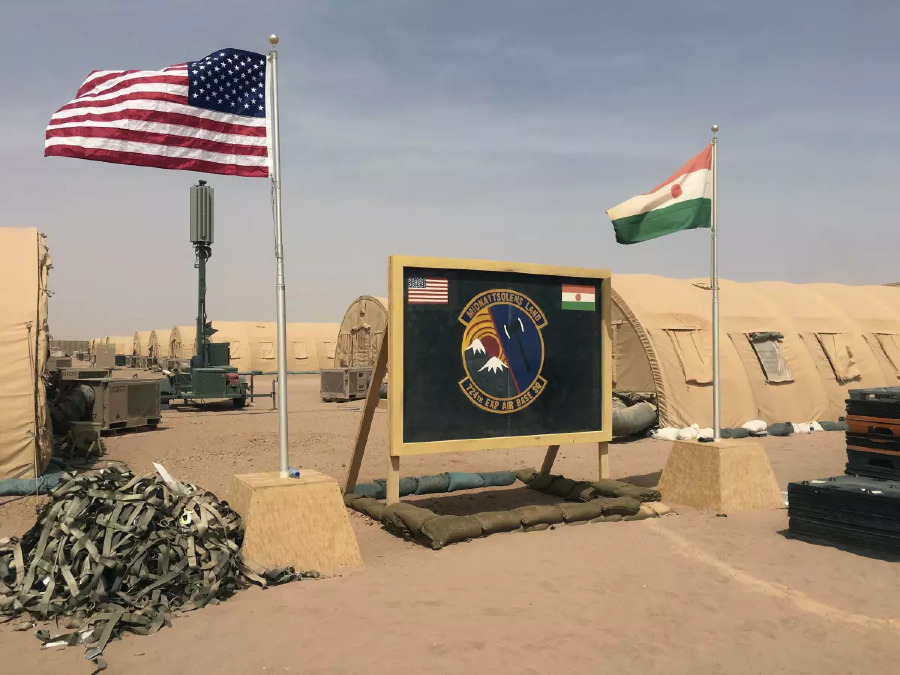
Following what has been described as intense negotiations, the U.S. government has agreed to withdraw its drone base from Niger. This base is considered critical in the fight against Islamist extremists in the Sahel region of Africa where local groups have pledged allegiance to al-Qaeda and the Islamic State groups, and this ouster is being seen as a serious blow to U.S. policy on Africa.
The U.S. government describes its Trans-Sahara Counterterrorism Partnership as a multi-faceted, multi-year U.S. strategy aimed at developing resilient institutions that are capable of preventing and responding to terrorism in the Sahel. Niger was one of the partner countries that also has included Algeria, Burkina Faso, Cameroon, Chad, Libya, Mali, Mauritania, Morocco, Nigeria, Senegal, and Tunisia. It is not yet certain what will happen with this program, but Burkina Faso and Mali have allied with Niger and have joined in quitting both the Economic Community of West African States (ECOWAS) and the French-led G5 Sahel force.
Al Jazeera reported on March 19, that Niger had suspended its military agreement with the United States that gave American troops a key base and launchpad in the Sahel. The move was said to have followed a dispute with the United States about the African nation’s ties to Russia and Iran, which erupted when US officials visited Niger to express their concerns.
Air Base 201 was built from 2016 to 2019 at a cost of more than US$100 million, Al Jazeera reported. The base has been used to launch drone operations against armed groups linked to ISIL (ISIS) and al-Qaeda in the Sahel.
“Niger is the centre of US operations in West and North Africa, notably at its Air Base 201,” Al Jazeera’s correspondent Shihab Rattansi said from Washington, DC.
Having a base in the Sahel is important for Washington’s operations against armed groups in the region, “but it’s really there also for great power projection against countries like Russia and China,” Rattansi said.
Nigerien officials said they were given no advance notification of the American delegation visit nor the composition of the mission. It was led by Assistant Secretary of State for African Affairs Molly Phee, Assistant Secretary of Defense for International Security Affairs Celeste Wallander and the head of U.S. Africa Command General Michael Langley. It seems unlikely that there was no notice of the visit since all visitors, including government ones, require the approval of the host government to enter the country.
Nigerian objection
Truth be told, many African officials, especially military officials, still bristle at being lectured to by females, even though the two women who headed the mission were the appropriate ones to handle this issue. Surely the Nigerien officials didn’t think the U.S. would make substitutions based on any objection to females handling negotiations.
As described by the Niger government, the crux of the matter was their objection to the United States seeming to dictate who the country’s allies would be. Shortly after the visit, Pentagon Deputy Press Secretary Sabrina Singh told the media that the U.S. officials had “lengthy and direct” discussions with the junta officials that were also in part spurred by concerns over Niger’s potential relationships with Russia and Iran.
“We were troubled on the path that Niger is on,” Singh said.
White House press secretary Karine Jean-Pierre said the US was “closely monitoring the Russian defense activities” there in order “to assess and mitigate potential risk to U.S. personnel, interests and assets.”
Following the meeting, the junta’s spokesperson, Col. Maj. Amadou Abdramane, said U.S. flights over Niger’s territory in recent weeks were illegal, Al Jazeera reported. Meanwhile, Insa Garba Saidou, a local activist who assists Niger’s military rulers with their communications, criticized U.S. efforts to force the junta to pick between strategic partners.
Army Times newspaper reported on April 19 that the U.S. military still had some 650 troops working in Niger in December, largely consolidated at Airbase 201. Singh said the total number of personnel still in country, including civilians and contractors, was roughly 1,000.
American concern over growing Russian influence and presence in Niger was borne out by Niger state media reports that dozens of Russian military instructors have arrived in Niger in recent weeks, bringing with them a state-of-the-art air defense system. As our colleague Fidel Amakye Owusu wrote in a recent blog on The Habari Network, the need for survival makes many juntas spend huge resources on personal and regime security. Expensive equipment is procured for such purposes at the expense of basic needs, he wrote, pointing to deals between Russia’s Wagner Group and some Sahel juntas.
Soon, Russian forces will have access to a US$110 million U.S. air base that is only six years old.
Also troubling the Niger-U.S. relationship is the U.S. objection to the coup in that country last year. American officials were not strident about their objection to the coup, one of several in the region in recent years, because of concern about how vehement criticism would impact the military presence there, but it would have been hypocritical to turn a blind eye to the coup in Niger while blasting coups elsewhere in Africa.
Crisis of instability
There have been nine coups in Africa in this decade, which account for more than a third of successful African putsches this century. The Economist estimated in a October 3 article that at this rate there will be more coups in the 2020s than in any decade since the 1960s. In the last three years alone, African militaries have carried out takeovers in Gabon, Niger, Burkina Faso, Sudan, Guinea, Chad and Mali.
Contributing to this growing crisis of instability and extra-constitutional government changes is the specter of increased arms sales to African juntas. According to a report published in mid-March last year by the Stockholm International Peace Research Institute, Russia has overtaken China as the leading provider of arms to African countries. This proportion rises to 40 percent if the Maghreb is included, the report stated, where Algeria has historically been a major client of Russian arms companies. China, however, has seen its market share plummet from 29 percent to 18 percent in the subregion, moving into second place, ahead of France (about 8 percent) and the United States (5 percent).
United Nations Under-Secretary-General for Political and Peacebuilding Affairs, Rosemary Anne DiCarlo said in a recent briefing that the war in Sudan has sparked “a crisis of epic proportions” fueled by weapons from foreign supporters who continue to flout U.N. sanctions.
“If the parties have been able to sustain their confrontation, it is in no small part thanks to the material support they receive from outside the Sudan,” she said. “These external actors continue to flout the sanctions regime imposed by the (Security) Council to support a political settlement, thereby fueling the conflict. This is illegal, it is immoral, and it must stop.”
The sanctions regime imposed on Sudan by the Resolution 1591 mentions parties in the conflict in Darfur that broke in the early 2000s. It includes an embargo on arms and ammunition as well as assets freezes.
Mohamed Ibn Chambas, chair of the African Union panel on Sudan and high representative for its Silence the Guns in Africa initiative, called external interference “a major factor compounding both the efforts to negotiate a cease-fire and to stop the war.”
Neither DiCarlo nor Chambas named any of the foreign supporters, but reports have alleged Saudi Arabia; the UAE and Egypt are involved in the continuation of the war.
Clearly, the U.S. government, recognizing Russia’s preeminence as a provider of arms to African governments, believes Russia is the existential threat to peace in Africa. True though that may be, there is a cost to telling one’s truth. In this instance, it’s the loss of a vital military presence in a troubled zone on the continent and a multi-million-dollar military base.
Gregory Simpkins, a longtime specialist in African policy development, is the Principal of 21st Century Solutions. He consults with organizations on African policy issues generally, especially in relating to the U.S. Government. He further acts as a consultant to the African Merchants Association, where he advises the Association in its efforts to stimulate an increase in trade between several hundred African Diaspora small and medium enterprises and their African partners.
