
A Diaspora View of Africa
Is Senegal an African election exemplar?
By Gregory Simpkins
When then-Senegalese president Abdoulaye Wade congratulated his opponent on his victory and peacefully stepped down following the 2012 election, he was internationally praised for his rapid concession by the African Union (AU), the European Union (EU), the United Nations (UN) and the United States (US). This was in contrast to the leaders ruling some of Senegal’s neighbors (including Guinea, Gambia and Guinea-Bissau) had all previously used the army to maintain themselves in power.
Thus, Senegal was considered an exemplar of how to handle election transitions in Africa. So, after a troubled lead up to the March 24 election, is Senegal still an example to other African nations on post-election transitions?
Prior to the March 24th elections, Afrobarometer, the pan-Africa research network, conducted a survey showing that most Senegalese endorsed elections as the best way to choose their leaders and also preferred limiting their presidents to two terms, a limitation that then-President Macky Sall had promised to respect. However, fewer than half of Senegalese said they were satisfied with the way democracy worked in the country, a significant decline compared to 2014 – two years after Sall defeated Wade – and a majority thought the country was less democratic than it was five years before.
While most citizens said their president must always obey the country’s laws and courts, a growing share said their president ignored them.
Sall postponed the vote that had been scheduled for February 25 of this year, citing questions concerning the Constitutional Council’s vetting of candidates. The Bloomberg news service reported that this move was condemned by critics who called it a constitutional coup. Sall said the deferral and a subsequent decision to grant amnesty to opposition leaders and others implicated in political violence were necessary to reconcile a divided nation, and normality would return after the vote.
Sall’s popularity in Senegal had steadily decreased since the protest of March 21 2021, which was triggered by the arrest of opposition leader Ousmane Sonko over rape allegations. Rioting left 13 dead earlier that month, and Sall subsequently jailed more than 500 people from the opposition. Again, Senegal has been widely considered one of the last bastions of democracy in a region roiled by a series of coups in recent years.
The uncertainty over the election date and the violent protests that marred the run-up tarnished the country’s reputation and unnerved investors.
Orderly transition
Dr. Joseph Sany, Vice President at the Africa Center of the U.S. Institute of Peace, has praised the Senegalese transition as an example for the rest of the region.
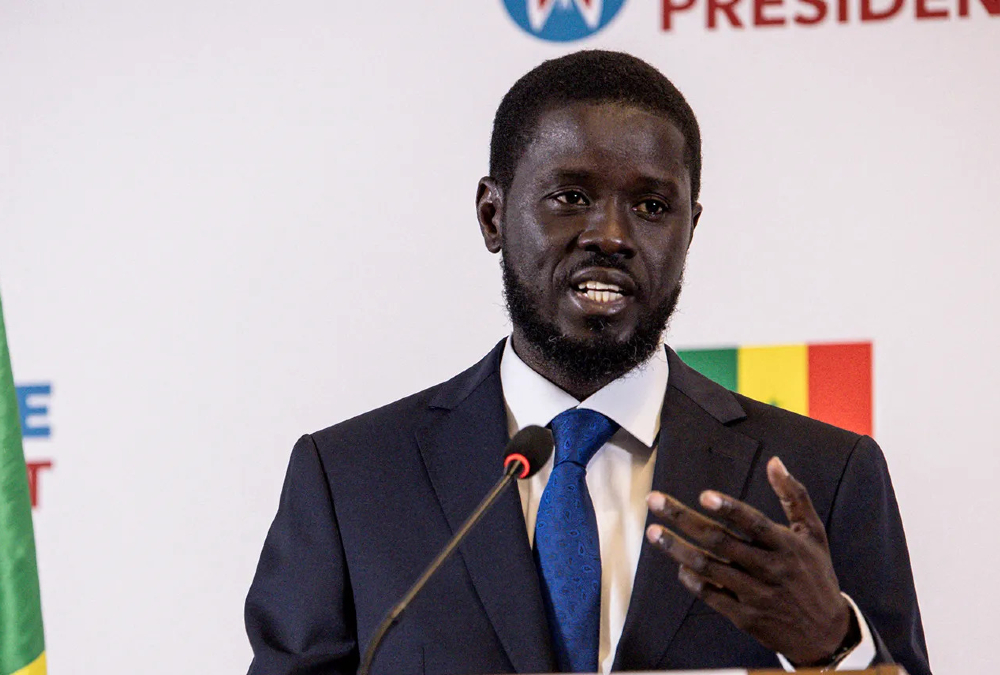
“Senegal’s orderly inauguration of President Bassirou Diomaye Faye is a victory of the democratic resilience that is needed to reverse Sahelian West Africa’s slide into chaos and prevent its vastly more disruptive spread to the five-times-more-populous West African coastal states,” he wrote. “This peaceful transfer of power, Senegal’s fourth since its independence, serves as a national rejection of former President Macky Sall’s attempt, a month ago, to unconstitutionally postpone the vote and extend his term in power.”
Not only was Faye inaugurated as Africa’s youngest elected leader as president, but the 44-year-old and previously little-known Faye completed a dramatic ascent from prison to palace within weeks. In fact, Faye was released from prison less than two weeks before the vote, along with mentor and popular opposition figure Sonko, following a political amnesty announced by outgoing President Sall. Their arrests had sparked months of protests over concerns that Sall would seek a third term in office despite term limits.
No matter how free and fair an election is held, it depends on the leaders to allow the transition.
Sany said international pressure on Sall joined with internal pressure to produce the results seen.
“While international responses have failed to seriously confront democratic erosions in many African nations, the response on Senegal was fast, firm, united and calibrated. French President Emmanuel Macron, US Secretary of State Antony Blinken and other foreign officials called Sall to urge a quick return to what the United States pointedly called ‘Senegal’s strong democratic tradition.’ The AU, EU and the U.S., all spoke in similar terms, along with West Africa’s regional bloc, the Economic Community of West African States (ECOWAS),” Sany wrote.
This situation was reminiscent of 1992 in Kenya, where international demands, joined with internal pressure from political organizations such as the Forum for the Restoration of Democracy to ensure that multiparty democracy would be allowed in Kenya.
As Sany said, this does not happen in many African nations. Uganda, next door to Kenya, was not pressured to install multiparty democracy because that government was seen as a valued ally, for example, in peacekeeping.
But will Senegal’s electoral experience really make a difference in other elections, such as in West Africa where that have been several coups in recent years? Mali has just clamped down on all political activities, and the history of coup leaders is marked by efforts to forestall elections that would see them replaced.
Internal and external pressure
One coup leader has held onto power for decades. Amnesty International has pointed out that Equatorial Guinea President Teodoro Obiang Nguema Mbasago took power on August 3, 1979 following a coup against President Francisco Masie Nguema – his uncle. Since then, the organization states, he has presided over an alarming decline in human rights, including torture, extra judicial executions, arbitrary arrests, and persecution of political activists and human rights defenders, which have been well documented by Amnesty International over the years.
Having observed elections in Equatorial Guinea and trained election observers, I have noted that the inability of opposition parties to unseat Obiang is a combination of government repression and their inability to organize coherent campaigns. Moreover, ethnicity plays a strong role in that country, as it does elsewhere, and Obiang’s Fang ethnic group has kept him in power through solidarity and superstition. Results from the 2022 elections showed Obiang with 97 percent of the vote on a turnout of 98 percent. Of course, the elections were considered a sham by international observers.
Will countries such as Chad, Guinea Bissau, South Sudan and others with upcoming elections heed the example of Senegal, or will their leaders frustrate the will of the people and prevent free and fair elections and an orderly transition of power? No matter how free and fair an election is held, it depends on the leaders to allow the transition. An opposition coalition led by Adama Barrow defeated long-time authoritarian ruler Yahya Jammeh in the presidential election of 2016, but it took the threat of force from ECOWAS for him to relinquish power.
The combination of internal and external pressure often works to encourage reluctant regimes to allow a peaceful, orderly transition. When citizens get fed up with repressive regimes and take to the streets, it can provoke change, although two conditions must prevail for this to be successful. First, the repression must not be so restrictive that protests are completely crushed. Second, opposition parties must be willing and able to organize effectively to mount a successful campaign.
As for international pressure, in the current global circumstances, Western powers must be careful and moderate in the pressure they use lest it backfire. Furthermore, double standards undermine the effectiveness of outside pressure if it is obvious that a blind eye is being turned to supposed allies while sanctions and other measures are used on those deemed not a vital to international interests.
It will be quite interesting to see how developed countries manage such situations in the currently developing world order.
Gregory Simpkins, a longtime specialist in African policy development, is the Principal of 21st Century Solutions. He consults with organizations on African policy issues generally, especially in relating to the U.S. Government. He further acts as a consultant to the African Merchants Association, where he advises the Association in its efforts to stimulate an increase in trade between several hundred African Diaspora small and medium enterprises and their African partners.
