
A Diaspora View of Africa
How France became a pariah in Africa

By Gregory Simpkins
Since the coup in Niger last month, sanctions have been levied against the new regime, borders have been closed and now that the deadline to reverse the coup has passed, there is consideration of an attack on Niger by troops from the Economic Community of West African States (ECOWAS). That may or may not take place as ECOWAS military intervention in The Gambia did in in January 2017 following long-time Gambian President Yahya Jammeh’s refusal to step down after his loss to Adama Barrow in the 2016 elections.
In this case, the Niger regime has been pledged support by coup leaders in Mali, Burkina Faso and Guinea, which could spark a regional conflict. Moreover, there is division among the ECOWAS members. According to Aljazeera, while some observers say the bloc’s hardline stance was prompted by Western allies – the United States and France in particular – ECOWAS’s moves reflect a different approach of its new chairman, Nigeria’s President Bola Tinubu, and they demonstrate the fear of member-state leaders who do not want their militaries getting their own ideas, analysts say. Military coups in West Africa used to be common and have increased lately.
“Coups are rarely carried out in isolation, especially when there are similar experiences, structures and institutions in neighbouring countries,” Afolabi Adekaiyaoja, an Abuja-based political analyst to Aljazeera.
“Militaries in the region exchange intelligence so democratic administrations are likely worried about the possibility of their soldiers engaging in similar acts.”
Despite Tinubu’s interest in reversing the Niger coup and discouraging other West African militaries from joining the current coup trend, his legislature has refused to support a military intervention. Without Nigeria or a non-African military force, an ECOWAS intervention seems ever more unlikely as of this writing.
But what is behind this increasing trend to overthrow elected governments in West Africa? Coup leaders accuse their elected superiors of governmental malfeasance and failure to successfully fend off jihadist threats. To some extent, such accusations may be true, but the governmental failures more likely are being attributed to the continuing alliance of these governments with a militarily ineffective and overbearing France.
Various books and articles have described the personal networks that underpinned the informal, family-like relationships between French and African leaders. These networks often lacked oversight and scrutiny, which led to corrupt practices that drained African resources in favor of elites and French officials. This seems more likely the cause of the current vehement opposition to France remaining engaged in the four West African countries that have experienced coups recently, and even though France is now taking a more diplomatic stance on the Niger coup, it may be too late to salvage the French relationships in West Africa.
However, the extent of the France’s refusal to relinquish its hold on African countries has not been fully or widely examined in the mainstream media.
“Colonial debt”
In the 1950s and 60s, France realized that its African colonies would eventually become independent. Although the Paris government accepted formal declarations of independence, it called on African countries to sign what some have called the “Pact for the Continuation of Colonization” or similar titles. That may not be its proper name, and some have doubted its actual existence, but the Government of Mali has just announced that it will no longer abide by this agreement, whatever it is called. The governments at that point in time agreed to introduce the French colonial currency FCFA (“Franc for the French colonies in Africa”), to maintain the French schools and military system and to establish French as an official language.
The CFA franc is today the common currency of 14 African countries members of the Franc zone. This currency, which hampered the economic independence of these countries, was created in 1945, when France ratified the Bretton Woods agreements and proceeded to implement its first declaration of parity to the International Monetary Fund (IMF). This has been recognized by the international community since then.
Under this arrangement, the 14 African countries are still obliged to store about 85 percent of their foreign exchange reserves at the Banque de France in Paris, where they are under the direct control of the French Treasury. The countries concerned do not have open access to this part of their reserves. Obviously, 15 percent of reserves are insufficient for their needs, so they must borrow additional funds from the French Treasury at market prices. Since 1961, Paris has controlled the foreign exchange reserves in Benin, Burkina Faso, Guinea-Bissau, Ivory Coast (Côte d’Ivoire), Mali, Niger, Senegal, Togo, Cameroon, Central African Republic, Chad, Congo, Equatorial Guinea and Gabon.
Moreover, these countries must each year transfer funds to pay their “colonial debt” for infrastructure built in these countries by France during colonial times to Paris as the website Silicon Africa has reported in detail. France takes about 440 billion euros (US$480 billion) a year from African governments. However, one must ask how much infrastructure France built in these countries, which are still poor after all this time and lacking in roads, power generation and transportation options. More than seven decades later, how long will it take to repay France for whatever it says did to provide infrastructure in its former colonies?
The government in Paris also has a right of first refusal on all newly discovered natural resources in African countries. Finally, French companies must have priority in awarding contracts in former colonies. As a result, most African assets in the fields of supply, finance, transport, energy and agriculture remain in the hands of French companies.
Two declared independent African banks – Banque des Etats de l’Afrique Centrale (BEAC) and Banque Centrale des Etats de l’Afrique de l’Ouest (BEACO) have in practice no monetary policies of their own. The countries themselves reportedly have not known, nor have they been told, how much of the pool of foreign reserves held by the French Treasury belongs to them as a group or individually.
I cannot confirm these policies firsthand, but I can say that I saw a direct confirmation of the lack of independence by an African financial institution. During a meeting with the head of the Bank of Africa in Bamako, Mali, in 2003, we discussed how Mali institutions could be structured to take greater advantage of the African Growth and Opportunity Act (AGOA). He listened carefully and then excused himself to go into another room for consultations. We found out later that he felt it necessary to discuss the matter with a French “counselor” who had not been publicly introduced as being influential in bank business. Apparently, it was preferred that he operate behind the scenes.
For years, former African Union (AU) Ambassador to the United States Arikana Chihombori Quao has railed against French neocolonialism in West Africa. Unfortunately, it would seem that her criticism fell more heavily on African leaders who she was seen as inadvertently portraying as stooges of France even though the current leaders didn’t initiate the continuing neocolonial system.
Assassinations and coups
The ruling elite in each African country still must fulfill these compulsory claims seemingly without any other choice since this system has been ingrained and widely accepted for decades. Would an international court support the abrogation of this arrangement? After all, the international community has watched this situation with little if any criticism since the beginning of the end of colonialism in Africa, and again, the mainstream media has not seen fit to explore this matter often or at all.
African leaders who have refused this arrangement were said to have been threatened with assassination or their government overthrown. Over the past 50 years, there have been 67 coups d’état in 26 African countries. Sixteen of these 26 countries were former colonies of France.
An example presented by Silicon Africa is the first president of Togo West Africa, Sylvanus Olympio, who was overthrown by a coup after he refused to sign the pact with France and decided to replace the CFA with his own currency. He objected to France’s insistence that Togo pay the compensation for the infrastructures that the French said they had built during the colonial period. The sum was equivalent to about 40 percent of household wealth in Togo in 1963, requiring the newly independent country to reach its economic limits quickly.
Three days after Olympio’s action, the new government was overthrown by a group of former foreign legionaries, and the President was killed. The head of the legionaries was Gnassingbé Eyadema. Four years later, Eyadema was promoted with the support of France as the new president of Togo. His reign in this West African country was protected by France and continued until his death in 2005.
It is estimated that France now holds hundreds of billions of African countries’ monies in its treasury and apparently will do anything to keep it. Moreover, the African countries do not have ready access to their own money. In addition, France places a limit on the amount of money the countries may borrow from the reserve. The limit is fixed at 20 percent of their public revenue in the preceding year.
If the countries need to borrow more than that, France routinely vetoes it. The former President of France, Jacques Chirac, reportedly said,
We have to be honest and acknowledge that a big part of the money in our banks comes precisely from the exploitation of the African continent.
This is a remarkably arrogant statement from a former French official who has acknowledged the vital role Africa has played in the survival of France.
Global Times reported in a 22 October 2022 article the March 2008 quote by Chirac who was said to have remarked:
Without Africa, France will slide down into the rank of a third world power.
In that same article, Chirac’s predecessor, François Mitterand, had been quoted in 1957 as saying that:
Without Africa, France will have no history in the 21st century.
As unbelievable as such statements seem, I recall during my time working in Congress that if not for U.S. airlift, French forces would not have been able to respond to the crisis in Mali in 2012 despite the critical impact such a situation could have on French interests, despite the tremendous amount of African currency at its disposal.
“Anyone but France”
The Committee for the Abolition of Illegitimate Debt, in a 26 April 2021 article, wrote that current French President Emmanuel Macron has made three adjustments to the current arrangement with former African colonies (but only for the West African countries involved, not those in Central Africa): the first is the name of the currency (it is now called the “eco”), the second is that French representatives will no longer sit in the bodies of the Central Bank of West African States and the third is the removal of the obligation to deposit at least 50 percent of foreign exchange reserves into the French Treasury.
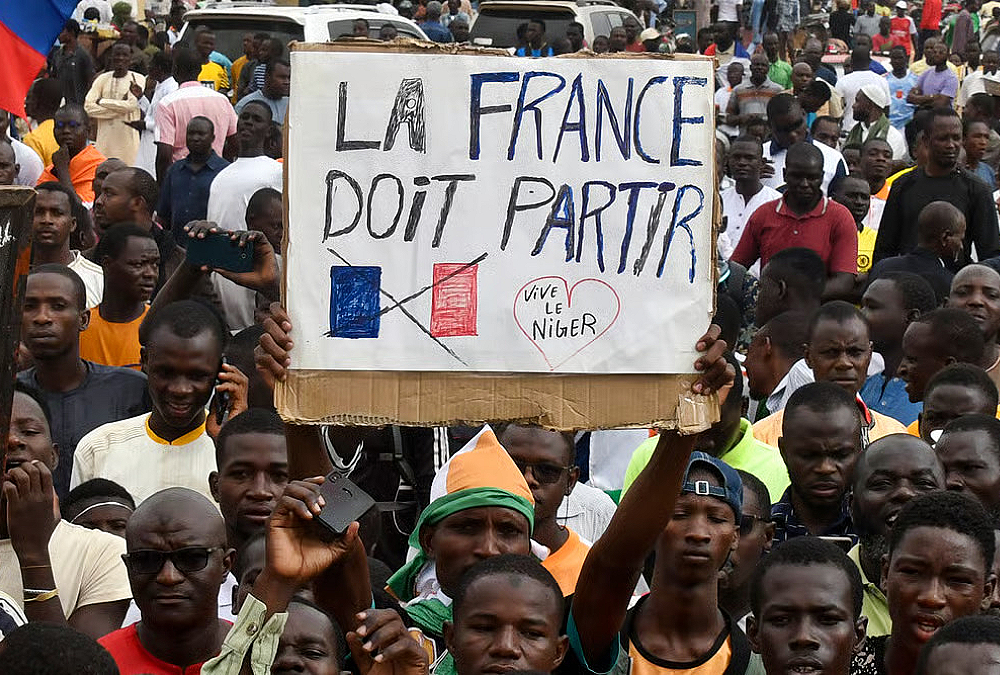
Given all the efforts France has taken to maintain its hold on its former African colonies, it puts the current trend of replacing governments that continue the French alliance in context despite the recent adjustments. Certainly, the Wagner Group, as the stalking horse for Russia, has inflamed African opposition to French neocolonialism, but the heavy-handed French domination of former African colonies over several decades as described earlier has created its own residual hatred in these countries without any outside encouragement. One should look at the attacks on French embassies and the flying of Russian flags as a situation of “anyone but France.”
The situation puts the United States in a difficult position as an ally of France and countries in West Africa. The United States is still seen favorably in countries with which it has partnered in the fight against jihadist violence, has a major military installation in Niger and more than a thousand American troops on the ground. Any conflict or effort to help France maintain its position in these countries could make life difficult for Americans there.
Gregory Simpkins, a longtime specialist in African policy development, is the Principal of 21st Century Solutions. He consults with organizations on African policy issues generally, especially in relating to the U.S. Government. He also serves as Managing Director for the Morganthau Stirling consulting firm, where he oversees program development and implementation. He further acts as a consultant to the African Merchants Association, where he advises the Association in its efforts to stimulate an increase in trade between several hundred African Diaspora small and medium enterprises and their African partners.
