
Opinion
Haiti is not “in Crisis.” Haitians are fighting for governmental accountability
By Cécile Accilien and Randal Maurice Jelks
When Haiti makes the headlines of The New York Times, it is always in “crisis.” The recent story written by Kirk Simple is headlined “‘There is No Hope’: Crisis Pushes Haiti to Brink of Collapse.” However, the article fails to decipher just who and what is behind the crisis. Instead, Haiti’s citizens come across as simply some “ungovernable” and “irrational” Black people, just like those in many other majority Black, particularly African, countries are frequently depicted. This is a problem more broadly in American news outlets in their representations of Black-led nations like Haiti, and as media watchdogs point out, is not a new phenomenon.
Haiti’s representation is not fully contextualized as being a part of the ongoing democratic struggles occurring throughout the Americas – Argentina, Bolivia, Brazil, Chile, the United States and Venezuela. Haiti is not alone in its “crisis.”
Haiti is one of the oldest democracies in the Americas. It is only three-and-a-half hours from the U.S. shore. The 2 countries share a long and complicated history, including the Louisiana Purchase that resulted in the western expansion of the U.S. This was a direct result of Haiti’s fight for independence from Napoleonic France. In 1804, Haiti became the first Black-led republic in the Western Hemisphere.
However, the United States has always been troubled by Haiti as a Black independent nation. This began with the country’s eradication of slavery. Further, most Americans are ignorant to the fact that the United States occupied Haiti from 1915-1934 and has been one of the country’s neocolonial overlords alongside France.
It’s only when it’s convenient that the United States, Canada, France and other powers claim that they do not want “to meddle in Haiti’s democratic process.” Yet there is a history of constant meddling by the United States and France in the support of corrupt politicians through fraudulent elections. In Silencing the Past: Power and the Production of History, anthropologist Michel-Rolph Trouillot has written that “the past does not exist independently from the present. Indeed, the past is only past because there is a present.”
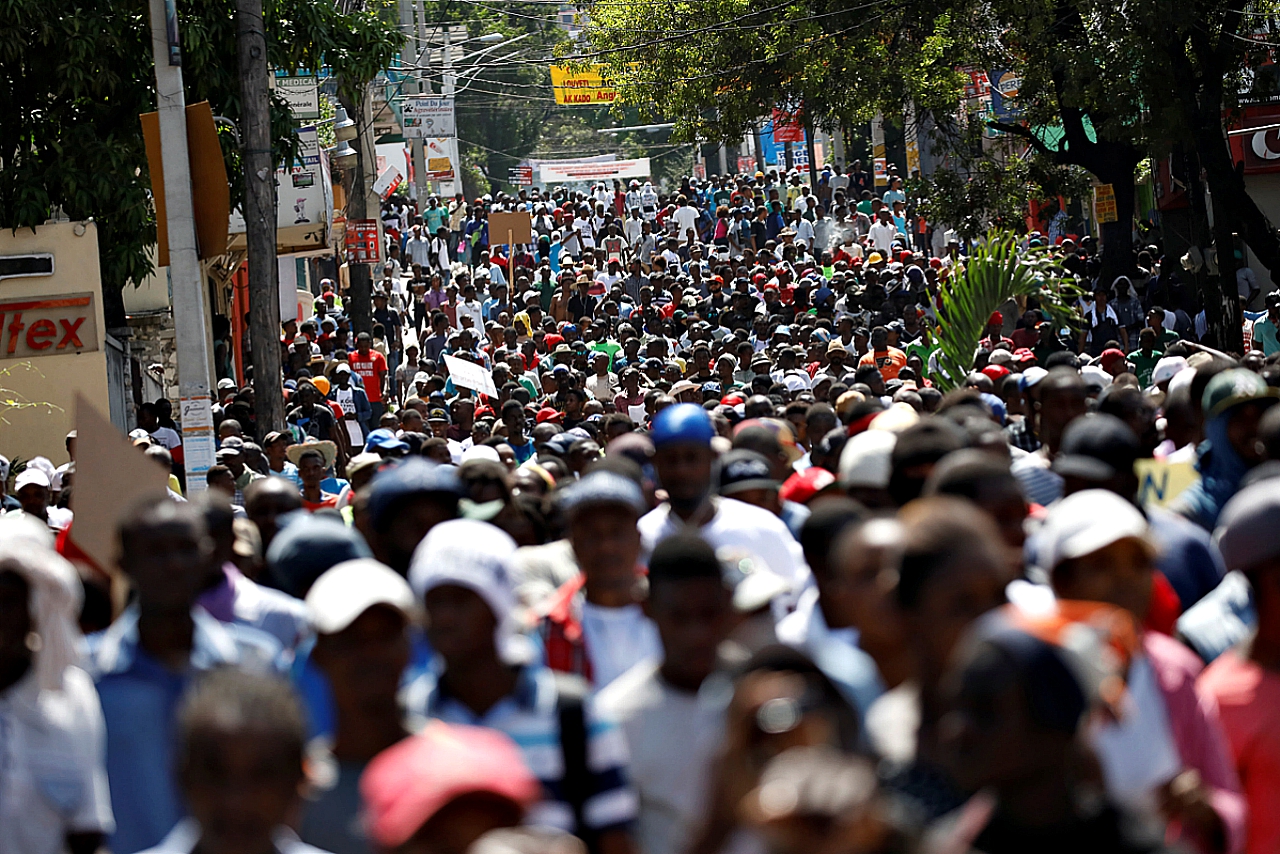
For weeks Haiti has been on lock down, or peyi bloke, as it is called in Haitian Creole. There have been several statements by professors at the Université d’ État d’Haïti who have demanded that President Jovenel Moïse step down. Haitian political activists have consistently called for a thorough investigation into the more than tens of millions misappropriated from the PetroCaribe fund, an oil alliance and economic cooperation fund between Caribbean countries and Venezuela.
Cleverly, Moïse has asked for foreign aid for famine relief from the United Nations. However, many Haitians have concluded that this is a political tactic to protect himself from being held accountable. Unfortunately, Moïse has self-servingly played into the stereotype of Haiti being a “shithole” of a country. As a result of his political manuvering, peaceful protests ensued to no avail before the current “crisis.”
In Haitian politics, politique de doublure refers to the various powers that control the country but hide their influence. Haiti, like the United States, is corrupted by a government whose only agenda is to serve the wealthy and foreign investors that include the United States, Canada and France – none of which seem interested in the actual lives of the Haitian people.
Haitians are not victims who are unable to speak for themselves. They have taken to the streets demanding governmental accountability. We stand in solidarity with all Haitian citizens who demand more transparent and democratic governing processes.
We also demand that the reporting by The New York Times and other news outlets provide more contextualization for the current state of affairs in the country. Haiti is not a racially exotic country; it is a small yet important Caribbean nation. It is a bellwether as to what is occurring throughout the Americas. We believe as scholars and intellectuals that responsible journalism must be employed when reporting on Haiti’s current struggles.
Cécile Accilien is interim chair of the African and American Studies Department, director of the Institute of Haitian Studies, and associate director of the Center for Latin American and Caribbean Studies at the University of Kansas, while Randal Maurice Jelks is professor of African and African American studies and American studies at the University of Kansas.
Truthout © Copyright 2019
