
Opinion
Funding Africa’s Scientists to Build Its Future
Africa’s industrialization and economic sovereignty depend on shifting capital from political patronage to patient funding for scientists and value-added production.

By Apollo Buregyeya
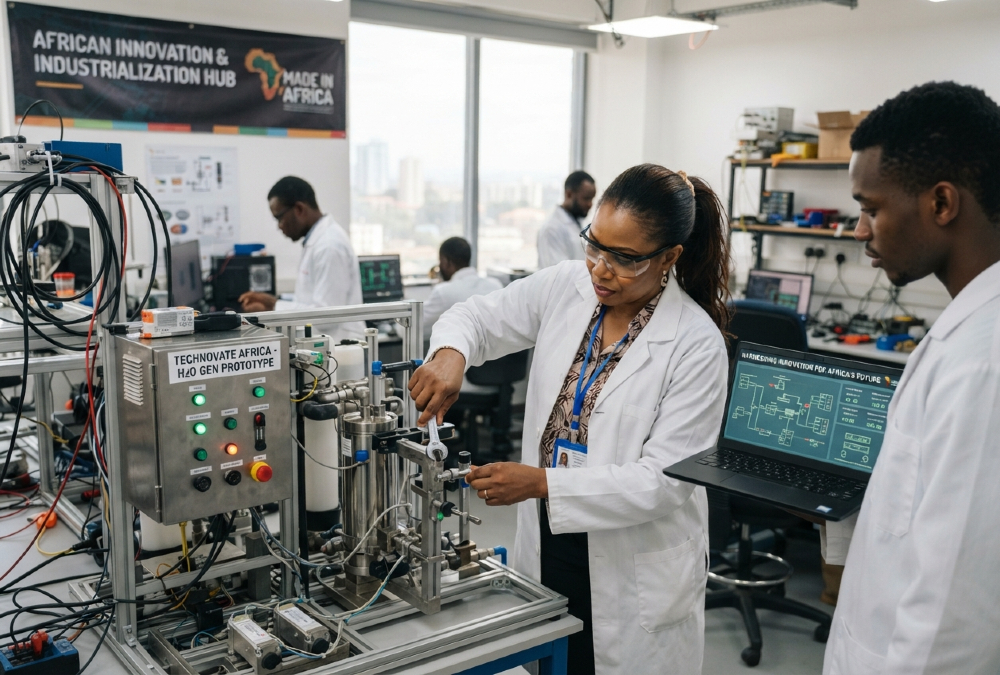
Walk into almost any university laboratory in Africa and you will meet the same tragedy. A chemist has designed a cheaper way to process shea butter, a metallurgist knows how to refine the ore that leaves the country as raw rock, and an engineer has sketched a solar-powered irrigation pump that a smallholder could actually afford. What they lack is not talent. It is a furnace, a reliable power supply, a few thousand dollars of reagents, and a financier willing to wait.
An idea needs equipment, materials, skilled hands, time, and money that can bear to wait. You cannot run a laboratory on patriotic speeches.
What a Society Chooses to Reward
Consider who in Africa raises fortunes with ease. Politicians do, as do pastors and, in some places, generals. Scientists struggle to equip a single bench. That says something uncomfortable about what our societies value. The ability to win votes, fill a cathedral or command a barracks is a real skill, but it does not amount to knowing how to organize production. Too often, the people who know how to build cannot find capital, while the people who control capital have never organized a production line and have little patience for those who have.
The result is a continent that sits on some of the world’s richest endowments of minerals, arable land and young people, and still imports much of what it consumes, from pharmaceuticals and fertilizer to the steel in its own bridges. A mineral deposit is only an opportunity. Turning it into a competitive product requires knowledge, machines, reliable processes, skilled workers and customers. The wealth beneath our feet needs the intelligence above it.
What Industrialization Really Takes
Industrialization is often mistaken for a ribbon-cutting at a factory. It is something harder. It means weaving engineering, energy, knowledge, institutions, labor, finance and markets into systems that produce more value than they consume. A plant without dependable electricity is a monument. A workshop without a link to a university is a dead end. A promising start-up without patient capital is a casualty waiting to happen.
The honest test of an industrial policy is therefore not how many factories it opens but what it teaches a country to do. Does it produce better products, stronger local firms and skilled jobs? Does it raise rural incomes? Does it leave behind technologies that Africans can maintain, adapt and improve themselves? The real prize is not the factory but a society that keeps learning how to produce.
The Chinese Lesson, and its Limits
It is tempting to look east for a shortcut, and the biographies are striking. Jiang Zemin trained as an electrical engineer. Hu Jintao studied hydraulic engineering, and Xi Jinping studied chemical engineering at Tsinghua University. By most accounts, every member of the Politburo Standing Committee that took office in 2002 had a background in engineering or geology. In China, technical training could carry a person to the summit of state power.
But the degrees were only part of the story, and it would be a mistake to treat them as the secret. China’s transformation also rested on market reforms, vast infrastructure, a thriving class of entrepreneurs, foreign investment, aggressive technology learning and access to global markets. Knowledge became productive because firms, institutions and webs of suppliers learned to manufacture and then kept getting better at it.
The lesson for Africa is subtler and more demanding. A country serious about development reveals it in three places: who makes the decisions, what gets funded, and what the nation learns to make. Leaders in charge of industrialization need to understand production well enough to ask the right questions. What can we make competitively? What must we learn? Where will the energy come from? Who will buy the product? The answers should shape budgets, appointments and institutions, not merely speeches.
From Raw Materials to Real Products
For Africa, moving beyond raw materials means learning to make tools, machines, industrial chemicals, components and finished goods. It means connecting farmers to processing plants, workshops to engineering knowledge, universities to manufacturers, and promising enterprises to patient capital. Above all, it means giving scientists and engineers room to experiment, fail, improve and eventually compete.
That last point is the most neglected. Failure is the price of learning, and every industrial economy has paid it many times over. A financial culture that punishes every failed prototype will never produce a successful product. African banks, which prefer to lend against land titles and government contracts, are poorly suited to this kind of risk. Governments, development banks, pension funds and diaspora investors will have to fill the gap with long-horizon money that treats a decade as a reasonable time to wait.
Uganda’s Tenfold Test
Uganda offers a useful case. Its Tenfold Growth Strategy sets an ambitious goal: to grow the economy from about US$50 billion to US$500 billion by 2040. The country has a strong starting point in its minerals, its land and its young population. But resources do not turn themselves into products. The target will be reached only if Uganda produces and keeps the engineers, chemists, geologists, technicians and entrepreneurs who can convert those resources into goods the world will buy, and only if patient capital gives their ideas time to mature.
The arithmetic of research spending is sobering. Uganda invests about 0.44 percent of GDP in research, and the national plan already aims to raise that figure. Many African governments have also pledged, under African Union commitments, to reach 1 percent of GDP. Pledges are cheap, however, and disbursement is not. A country that wants to grow tenfold cannot fund its laboratories like an afterthought.
The Means To Build
The question in the headline is not rhetorical. Someone must supply the means, and the candidates are plain enough: finance ministers who treat research as an investment rather than an expense, banks and investors willing to back technical founders, universities that partner with manufacturers, and citizens who decide that engineers deserve at least the esteem we reserve for evangelists and politicians.
Africa does not have a shortage of dreamers. It has a shortage of builders who are funded, trusted and allowed to fail forward. Our scientists can dream. If we are serious, we will give them the means to build.
Apollo Buregyeya, Ph.D., is a civil engineer and entrepreneur focused on developing sustainable African industries that leverage local mineral resources to improve living standards. He is the founder and CEO of Eco Concrete Ltd, a construction company specializing in innovative solutions tailored to the African environment. Committed to resource ownership and appropriate technology for value creation, he also teaches at Makerere University in Kampala, Uganda.
