
Editorial
The Even-Bigger Crisis of Africa’s Intellectual Elite
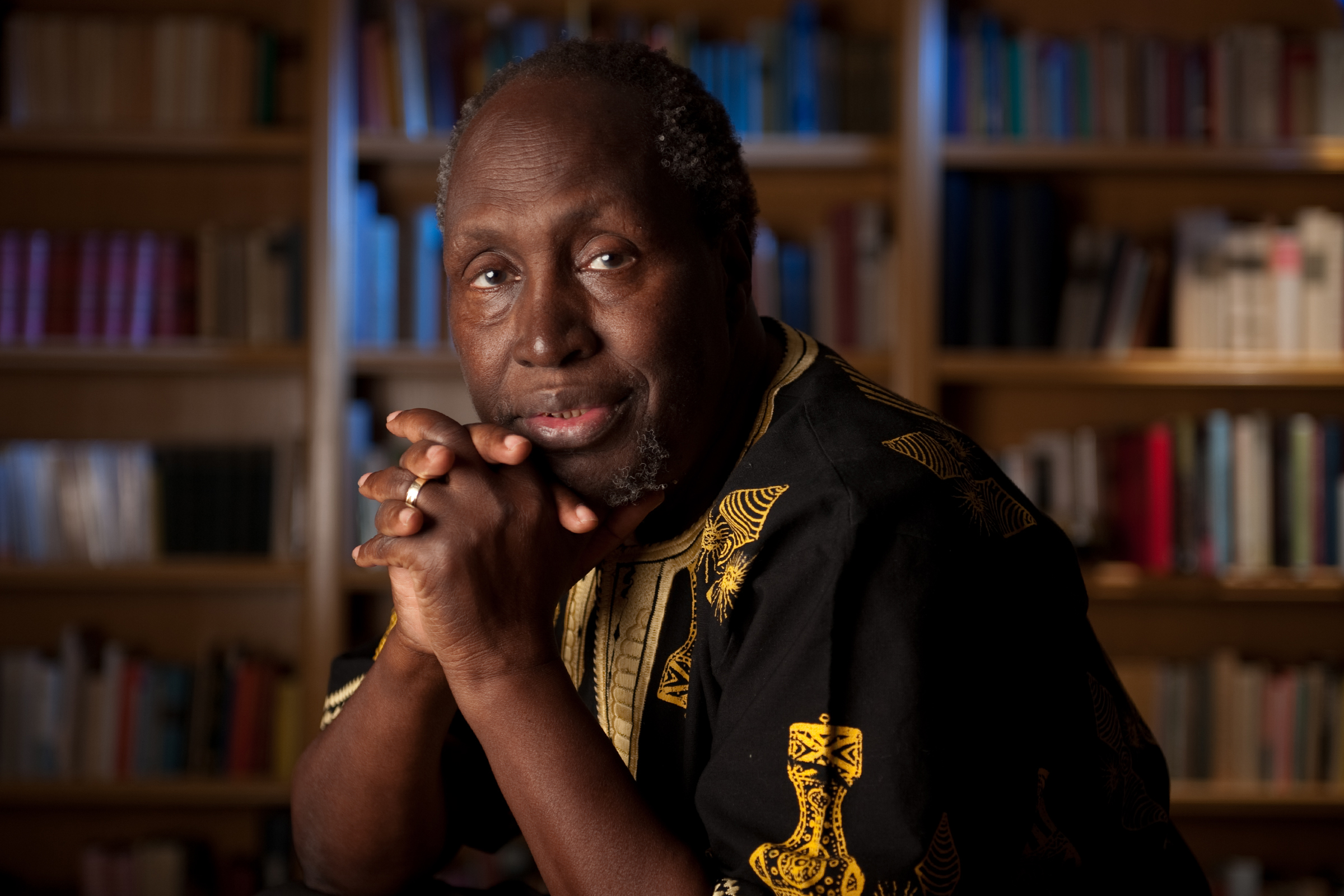
Kenya’s Ngugi wa Thiongo
Africa’s best and brightest ought to be very afraid. In 2015, many of us – writers, theorists, exemplars, journalists, editors, inventors, university professors and bureaucrats – could, in ensnaring ourselves to intellectualism, slip further into irrelevance, which has real life consequences for our continent. But let me back up a little bit: In this day and age of social media and cultural phenomenon, we, amazingly, still defer to intellectualism; a Bounderby-esque sentiment that compels Africa’s foremost thinkers to quote from supposedly rational thinkers – Nietzsche, Marx, Gramsci, Machiavelli and Madison. Perhaps, we hope to show that our theory and actions are based on facts, more facts, and only facts.
However, these are the facts: We, supposed intellectuals, wholesomely lap up James Madison just because he, in 1878, led the writing of the U.S. Constitution; misremembering that then, the population of the United States was rag-tag collection of less than 10 million people. We idolize Nietzsche because philology and existentialism are cool; not really thinking that much of his work was redacted to fit another’s philosophy. We are as misled as Josef Stalin in drinking Machiavelli’s bile, ignoring Machiavelli’s subliminal warning that he wrote his leadership manual as a way to save his own neck. And yet, the world celebrates a great many of us as African intellectuals. The world does not realize that in following this path, we are, basically, condemning our own African societies to perpetual imprisonment.
I am not, in anyway, dismissing great thinkers, writers or philosophers: James Madison just as deeply influences me, as does the gone-too-soon Nat Nakasa. Amongst those that filled my formative years with awe are Franz Fanon, Hans J. Morgenthau, Ngugi wa Thiongo, John Steinbeck, Chinua Achebe, Arthur Koestler and Lewis Carroll. Closer to home, I really liked Yoweri Museveni’s Sowing the Mustard Seed until he reinvented himself; on top of admiring Andrew Mwenda’s uncanny ability to process and churn huge amounts of information, you’d envy me for the insight I owe to minds of Timothy Kalyegira and Charles Onyango Obbo. So, I’d be going against my own people if I turned around and treated these great men with disdain.
But if we are going to save Africa, it behooves us, so-called African intellectuals, to, first of all not refer to philosophers or worldly intellectuals with the reverence we currently reserve for them. There’s no need to disparage anyone; instead, we must vigorously question their premises and contextualize their very circumstances. We must not allow them to loom as large as they did in the past and to replace this huge space they leave for us, it might be time for a little innovation on our parts – home grown wisdom, so to speak. Secondly, we must start to realize that the West is neither our friend nor our foe. Different regions can either be allies today or not. It gets even more complicated since its no longer ‘the enemy of my enemy is my friend.’ Today, everyone is a friend and every one is an enemy – and everyone is both at the same time since anyone can come to represent their country on social media and the world wide web if they loom large enough.
Besides, we are not as fortunate as our western colleagues. The intellectual elite in Europe and the United States can afford to choose and quote any idiot or knave from their past, and temporarily shake their societal zeitgeist – Barack Obama did something like this. – but when we Africans do this, we do not have the luxury of context. Madison did not write for Mauritania, Morocco or Madagascar. He wrote for the United States, and his words are almost right and fitting for THAT society. Thus, when Africans quote Madison for an African audience, we do not have the same trajectory: We can only quote out of context –ultimately ensuring that our readers and the influenced are further yoked to philosophy that is not necessarily ours.
Dennis Matanda, Editor
The Habari Network
January 12, 2015
