
A Diaspora View of Africa
Emerging World Order and Accountability

By Gregory Simpkins
The seismic shift in the world order is causing many economic and political changes. The determination to replace the U.S. dollar as the world’s reserve currency is just one example, but it is not the only one. Among African leaders, there has been a growing tendency to call out Western powers for their past violations of human rights and their modern manipulations in Africa to discredit any support of Israel in the conflict in Gaza.
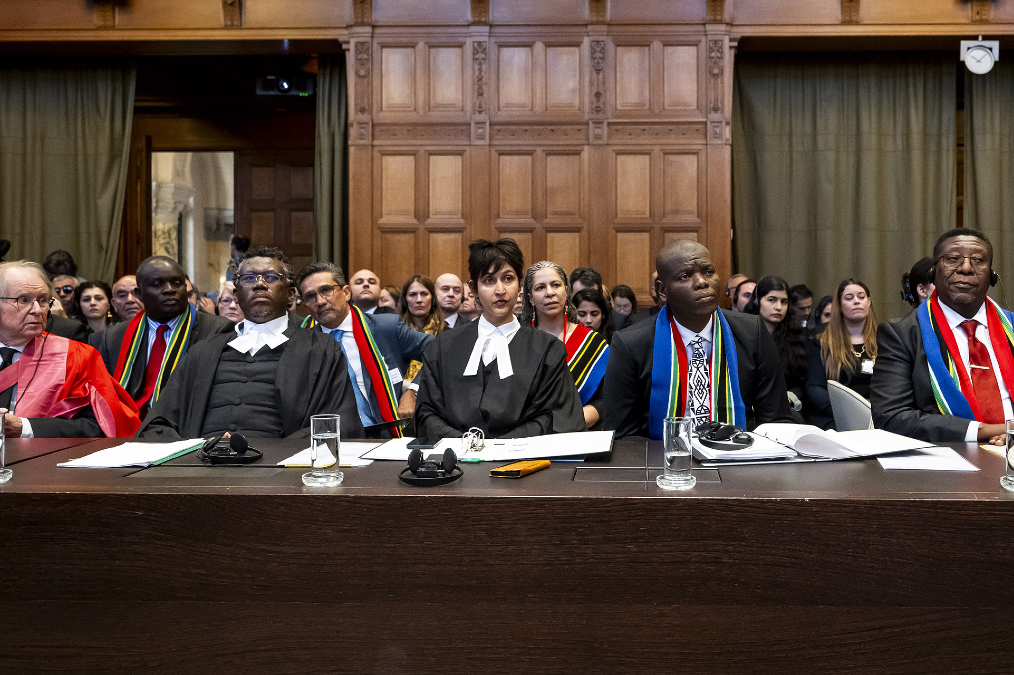
South Africa filed a genocide suit against Israel for its war in Gaza, and there are elements in that country that want to extend the legal action to the United States and the United Kingdom for complicity in genocide for supporting Israel’s response to the October 7 attack by Hamas.
No reasonable, humane person would want to enthusiastically support a conflict in which thousands of innocent Palestinian civilians are being killed. However, where is the African condemnation for the brutal Hamas attack and the continued imprisonment of Israeli and civilian hostages from other nations, not to mention the longtime location of Hamas military facilities in or near schools, hospital and residences?
Has there been a call for a Hamas effort to evacuate civilians from what they knew would be a war zone, especially in light of repeated Israeli warnings before their attack was launched? And what proof is thee that Israel is specifically trying to eliminate the Palestinian people, which is the predicate for a charge of genocide?
One can point to numerous Western violations of human rights in Africa. Some on the continent are now using Germany’s past human rights violations in Namibia to impugn their stand with Israel in its conflict in Gaza, but Germany has repented of their human rights violations from more than a century ago. As reported by the Associated Press on May 28 2021, Germany reached an agreement with Namibia that to officially acknowledge as genocide the colonial-era killings of tens of thousands of people and commit to spending in that country a total of US$1.3 billion, largely on development projects.
The accord was the result of more than five years of talks with Namibia on the events of 1904–1908, when Germany was the southern African country’s colonial ruler. Historians say German Gen. Lothar von Trotha, who was sent to what was then German Southwest Africa to put down an uprising by the Herero people in 1904, instructed his troops to wipe out the entire tribe. They say that about 65,000 Herero were killed and at least 10,000 Nama.
This criticism of Germany for its support of Israel also ignores the remaining guilt Germans feel for the holocaust against Jews that killed an estimated six million people, including others such as Gypsies.
If we are to hold nations responsible for genocidal behavior in perpetuity, then who would be eligible to speak out against genocide? If you look far enough in the past, most nations have done shameful things to eliminate ethnic or religious groups, such as the actions past United States governments took against the Native Americans – expelling them from the lands on which they lived, killing many and using schools to strip their tribal culture from their young people.
One cannot say this has been totally remedied nor has the remnants of the chattel slavery of Africans in America that ended more than a century ago, but hasn’t there been enough movement in those directions to credit American policies as no longer supporting genocidal practices?
Contradictionary views on genocide
Israel is a prime example of conflict being halted in the short term without a comprehensive effort to bring these conflicts to a lasting, satisfactory conclusion. The United Nations has accused Israel of occupying Gaza and oppressing the Palestinian people because Israel tightly controls its border with Gaza and restricts movement into Israel and controls the airspace and coastline of Gaza.
But is this a sign of trying to eliminate Palestinians? Isn’t it more likely a protective measure to prevent terrorists from infiltrating into Israel or receiving weapons that could be used to attack that country – both of which have actually happened?
One must ask why countries in the Middle East haven’t worked with Western supporters of Israel to bring to a halt the repeated Hamas and Hezbollah attacks on Israel. The true acceptance of a two-state solutions should end the tensions that repeatedly lead to conflict, but genuine support for that has not been forthcoming.
Africans are well justified to criticize Western nations for discounting the suffering of people in developing countries, often at the hands of their governments, such as France’s predatory economic policies
Countries such as Iran use the ongoing Palestinian conflict as a political weapon against the United States and Israel that they call the ‘Big Satan’ and the ‘Little Satan’. Support for the October 7 attacks surely was not aimed at fighting a war to liberate Gaza.
Not only was there no second level military effort, but the rhetoric from Hamas and their international supporters continues to speak of the elimination of the State of Israel. “From the river (Jordan) to the sea (Mediterranean)” is simply a call to eliminate Israel from the map. How is that intended to facilitate a lasting peace?
Africans are well justified to criticize Western nations for discounting the suffering of people in developing countries, often at the hands of their governments, such as France’s predatory economic policies and ineffective anti-terrorist response that seemed more attuned to protecting France from the migration of potential terrorists to its territory than in protecting African citizens. However, there is question about the real African opposition to genocide and war crimes by their allies.
There are too many reports to ignore about China being engaged in genocide against the Muslim Uyghurs in Xinjiang Province. Beginning in 2014, the Chinese government incarcerated more than an estimated one million Turkic Muslims in internment camps with no legal process. The Chinese government reportedly began to wind down the camps in 2019. According to Amnesty International, detainees have been transferred increasingly to the formal penal system.
Reports from sources such as varied as the Brown Journal of World Affairs, The New Yorker, the Journal of Genocide Research and the Congressional Research Service, attest to the arbitrary detention of Uyghurs in state-sponsored internment camps.
Chinese government policies have included forced labor, suppression of Uyghur religious practices, political indoctrination, forced sterilization, forced contraception and forced abortion. Experts estimate that, since 2017, some sixteen thousand mosques have been razed or damaged, and hundreds of thousands of children have been forcibly separated from their parents and sent to government-run boarding schools. Chinese government statistics reported that from 2015 to 2018, birth rates in the mostly Uyghur regions of Hotan and Kashgar fell by more than 60 percent. In the same period, the birth rate of the whole country decreased by 9.69 percent.
Vital economic relations
Nevertheless, despite these reports and numerous articles in the international media, African governments have not only refused to call out China for genocide against the Uyghurs, but some have signaled approval of their human rights practices. In July 2019, several African governments, including several African countries, including Algeria, the Democratic Republic of the Congo, Egypt, Nigeria and Somalia, signed a letter that publicly praised China’s human rights record and dismissed reported abuses in Xinjiang, according to a 15 July 2019 report in The Diplomat.
Other African countries, including Angola, Burundi, Cameroon, the Central African Republic, Madagascar, Morocco, Mozambique and Sudan signed an October 2019 letter that also publicly expressed support for China’s treatment of Uyghurs.
Is positive African economic relations with China so vital that these governments must not only ignore Chinese human rights violations against Uyghurs but also vouch for China’s observance of human rights against this Muslim minority?
The continuing call for a cease-fire is understandable, but unless there is a concerted effort to find and secure a lasting peace between Palestinian leadership and Israel, it will be only a temporary respite.
Similarly, African governments have often avoided criticizing Russian human rights violations. When the United Nations took up the issue of condemning this Security Council member for the invasion of Ukraine in March 2022, only 28 of 54 African members voted in favor of the condemnation.
Seventeen African governments abstained, 8 did not submit a vote and Eritrea was the sole Africa government voting against the resolution. Certainly, many African nations depend on Russia for imports such as grain and fertilizer, as well as weapons. Yet is this harmonious trade relationship sufficient to justify turning a blind eye to human rights abuses in Ukraine?
Human Rights Watch has reported that since Russia’s full-scale invasion in 2022, its war against Ukraine has had a disastrous impact on civilian life there, killing thousands of civilians, injuring many thousands more and destroying civilian property and infrastructure.
Russian forces committed a litany of violations of international humanitarian law, including indiscriminate and disproportionate bombing and shelling of civilian areas that hit homes and healthcare and educational facilities. The human rights organization called for Russian actions to be investigated as war crimes.
Human Rights Watch also stated that in areas they occupied, Russian or Russian-affiliated forces committed apparent war crimes, including torture, summary executions, sexual violence, enforced disappearances and looting of cultural property. Those who attempted to flee areas of fighting faced terrifying ordeals and numerous obstacles; in some cases, Russian forces forcibly transferred significant numbers of Ukrainians to Russia or Russian-occupied areas of Ukraine and subjected many to abusive security screenings.
Where is the organized African outrage over Russia’s actions in Ukraine, another nation that has been a major trading partner?
Without question, African governments should point out hypocrisy and predatory actions by members of the international community, but singling out Israel is hypocritical on their part if they cannot condemn China and Russia for their genocidal actions and war crimes.
Israel has long been a whipping boy, so to speak, of the United Nations for its actions involving Palestinians, but there is no evidence that it is trying to eliminate the Palestinian population, especially since an estimated 40 percent of that country’s population is Palestinian, many of whom are in government or who hold important positions in civilian life.
The continuing call for a cease-fire is understandable, but unless there is a concerted effort to find and secure a lasting peace between Palestinian leadership and Israel, it will be only a temporary respite. If Israel stopped its invasion of Gaza and even lifted its control of Gazan airspace and seacoast, what guarantees can anyone give that Hamas aggression toward Israel will end? If that cannot be achieved, we will only be temporarily silencing the gunfire and bombings that likely will pick up again in short order.
This murderous carousel must end.
Gregory Simpkins, a longtime specialist in African policy development, is the Principal of 21st Century Solutions. He consults with organizations on African policy issues generally, especially in relating to the U.S. Government. He further acts as a consultant to the African Merchants Association, where he advises the Association in its efforts to stimulate an increase in trade between several hundred African Diaspora small and medium enterprises and their African partners.
