
Editorial
Democratic Republic of Congo – A Historical win for the Opposition
By Dennis Matanda
Editor-in-Chief | The Habari Network
An Interview with Prof. David Kiwuwa, Associate Professor in International Studies, University of Nottingham, Ningbo China.
Full Disclosure: A few weeks ago, I volunteered to serve on the Tshisekedi Transition as a strategist. My key responsibilities are to support the new President’s U.S.-based team in various capacities. On the other hand, Prof. Kiwuwa and I have been very good friends for over 25 years now.
Robbinsville, NJ | I call David at precisely 3:00 am EST. He picks up on the first couple of rings and compliments me on my alertness at such an ungodly hour. My response is that democracy and the fight for human security in Africa does not rest. He laughs and says something to the effect that the recent election in the Democratic Republic of Congo (D.R. Congo) is a significant contribution to this fight.
I agree, and we launch into the taped conversation. In this transcription, the interviewee is Prof. Kiwuwa, and the interviewer is The Habari Network’s Dennis Matanda (DM).
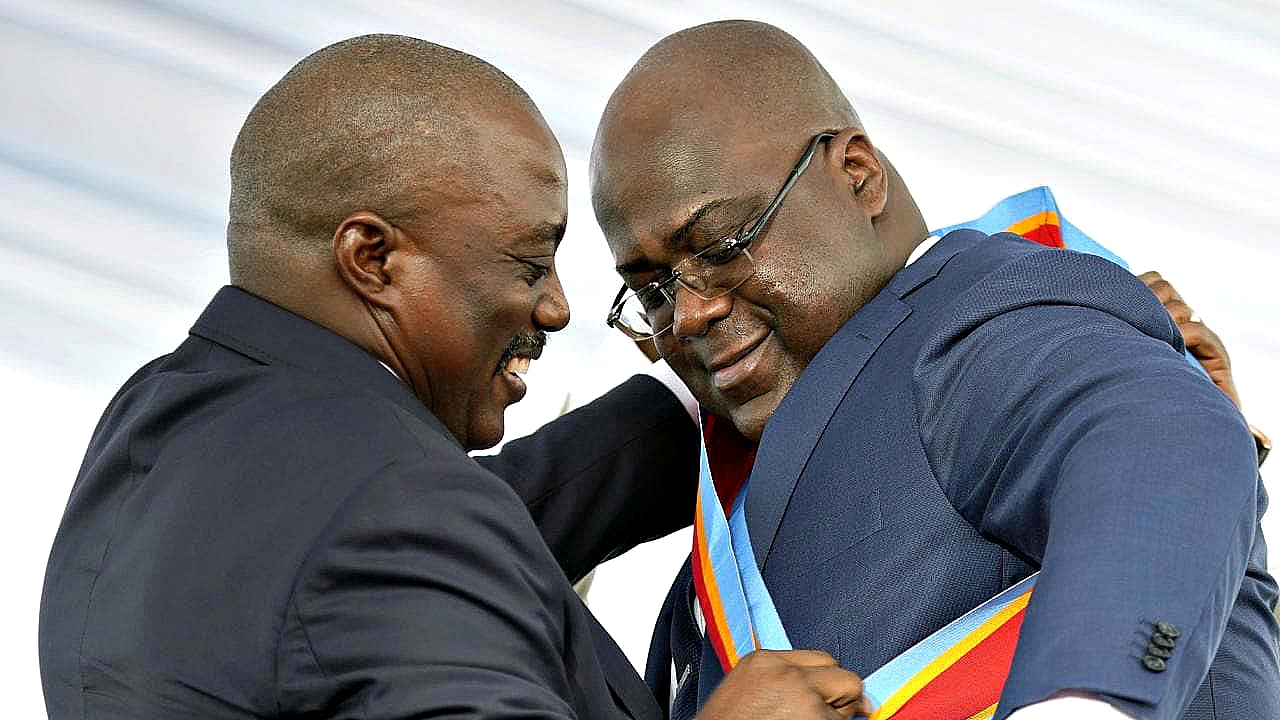
DM: David, thank you for taking the time to speak with me about the very recent inauguration of Felix Tshisekedi as President of the Democratic Republic of Congo.
Prof. Kiwuwa: It is my pleasure, Dennis. And for the record, it is quite timely that we are talking about the D.R. Congo, considering what is going on in Gabon.
DM: But what do the two have in common?
Prof. Kiwuwa: It is not necessarily what they have in common – and more about what is happening to democratization movements across Africa. If you look at Gabon, Omar Bongo Ondimba was in power for 42 years. He handed over to his son, Ali – and for 9 years, the younger Bongo made several far-reaching constitutional amendments.
When Ali won the presidential election by a razor thin margin 2 years ago, opposition protesters took to the streets – setting Gabon’s parliament on fire and leading to state-sanctioned deaths and hundreds of arrests. So, I am not surprised that there was a coup attempt – after all, although judges upheld Bongo’s victory, he is still on much shakier ground than he was just 2 years ago. Now, look at the D. R. Congo where former President Kabila’s handpicked man, Emmanuel Shadary lost by a landslide, and this was despite having the full weight of the Kabila Regime behind him.
DM: However, what are we to think of Tshisekedi’s win?
Prof. Kiwuwa: Let me start from this premise: there was genuine disbelief and a genuine outpouring of grief when Etienne Tshisekedi died in February 2017. And from this premise, the death of the older Tshisekedi – combined with a confluence of factors and opportunities – might as well have come together to get Felix elected. Lest we forget, now President Tshisekedi had agreed to a joint opposition ticket – although he wasn’t the leader. However, pressure from his party supporters was what forced him to renege on the tentative agreement.
DM: Are you saying that this is a win for the father?
Prof. Kiwuwa: Not necessarily. I am just saying that those who reference a (Martin) Fayulu win – however plausible – may not necessarily understand the tribal aspects, networks, and seismic forces that came together to ensure that Felix Tshisekedi is President of the D. R. Congo today. While you may disagree, connections do matter, and in my opinion, the Tshisekedi and Kamerhe collaboration was a masterstroke – a stroke of genius – and that is how they garnered 38.5 percent of the vote.
DM: Was that all Felix Tshisekedi had to do to win over Fayulu and Shadary?
Prof. Kiwuwa: There’s more. But first, let us look at Fayulu both as a candidate and as a man. Of all aspirants, Fayulu was the most acerbic of Kabila’s critics. Whenever there was a demonstration against the Kabila Regime, Fayulu was often found at the forefront. He was beaten a few times and essentially rebuilt his political credibility as a protester and critic. On the other hand, if you look at the October 2018 poll undertaken by the New York University Congo Center, it’s no surprise that Tshisekedi garnered 38 percent of the vote, while Shadary and Fayulu got what they got. And here, that original poll reflected the fact that Fayulu did not have national appeal in the D.R. Congo – at least as broad as one would like to think.
The reason Martin Fayulu did much better in the December 30, 2018 election than in the October polling is simply because of his collaboration with (former Vice President Jean-Pierre) Bemba and (former Governor of mineral-rich Katanga province Moise) Katumbi. These 2 are luminaries of D.R. Congo politics; they threw their weight behind Fayulu and this boosted his lack of a personal national constituency.
DM: I am sorry to keep bringing this up – but what are we to do about those that claim that Fayulu won over Tshisekedi?
Prof. Kiwuwa: I completely understand why people – especially in the west – are talking about things in this fashion. But I can bet you that this is not the case in the D. R. Congo. Yes – Fayulu was grazed by a bullet in September 2016. Yes – he is called ‘the people’s soldier.’ But should that not have been reflected in the October 2018 poll? And based on that poll, what could have changed in the two months of the campaign? If one were to compare rally sizes and people who came to see their respective candidates, Felix Tshisekedi and the UDPS party would have won hands down.
And as for Fayulu, wasn’t his LAMUKA coalition not calling for a protest of the electronic vote? At this juncture, we really must consider Tshisekedi name recognition. Tshisekedi senior was rumored to have won the 2011 election. So, why is it so implausible that Tshisekedi would win in 2018? Invariably, we must also note that this was a marginal win: 38 percentis hardly a convincing national mandate. It is, however, within the margin of support for the oldest opposition party in D.R. Congo. In fact, Fayulu’s own claim of a 60 percent win margin looks even more improbable all things considered.
DM: So, going forward, what is the ideal scenario for the D. R. Congo?
Prof. Kiwuwa: First and foremost, like I predicted, the genie is not going to be put back in the bottle. The election results and Tshisekedi’s win were never going to be annulled. The status quo held – down to the Constitutional Commission’s certification of the result. And given the systemic structure, it does not matter that people outside are uncomfortable with things. Deal making is a historical and pragmatic hallmark of D.R. Congo politics and Tshisekedi Senior and Kabila went there in the last elections. That’s why rumors of a gentleman’s agreement between Tshisekedi and the Kabila Regime should give people some form of comfort. I think that there’s going to be mutual respect between Kabila and Tshisekedi – and I am not surprised that Felix Tshisekedi is sending out positive vibes to Kabila. The man will, obviously, play a larger-than-life role in building a stronger D. R. Congo.
DM: Shouldn’t we look at this as a negative? Seeing Felix Tshisekedi as compromised?
Prof. Kiwuwa: The best way to describe this gentleman’s agreement – if one even exists – is to say that Tshisekedi – who is a newcomer – cannot be seen bringing a wrecking ball to the party. He cannot antagonize the status quo.
As a newcomer, he must be a dealmaker and must make certain compromises simply because it has been the Kabila Regime’s system for the past 20-something years. If he is to have a smoother run, the military establishment – Kabila’s military – can only acquiesce to Tshisekedi if the new president adopts a ‘let bygones be bygones’ stance. Here, a Truth & Reconciliation Commission to investigate the Kabila Regime excesses is an option, but it could also be politics.
DM: Is your opinion based on what is happening in the United States?
Prof. Kiwuwa (laughing): No. Far from that. But closer to home, we saw what happened in Zimbabwe where the new president (Emmerson Mnangagwa) chose not to antagonize the system. It helped that he had been part of the system. But if one is as new to the system as Felix Tshisekedi is, the best-case scenario is that they make big compromises with the status quo so as not to antagonize existing networks; there may be a little change on the margins, but I will not be surprised if there’s co-habitation and co-existence.
DM: Speaking of the regional dynamic, what are we to do with the fact that the world has congratulated and recognized the Tshisekedi administration?
Prof. Kiwuwa: This was going to happen anyway. But in the grand scheme of things, the most important countries are Uganda and Rwanda in the immediate vicinity and South Africa, Zimbabwe and Angola. I am surprised that although Kampala congratulated Tshisekedi on his historic win, President Museveni was not at the inauguration. However, my sources say that President Museveni is willing to help Tshisekedi stabilize eastern Congo. As you may remember, Felix Tshisekedi went to Kampala some time last year to pay a courtesy call to a regional heavyweight, and this bought him a significant amount of goodwill. As for Rwanda, President Kagame as current African Union (AU) Chairperson has a significant role to play in the D. R. Congo.
In this regard, if the African Union Commission Chairperson, Moussa Faki Mahamat has reiterated his congratulations to the Congolese on a satisfactory election – certifying what the African Union Election Observation Mission deemed a ‘satisfactory’ election. Thus, we can assume that Tshisekedi will be admitted to the African Union heads of state. One can also expect Angola’s President Lourenço and Namibia’s Geingob to side with SADC Chair, Zambia President Lungu in congratulating Tshisekedi. With Tshisekedi now sitting as president, the regional body is going to let sleeping dogs lie. They’re cognizant of not wanting to heighten communal tensions and understand that many other African leaders want this process to go on. As such a mutually acceptable compromise as in a government of “national unity” appears the best of outcomes.
DM: So, what happens to Marin Fayulu?
Prof. Kiwuwa: The uninteresting bit is that while some expect Fayulu to have a major role to play in a government of national reconciliation, he may become more marginalized going forward. After all, the pro-Kabila group under the Common Front for Congo (FCC) won a parliamentary majority. As stipulated by the country’s Constitution, president Tshisekedi is going to have to strike a power-sharing deal with the FCC or, as reports suggest, face a lame-duck presidency. Because the Union for Democracy and Social Progress (UDPS) and its affiliate, the Congolese Nation (UNC) won only 46 seats, Tshisekedi has started out by, inadvertently, breaking his promise to Vitale Kamerhe: the prime minister will come from the pro-Kabila coalition.
In this scenario, I really don’t see a place for Fayulu. Although the LAMUKA coalition garnered over 95 seats in the Congolese national assembly, the FCC has an iron-clad majority of over 300 out of the 500 seats. Hence, whether one likes it or not, Joseph Kabila, who is himself going to be a senator for life, shall have significant sway in the appointments of the Ministers of Defense, Finance, and the Governor of the Central Bank.
DM: What about Bemba and Katumbi?
Prof. Kiwuwa: Bemba and Katumbi are both relatively young and very wealthy Congolese luminaries. They will continue to exert influence in Congolese politics. Simply, while UDPS is the main protagonist in this game, the pro-Kabila forces will midwife the next stage of the D. R. Congo’s future.
DM: Is there a scenario for post-election national reconciliation?
Prof. Kiwuwa: The politics of D. R. Congo are very much a patronage network thing. That’s why I am shocked that the global community is aghast at Felix Tshisekedi’s deal with the Kabila Regime. What did they expect Tshisekedi to do? Besides, national reconciliation depends upon regions or camps; and of course, reconciliation is part of the game. But in the context of reconciling the protagonists: Bemba and Katumbi – by their wealth – will continue to play a role in the D.R. Congo. They are relatively young, very rich and like Katumbi, very popular in parts of Eastern Congo. But Fayulu’s destiny is a little uncertain.
However, if Tshisekedi is going to create a longer-lasting peace, Bemba must be on board; you need Katumbi on board. But Fayulu does not have a base. And I will reiterate that when he was nominated to be joint opposition candidate, I am not surprised that Tshisekedi broke away.
DM: As we come to the end of this interview, what do you think of the fact that the President’s late father, Etienne Tshisekedi is still languishing in a Brussels morgue?
Prof. Kiwuwa: The fact that Tshisekedi Senior is going to be brought back to the Democratic Republic of Congo by his son, the President, is going to have powerful symbolism. The Son has achieved what the father failed to achieve since the 1960s. Clearly, it’s one of those things where Felix Tshisekedi is going to say: Daddy, it’s time for you to come home because I have achieved your dream. Felix Tshisekedi is going to live the dream that his father was meant to. This ought to increase the appetite for national reconciliation. There’s also cultural mileage in bringing the old man to rest, and here, credit will go to Felix Tshisekedi: The Son that brought the Old Man back. On the other hand, it was the Etienne Tshisekedi doggedness that kept his party in the opposition. So, essentially, you could say that Tshisekedi Senior won, even if it was from the grave.
DM: Finally, what should the world take way from this experience in the D. R. Congo?
Prof. Kiwuwa: First, although the electoral process was not perfect, the very fact that these elections were held in the first place was a monumental achievement. Second, the whole process had significant challenges but a country transitioning from a long authoritarian streak should be given a lot of leeway to improve; these elections were a good starting point. Seminally, the results have demonstrated an unease in western capitals. Not congratulating Tshisekedi seems to show that they have preconceived notion that African institutions are not able to certify their own results. After all, if a western poll, and an institution like the Catholic Church suggest that the result was something else, then this is the gospel truth, and that there’s no way that Tshisekedi won. However, people should remember that while the church whispered something to the diplomats on Fayulu, Bishop Marcel Utembi, who heads the conference of Catholic bishops in Congo, has not named Fayulu the victor of the election.
Also, if anyone is going to focus on polling, what are we to say about the dynamic between Hillary Clinton and U.S. President Donald Trump? Of course, further suspicion may come from the fact that the Kabila Regime did not ask for any electoral support; instead, he used Congolese resources to conduct the vote. Equally of note was the first use of electronic voting. This will be memorable and trendsetting in the region.
Regionally, the D. R. Congo’s political turn is significantly transformative in the Great Lakes region. An unstable D. R. Congo creates problems for Angola, Rwanda, Uganda, et al. This first change of government may not be perfect, but it’s a good start. Ultimately, it also looks like repetitive elections tend to habituate democratic practice and in the medium term qualitatively improve the democratic architecture; institutions and all. As such, the western world must give credit to outgoing president Kabila. Kabila eventually relented to external pressure and his own moral conscious leveraging his own mortality for the stability of the D. R. Congo. In a very Machiavellian way, Kabila might just have found another lease of life but for Congolese, he spared them a potentially much worse scenario.
DM: David, thank you so much – and have a lovely day.
ENDS
To contact Prof. David Kiwuwa, email him on [email protected] .
To contact the Habari Network, you can email Dennis Matanda on [email protected], or on [email protected].
