
A Diaspora View of Africa
De-dollarization and Africa
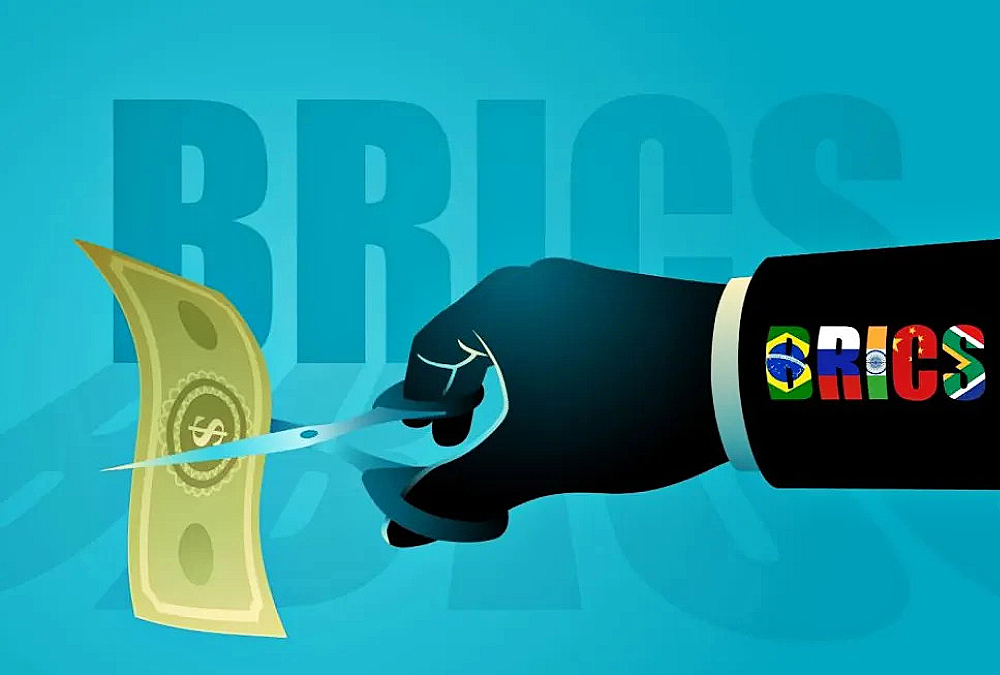

By Gregory Simpkins
Recently, I wrote about the current drive to replace the U.S. dollar as the world’s reserve currency. A reserve currency is defined as money recognized internationally as a stable, safe, and trusted store of value and accepted as a medium of exchange, within countries and between countries in trade. As explained by Moscow-based journalist Ilya Tsukanov, central banks and major financial institutions use reserve currencies for international transactions, simplifying global trade and reducing the headaches often associated with trade in local currencies (such as imbalances between imports and exports, which can leave one country with stacks of the other’s currency that cannot easily be spent, as well as inflationary risks). Typically, he says, a reserve currency is somewhat inflation-resistant, meaning that it is not as vulnerable to sudden drops in value as other forms of fiat money (i.e., money not backed by gold, or other commodities or resources of real, tangible value).
Not so true today for the U.S. dollar.
Tsukanov said the dollar became the world’s de facto reserve currency at the close of the Second World War with the emergence of the Bretton Woods Agreement – a monetary system responsible for managing commercial, financial and trade relations between the US and its post-war sphere of influence – including Canada, Western Europe, Australia and Japan and these countries’ various colonies and client states. The Bretton Woods Agreement gave rise to institutions like the World Bank, the International Monetary Fund (IMF) and the General Agreement on Tariffs and Trade – precursor to the World Trade Organization (WTO).
Use of sanctions
The use of sanctions invoked by the United States and supported by other governments that were part of the Bretton Woods Agreement have long been a source of irritation among developing countries, but the sanctions on Russia had unintended consequences for developing countries not actively supporting Russia’s assault on Ukraine. Grain, fertilizer, arms and other goods were sanctioned if coming from Russia, which caused immediate problems for bystander nations.
Moreover, Russia and China began agitating for a change in the world order managed by the United States as a means of establishing a truly multipolar regime. Indeed, the world has changed since the Bretton Woods Agreement, and nations such as China and India have become much larger economic players on the global scene. Lord Jim O’Neill, chair of Northern Gritstone, former commercial secretary to the United Kingdom Treasury and the former chair of Chatham House, is credited with coining the acronym BRICs (Brazil, Russia, India and China) in a 2001 article on the evolution of the global economy. In 2010, South Africa joined the group, which then truly became known as BRICS.
How many years have successful African countries sought the proverbial “seat at the table” at international conferences designed to determine the economic fate of the world? The failure to achieve that led South Africa to join BRICS and motivates others to follow their example.
In an interview with IC Intelligencer Insights, O’Neil said the time for solid control of the global economy by the Bretton Woods partners has passed:
“The whole idea that this group of seven “industrialized” or, “more developed”, “earlier developed” countries can run the world, is embarrassing. Because, first of all, their share of the world gross domestic product (GDP) has declined,” O’Neill said. “Japan’s not shown any net increase in its GDP for 20 years. Italy virtually never grows. So, this idea that they are some kind of thing for the whole world to follow. And then on top of it, effectively it’s a hostage to whatever Washington wants.”
In the aftermath of the Russia sanctions and its broader than anticipated impacts, more than 20 countries reportedly have submitted membership requests to the BRICS bloc. Certainly, the popularity of the growing collective is undeniable, with nations wanting to add to what is possible from the economic alliance, a rival to the Group of 7 (G7) industrialized nations.
How many years have successive African countries sought the proverbial “seat at the table” at international conferences designed to determine the economic fate of the world? The failure to achieve that led South Africa to join BRICS and motivates others to follow their example.
Senegal is said to be interested in bringing in its gold mining and energy contributions, including a robust reserve of gold, oil, and gas. It may not be the economic heavyweight of the current BRICS members and wouldn’t bring the financial heft of say, Saudi Arabia, which offers more significant investments in a BRICS bank, but it would be a contributor. Senegal’s export potential and its adoption of the BRICS currency could increase the current trajectory of the alternative to the dollar.
Egyptians, for example, have been hard hit in foreign travel by not only the scarcity of dollars – a situation that has hit other nations as well – but also the simultaneous second round of the Egyptian pound devaluation that followed an initial depreciation in March. Consequently, the Egyptian government is seeking a more flexible exchange rate regime.
Will BRICS currency be competitive?
But will a BRICS currency be competitive enough with the dollar for African and other developing countries to dump the greenback? A resource-based currency favors strong economies that control their resources to the largest extent possible. African and other Diaspora-controlled nations have abundant resources but relatively little control over them. How will being under the BRICS regime be different from being under the dollar?
The United States wields the dollar as a tool to ensure compliance with the international order, but yes also to coerce nations into not going too far in opposing American interests. Will China and Russia be less willing to use their new currency to enforce discipline on users who are seen as out of line with their agendas?
Conflict within the bloc has long been an issue within the collective. China and India are longtime rivals, and India has been attempting to create a Chinese alternative in the manufacturing sector. So, where China attempts to use the bloc to promote its own interests, India likely will stand against that growth.
That reality gets even more concerning when you consider the growth of the bloc. Saudi Arabia and Iran both seek entry but have a similar conflicting relationship as India and the Chinese. Don’t be surprised if current allies Russia and China fall out over supremacy within BRICS. China is clearly the stronger partner, but the Russians won’t easily accept their supremacy any more than European Union members have accepted German supremacy. Moreover, should BRICS take on members with weaker economies, might they run into the problems the European Union has had with its weaker members, namely needing to bail them out of economic difficulties?
De-dollarization efforts have been fully embraced, but how difficult could the process become? For example, if Brazil executes a trade with China in the yuan (or officially the renminbi), what does it do with those funds? Further, it maintains debt in US dollars, and it constantly purchases manufacturing equipment from Japan. Thus, the country needs both of those national currencies, and that does not include its other global trade interests.
Globally, the dollar remains the single most significant reserve currency, accounting for about 40 percent of global trade, nearly 90 percent of foreign exchange transactions, and about 60 percent of reserves held in foreign central banks.
And the U.S. is not the only game in town, with the euro, the single currency of the European Union, accounting for about 30 percent of trade, and 20 percent of countries’ foreign reserves. As a major currency, the euro is a popular choice for nations sanctioned by the United States, with Iran, for example, officially switching to euros (and to a lesser extent yuan) in its oil trade starting in 2012. However, the euro’s status has been hindered by its instability compared to the dollar, and by Brussels’ attempts to use its currency punitively to sanction other countries, as Washington has done.
This current threat to the reserve status of the U.S. dollar has been abetted by the unsustainable ramping up of U.S. debt, which doubled over the past decade alone and now stands at nearly US$32 trillion, or more than 123 percent of GDP. A debt this large increases the risks that, eventually, Washington will be unable to pay it off. If a less developed country faced such a circumstance, the U.S. government would be critical of this self-inflicted financial wound.
Collapse of some US banks
The collapse of several major corporate lenders, including Silicon Valley Bank, had made the dollar and dollar-denominated debt as an investment vehicle much less attractive, and Federal Reserve manipulations with interest rates to try to get inflation under control have been more than problematic.
Efforts by an increasing number of nations previously recognized as US client states to increase the use of local currencies, yuan, euros, and other tools for trade instead of the dollar is an ominous sign.
While Congress did pass a debt ceiling bill to avoid a crisis, the resulting spending cuts could cause a massive recession, meaning the further decline in confidence in the American currency. Even as the current debt ceiling crisis is resolved, it comes up every year, and the rest of the world is getting tired of the drama in Washington.
African and other developing nations are in a dilemma about how to proceed on the use of an international currency. They cann0t easily create one and going to a reserve currency managed by stronger nations keeps them beholden to other economic and political interests. As the global order changes, African governments must take care to serve the long-term interests of their countries and not the trends of the moment. Decisions made today will have to be lived with in the future – for good or for ill.
Gregory Simpkins, a longtime specialist in African policy development, is the Principal of 21st Century Solutions. He consults with organizations on African policy issues generally, especially in relating to the U.S. Government. He also serves as Managing Director for the Morganthau Stirling consulting firm, where he oversees program development and implementation. He further acts as a consultant to the African Merchants Association, where he advises the Association in its efforts to stimulate an increase in trade between several hundred African Diaspora small and medium enterprises and their African partners.
