
Opinion
Burkina Faso’s Economy Is Mending. Is Self-Reliance the Reason?
A junta-run Sahel state has slashed its deficit and tamed inflation. The lessons for African public finance are real, but narrower than its cheerleaders claim.

By Charles F.V. Chitekwe
In 2022 Burkina Faso looked like a textbook case of how fragile states unravel. Two coups in eight months had shaken the government. Inflation averaged 14.1 percent. The budget deficit reached 10.7 percent of GDP. Growth, by the International Monetary Fund’s reckoning, limped along at 1.8 percent.
The 2025 numbers read very differently. Real GDP grew 5.3 percent. Average inflation turned negative, at -0.5 percent. The deficit shrank to 1.8 percent of GDP, less than half the 4 percent ceiling set by Burkina Faso’s IMF program. These are the Fund’s own figures, endorsed by its executive board on June 26. Growth of that order is nearly four times the euro area’s 1.4 percent, achieved in a country fighting a jihadist insurgency that has left roughly 2.1 million people displaced.
It is a striking turnaround, and an irresistible one for anyone who believes African economies should stop waiting for rescue packages. The question is what, exactly, it proves.
Gold Did a Lot of the Work
Honest accounting starts with the metal. The IMF credits the 2025 expansion chiefly to a mining boom and record bullion prices. Gold rose 44 percent that year, exports jumped 63 percent, and gold now accounts for almost 90 percent of the total. Windfall mining revenue and fuel-price markups financed much of the fiscal repair. The government also cut domestically financed investment by 2.5 percentage points of GDP, a saving that will not repeat itself without a cost to roads, schools and clinics.
Nor is the deflation quite the triumph it appears. The Fund attributes it mainly to base effects and cheaper food after a good harvest across the West African monetary union. Sound budgeting helped. Weather and base effects helped more.
None of this diminishes the discipline on show. All of the program’s quantitative performance criteria were met in 2025, and the government has implemented seven of eleven priority governance recommendations. But a turnaround powered by a commodity boom is a different thing from a turnaround powered by self-reliance.
The Domestic Toolkit is Real
Still, Ouagadougou has leaned hard on its own citizens and savers. The Patriotic Support Fund, created in 2023 to pay for the army and volunteer militias, raised about 497 billion CFA francs (US$861 million) through 2025 and a further 250 billion (US$439 million) by September 29 this year: close to 750 billion (US$1.3 billion).
“Patriotic” is generous, however. In the first quarter of 2026, tax levies and compulsory deductions from public servants’ salaries supplied about three-quarters of receipts. Private companies gave under 2 percent; voluntary gifts, under 4 percent. This is taxation by another name, and none the worse for it, provided it is accounted for like taxation. IMF staff have noted, as a matter of good practice, that spending from such funds should be reported openly. It is not part of the current reform plan.
The regional bond market is the sturdier pillar. In 2025 the Treasury raised 1,189 billion CFA francs (US$2.06 billion) through auctions on the West African monetary union’s securities market. Average yields on new issues fell from 9.3 percent in March 2024 to 8.2 percent in 2025 and 7.1 percent in April 2026. This year’s first diaspora bond drew 151.5 billion francs (US$262 million) against a 125 billion (US$217 million) target, a 121 percent subscription, paying 6.75 percent over five years or 6.85 percent over seven. A 75 billion franc sukuk (Islamic bond) followed in June.
These are the instruments of a state that has found local savers. They are also debt. The average maturity of new issues has shortened, from 4.6 years in May 2024 to three in April 2026, which raises rollover risk. Borrowing at home is still borrowing.
Self-reliance, with Multilateral Support
The sharpest irony is that the country held up as proof of life beyond conditionality is halfway through a 48-month IMF Extended Credit Facility, approved in September 2023. In June the Fund added half a quota to the program, lifting total access to 289 million Special Drawing Rights, to cushion a fertilizer and fuel shock tied to the war in the Middle East. The Fund will cover just over half of a 285 billion franc (US$494 million) financing gap for 2026 and 2027; the World Bank and the African Development Bank are expected to fill the rest.
Self-reliance and external credibility, in other words, are working as complements rather than substitutes. A government that collects its own taxes and clears its arrears is easier for anyone to lend to, including its neighbors’ savers. The lesson for Africa is not “refuse the Fund.” It is “earn the right to negotiate with it.”
The Caveats are Large
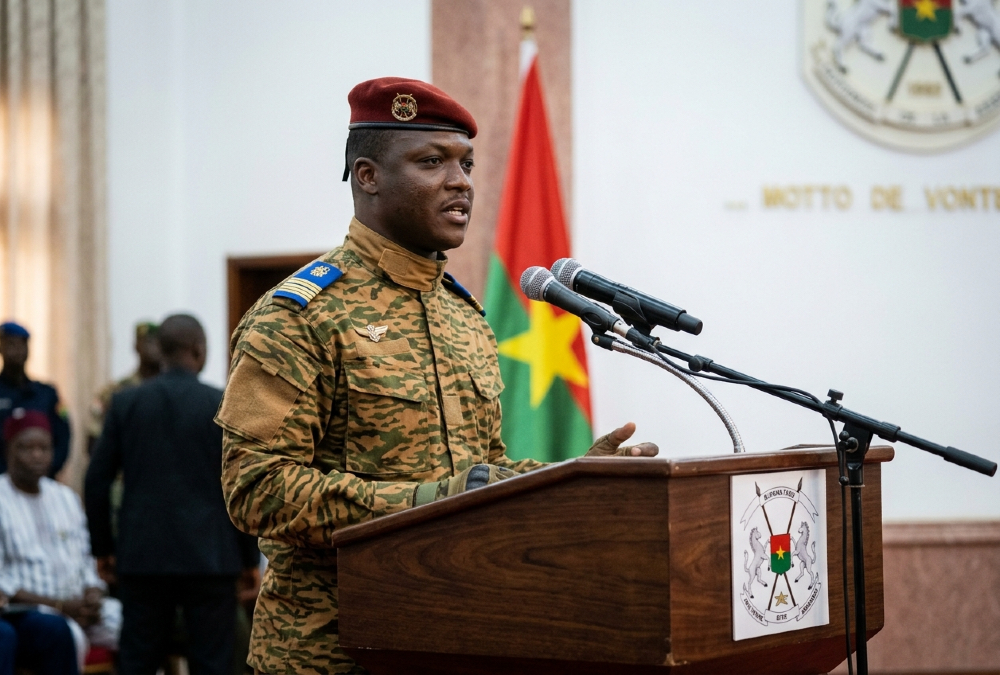
Burkina Faso has been run by a military government since a September 2022 coup. A charter adopted in March dissolved political parties and set elections for 2029. In January 2025, along with Mali and Niger, it formally quit the regional bloc ECOWAS, a departure whose fallout the IMF judges limited. It remains in the monetary union, whose council of finance ministers its own minister has chaired since October 2025.
The Fund’s staff also flag gaps in statistics on artisanal mining and trade, and a governance diagnostic that has not been published. Much of the recent revenue gain comes, they say, from higher rates and new levies rather than a broader tax base. The finance ministry reports 3,714 billion francs of revenue in 2025, up 22.4 percent, and roughly 2.7 trillion francs collected through August this year. Those are government numbers; independent checks are thin.
The outlook has darkened, too. The IMF now expects growth to slow to 3.6 percent in 2026 as fertilizer and fuel prices spike and farm output falls by 5 percent. It sees inflation at 4.2 percent and has loosened the deficit target to 4 percent. The government is far more bullish, projecting 7.7 percent. Humanitarian funding has collapsed: the World Food Program received US$16 million of an expected US$207 million in the first quarter.
The Case for Wider Adoption
So what would change if more African governments treated domestic revenue, citizen savings and regional capital markets as their main engine? Plenty, if they copy the right parts. Widen the tax base instead of raising rates on the same few payers. Build a deep local-currency bond curve, and lengthen its maturities. Save the windfalls: the IMF urges a countercyclical fiscal rule, and Ouagadougou created a sovereign mining investment fund in May. Publish audits, so that contributions are given rather than extracted. And fix the data, because nobody can verify a miracle they cannot measure.
Burkina Faso has made a start on some of these and barely begun others. Economic sovereignty is not a speech. It is a balance sheet, and balance sheets get audited. The 2025 accounts pass a first inspection. The real test comes when the gold price stops cooperating.
Charles F.V. Chitekwe is a diplomat and global relations specialist at the Alpha Sirius Foundation, where he advises heads of state, senior policymakers, and international delegations on Africa-focused diplomacy, trade, and development strategy. He advocates for a unified African position in global negotiations, promoting innovation-driven growth, investment, and economic self-reliance over aid dependency. He writes on African development, pan-African finance, diaspora investment, and the role of AI and technology in accelerating the continent’s economic transformation.
