
Editorial
Briefing on the State of Afro-Caribbean Aspects
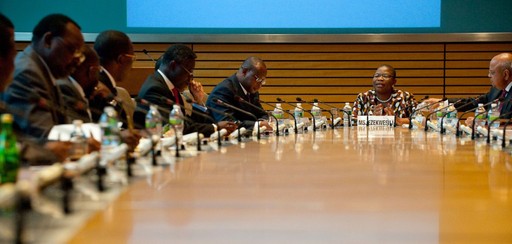
A Group of ACP Country Delegates – Courtesy of the World Bank
Just last week, in what was termed ‘the first official high-level structured dialogue between the Caribbean Community leaders and Obama’s administration,’ U.S. Vice President Joseph Biden signed a trade and investment agreement with 16 island and low-lying coastal states.
Starting May 28, 2013, more than 15 million people and their countries could take advantage of an 85 percent tariff elimination on goods and services coming from their region. This negotiated agreement also established a special council to work on removing barriers to trade and investment between the U.S. and the Caribbean Community (CARICOM) states – addressing issues like renewable energy and energy security.
On the other side of the black spectrum, sub-Saharan Africa beneficiaries of the Africa Growth and Opportunities Act (AGOA) met May 30 and 31 at the World Bank in Washington, DC to review their non-reciprocal program and ensure that more than a billion Africans could take more advantage of access to the U.S. market.
Unfortunately, although there was some positive noise coming from respective quarters, the truth is that unless Africa, collectively, comes up with a ‘demand’ for more U.S. investment to go alongside an allowance for agricultural products like groundnuts, sugar or even tobacco leaf, AGOA may continue to be largely ignored on the continent.
The Habari Network is as pleased as Punch with the progress the Caribbean has made vis-a-vis its American trade and investment relationship. One can, actually, see how strategically important the Caribbean is to the U.S. Just like Cuba almost brought the world to its knees during the Cuba Missile Crisis of the 1960s, the Chinese are ‘invading’ off-shore locations near the North America.
Of course, most of these are China’s entrepreneurial ventures into lucrative opportunities presented by American tourists and investors. However, like anyone knows, these economic interests present a clear and present danger to U.S. national security; thus, it was understandable that the U.S. needed to do something beyond the Caribbean Basin Initiative (CBI).
Initially launched in 1983 and in effect till September 2020, the CBI, just like AGOA does, provides 17 countries with duty-free access to the U.S. market for a few goods.
