
Editorial
A historical opportunity in the Democratic Republic of Congo
An Overaching Interview
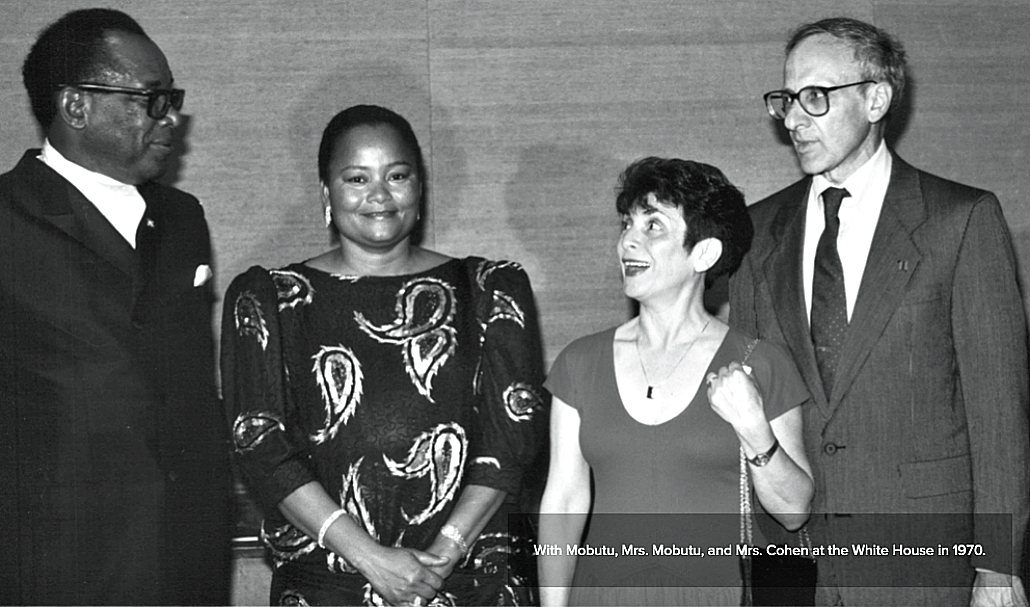
Based on a glorious past – including brokering an end to the Ethiopian-Eritrean war in 1991 – former U.S. Assistant Secretary of State for African Affairs, Herman Jay “Hank” Cohen is one of the most sought-after experts of Africa. He spoke with The Habari Network’s Dennis Matanda (DM) to discuss the upcoming historic election in the Democratic Republic of Congo, and what this might mean for the United States. Ambassador Cohen left the U.S. Department of State in 1993 after helping to usher peace into conflict areas such as Angola and Mozambique.
Since then, he served as Senior Advisor to the Global Coalition for Africa and as a professorial lecturer at the Johns Hopkins School of Advanced International Studies for 12 years. As the President of CEO of Cohen & Woods International, Ambassador Cohen also served on the Board of Directors of Hyperdynamics Oil & Gas, and as a Consultant for ContourGlobal.
An Introduction
On December 23, 2018, the Democratic Republic of Congo, a country of over 80 million people, will hold a historic election. As Ambassador Cohen observes, the country’s sitting president will not be on the ballot.
Instead, there are 3 groups running for election: People’s Party for Reconstruction & Democracy is President Kabila’s party & supports candidate Emmanuel Ramazani Shadary; a coalition that is loosely termed ‘Lamuka’ that fronts Martin Fayulu, a candidate also backed by opposition leaders including Jean-Pierre Bemba and Moise Katumbi, and then there’s Félix Tshisekedi, son of Etienne Tshisekedi, and leader of the Union for Democracy and Social Progress, the country’s largest opposition party. The Tshisekedi ticket is further boosted by Vital Kamerhe as a running mate; Kamerhe was placed third in the 2011 election.
DM: Why is this election as consequential and as important as it seems for the DRC?
Hank: Well, the Democratic Republic of Congo [former Zaire] has, since its independence in 1960, never had a normal election where there has been a transfer of power. So, this is the first election where the sitting president will not be a candidate. With, amongst other forces, a push from U.S.’ Ambassador to the UN, [President] Kabila has agreed to leave [power] voluntarily and it will be the first time in the country’s history where Congolese can choose a new president to replace one that’s leaving.
DM: Why should people be worried?
Hank: A lot of people fear that the outgoing president wants to continue controlling power from a handpicked successor – Mr. Shadary – someone selected as Kabila’s heir apparent. People fear that since the president has strong control of the army and the money, then the new president will just be a surrogate of the old president. And this could lead to violence because the majority of the people feel that they want to make a change.
DM: What are the chances that Felix Tshisekedi will be the next president of the D. R. Congo?
Hank: If the election is free and fair, Felix Tshisekedi Tshilombo is clearly the most popular candidate and politician in the Congo today. And with his running mate, Vidal Kamerhe, free and fair election results should, no doubt, return a clear victory for Tshisekedi and Kamerhe. They will get more than 50 percent on the first ballot.
DM: What situation do you foresee if Tshisekedi wins?
Hank: First, like I said, if the election was free and fair, Tshisekedi should be the clear winner. However, there are growing doubts that the current regime will allow the election to be free and fair. They will try to rig in favor of President Kabila’s chosen successor.
DM: Should there be a situation where this December election in the D. R. Congo is rigged, how should the United States react? How should the world react?
Hank: The U.S. and the International Community should refuse to accord de jure recognition to the government that is illegitimately elected.
DM: What would that do? How will that change Congolese lives?
Hank: That is a difficult question to answer, but I think that if the U.S. and international community apply appropriate sanctions and pressure, the government may change its mind and allow Tshisekedi to be elected.
DM: What should the U.S. do between now and the election day?
Hank: The U.S. policy is to insist on a free and fair election in the Democratic Republic of Congo, and to have an election in which President Kabila departs. So far, the government has said that they will do that. So, the [point] is to continue observing incidences where he violates his promise.
At this juncture, Hank, who was at the Dulles Airport had to get onto a flight to Florida.
DM reached out to Max Karst (MK) of Pamoja USA, and Jean Michel Mundela (JMM) and Thotho Mabiku (TM) who are embedded with the U.S.-based Tshisekedi Campaign.
DM: How are the Congolese people feeling about the current election?
JMM: If you look at Articles 62, 63, and 64 of the Constitution of the Democratic Republic of Congo, you will understand what is going on in the D. R. Congo. You will also understand why people are so excited about the Tshisekedi Candidacy.
All Congolese understand that there is no excuse of ignorance of the law. That’s why we must defend the country by voting this December. Looking at the crowds that are coming to attend Felix Tshisekedi’s rallies, we shall elect a historical president this year.
DM: But what happens if President Kabila rigs the election in favor of his anointed successor?
JMM: Then the people may have no choice but to invoke Article 64. It is our duty to oppose any individual or group of individuals who seize power by force or who exercise it in violation of the provisions of the D. R. Congo Constitution.
TM: That’s why we the Congolese people need the United States. Just as U.S. National Security Advisor Ambassador Michael Bolton said at his recent speech at the Heritage Foundation, the U.S. is keen to build a strategic partnership with Africa. We are one of Africa’s consequential nations and Felix Tshisekedi would like to have a strategic partnership with the American people.
DM: But how would the U.S. help under the circumstances? Isn’t the International Community more involved in the D. R. Congo?
MK: If you look at what the United Nations and bodies like the UN/MONUSCO are doing, this peacekeeping effort was supposed to reduce as conditions on the ground improved. However, given how long they have been there, something has to give. In this regard, the United States can help with reforming the Congolese military and local policing agencies. This shall empower the Congolese – the U.S. can play a significant role in training and equipping these agencies. And this is what would sustainably reduce an annual US$2 billion cost to the international community.
TM: If I may interject: Mr. Tshisekedi has made a solemn promise to his countrymen; to restore peace, security and stability. He’s aware that this would mean peace, security and stability in the Great Lakes Region. To achieve regional and continental success, we need support – a strategic partnership – with the United States.
MK: I also think that the D. R. Congo under Felix Tshisekedi has a historical opportunity to gain better control of mineral trade – so as to reap commensurate tax income for the country. These are the sort of plans that Felix has put forward: he intends to invest in infrastructure, healthcare, education, etc. He also intends to prioritize these services in the mining areas so as to cover the chronic open sore that has been eating away at the Great Lakes region. Once he does these things, we can start to see an end to militias that continue to affect Congo’s security.
TM: The other reason the International Community should support the Tshisekedi Candidacy is that unlike groups like Lamuka and the current government, he has not been embroiled in the scandals and human security abuses of the last 17 years. Besides, although all other opposition groups are now going to the ballot this December with or without an electronic voting machinery, the point here is that Mr. Tshisekedi is consistent, firm and clear-headed.
To Contact Dennis Matanda:
[email protected]
