
A Diaspora View of Africa
Africa’s Wealthy Provide Promise for the Future
By Gregory Simpkins
There is a saying: “God helps those who help themselves.” It is often used by those who hesitate to aid those in need, but it also carries the truth that one mustn’t depend solely on others to survive or to thrive. Since independence, African governments have appealed to donor nations and international financial institutions to keep them afloat despite most having wealthy citizens who could contribute to the advancement of their countries. That appears to be changing.
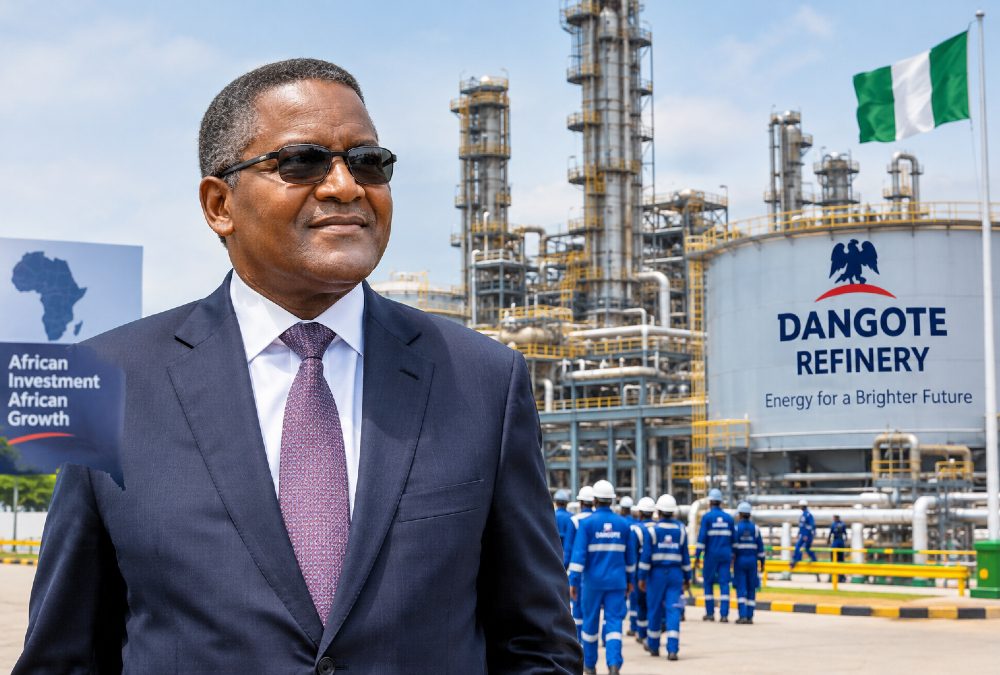
Taking the lead at this point is Aliko Dangote, the Nigerian billionaire who has not only helped to advance his own country’s economic prospects but is now engaged in a project to spread economic benefits elsewhere on the continent. In interviews he’s repeated three pillars for African economic development:
- “Add value here” – Don’t export crude, cement, sugar. Refine and package them on the continent.
- Jobs and Skills – Large factories create manufacturing jobs and technical training.
- Stability through production – If Africa produces its own fuel, food and building materials, it’s less vulnerable to global shocks.
With a net worth estimated at over US$50 billion as of September 2026, he is far and away the wealthiest African businessperson. His Dangote Foundation fights hunger and illiteracy. His premier business venture is Dangote Refinery. At 700,000-barrel-per-day, it is one of world’s largest single-site refineries since starting operations in 2024. The goal is to end Nigeria’s reliance on imported fuel, stabilize supply and make Nigeria an exporter to Africa. Dangote says it’s about Africa “refining its own crude oil and create wealth on the continent.”
He also owns Dangote Cement – Africa’s largest producer of this vital building material. The company experienced record profits in 2025 and is now expanding in Ethiopia.
Taking the Model to Kenya
But his largest project outside Nigeria is in Kenya. He told reporters in Nairobi in late September that Africa would largely supply its own refined fuel needs by 2030 as he prepared to launch a US$16 billion refinery on the Kenyan coast. At that point, he planned to break ground on the East African oil refinery, with a planned capacity of 700,000 barrels per day, in a few days. It was expected to take around 30 months to build.
Unfortunately, a Kenyan court had another idea. A Kenyan High Court issued a status quo order regarding the proposed Lamu oil refinery. International outlets like Bloomberg reported that the court ordered the multibillion-dollar project to be paused, but local reporting from Kenyan media outlets described the order by Judge Jane Onyango as less definitive. The court declined to completely stop the upcoming groundbreaking ceremony – originally scheduled for September 30 – instead directing that the respondents be served notice of the court action and given two weeks to file responses. Further legal directions were set for October 14. The judge allowed the groundbreaking to proceed as scheduled, but ordered the status quo kept on land that 133 residents say holds their homes, mosques and family graves until a hearing.
According to Africa.com, the facility will be modeled partly on Dangote’s 700,000-barrel-per-day refinery in Nigeria. Ruto said the project, Kenya’s largest-ever foreign direct investment, could increase annual GDP by 12 percent. To support the refinery, Dangote plans to build a 1,000-megawatt power plant, double that of its Nigerian counterpart. The refinery is expected to support Lamu Port and create more than 50,000 jobs. However, questions remain over how it will secure crude supplies. Environmentalists also fear damage to Lamu Old Town, a World Heritage site, and have challenged the project in court.
Given the overall importance of this project and the strong Kenyan government support, there is no doubt that legal restrictions will be strenuously fought. As Dangote breaks new ground in terms of African investment in Africa – both literally and figuratively – he leads the way for other wealthy Africans to expand their business ventures – first in their own countries and then throughout the continent.
Africa’s wealthy class is having an increasingly significant impact – not only on their countries, but also on countries throughout the continent.
Other African Billionaire Projects
There are 23 people African billionaires at this time with a combined US$126.7 billion, up 21 percent from 2025. South Africa has the most with seven, followed by Egypt with five, Nigeria with four and Morocco with three. Fourteen are self-made billionaires.
South Africa’s Johann Rupert and family are worth an estimated US$16.1 billion. Through their Richemont brand, the family owns Cartier and Van Cleef & Arpels, driving the South African luxury jewelry exports. Their Rupert Nature Foundation supports the South Africa College for Tourism through the Peace Parks Foundation, which was founded by the late South African President Nelson Mandela, Netherlands Prince Bernhard and Dr. Anton Rupert in 1997 to expand southern Africa’s wilderness areas.
Nigerian Abdulsamad Rabiu’s BUA Group operates BUA Cement plants such as the US$900 million Edo State plant and BUA Foods. His business focus is on food security, infrastructure and local manufacturing. Worth an estimated US$11.2 billion, Rabiu’s ASR Africa Foundation pledges US$100 million per year for hospitals, schools and security infrastructure. The foundation has built a 7,000-sqare-meter pediatric ward at Aminu Kano Teaching Hospital.
South African Nicky Oppenheimer and family are worth an estimated US$10.6 billion. Their Oppenheimer Generations organization engages in private equity investing across Africa. Their Tswalu Kalahari reserve in South Africa advocates for ethical/sustainable mining.
Egypt’s Nassef & Naguib Sawiris have an estimated combined net worth of US$9.6 billion. Nassef operates Orascom Construction Industries, the country’s first multinational corporation. Earlier in 2026, he commenced infrastructure projects in Rwanda. Naguib built Orascom Telecom, expanding mobile networks across Africa, Asia and the Middle East.
Nigeria’s Mike Adenuga, whose estimated worth was about US$6.5 billion at one point, operates Globacom, one of Nigeria’s largest telecoms, which has expanded connectivity. He also operates Conoil oil exploration, which provides gasoline products for motor vehicles and aircraft, lubricants and liquefied petroleum gas.
South Africa’s Patrice Motsepe, worth an estimated US$3.7 billion, operates African Rainbow Minerals, which mines gold, platinum and iron ore. He also is non-executive Chairman of Harmony Gold, the world’s 12th largest gold mining operation and Deputy Chairman of Sanlam, one of the largest insurance companies in Africa. Moreover, he is President of the Confederation of African Football.
As these and other wealthy Africans spread their economic wings, so to speak, they have facilitated a wealth jump driving stronger African markets and currency stability. This is not to say that outside finance no longer has a place on the continent, but Africa’s wealthy class is having an increasingly significant impact – not only on their countries, but also on countries throughout the continent.
Dangote’s “Vision 2030” plan aims to turn his companies into a US$100 billion industrial powerhouse by 2030. If the other African billionaires pursue similarly lofty goals, Africa will finally achieve the advancement often predicted but thus far not fully realized.
Gregory Simpkins, a longtime specialist in African policy development, is the Principal of 21st Century Solutions. He consults with organizations on African policy issues generally, especially in relating to the U.S. Government. He further acts as a consultant to the African Merchants Association, where he advises the Association in its efforts to stimulate an increase in trade between several hundred African Diaspora small and medium enterprises and their African partners.
