
A Diaspora View of Africa
What are BRICS prospects long-term?

By Gregory Simpkins
The transition of colonies in the developing world have been difficult over the years to say the least. In this phase, colonial powers tried neocolonial control, including through leaders selected for their cooperation with the former colonizers. Then the East-West struggle known as the Cold War between the United States and Western nations versus Russia and China forced African and other developing countries to choose sides.
To counteract this dilemma, at the 1955 African-Asian Bandung (Indonesia) Conference, it was proposed that developing countries avoid lining up with either side in the Cold War, and in 1961, the Non-Aligned Movement was established at the Belgrade (Yugoslavia) Conference to promote self-determination and fight all forms of colonialism. The conditions for membership included a prohibition on officially joining a multilateral military alliance (such as the North Atlantic Treaty Organization [NATO]) or have signed a bilateral military agreement with one of the “big powers.”
By the early 21st century, there were 120 members of the Non-Aligned Movement.
However, while some developing countries didn’t maintain alliances in the form of official agreements, some did tilt one way or another. Furthermore, it was felt that the Group of 7 (G7) industrialized nations wielded outsized power over the economic fate of African and other developing countries, including some neocolonial influence in their former colonies.
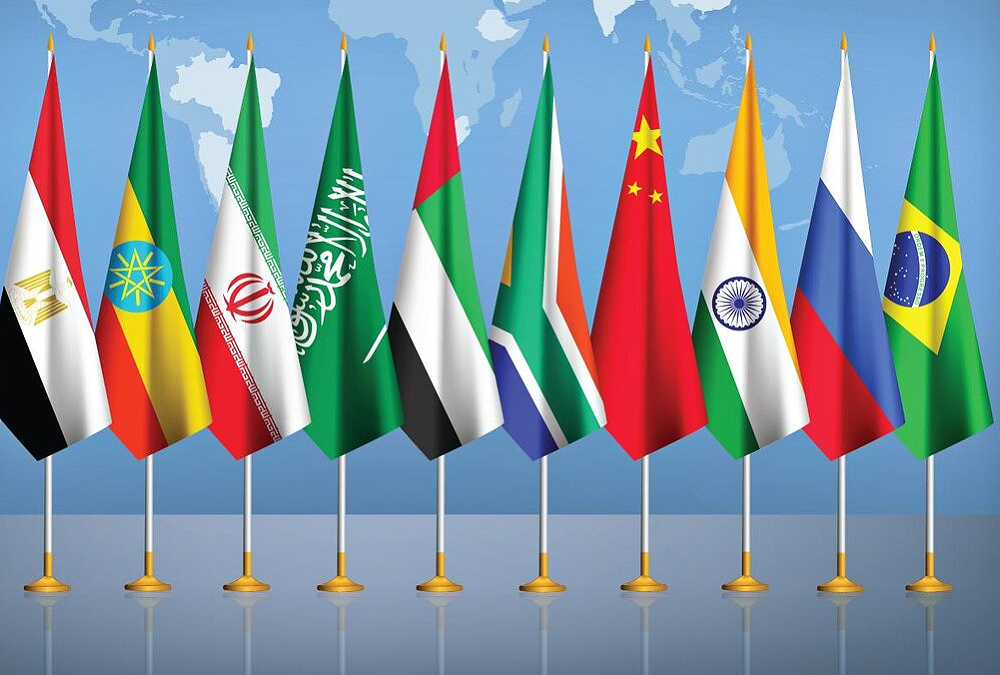
By 2009, Brazil, Russia, India and China met in Yekaterinburg (Russia) to form a coalition on the basis of non-interference, equality and mutual benefit. A year later South Africa joined and as of January 2024, Iran, Egypt, Ethiopia, and the United Arab Emirates joined the coalition. The coalition now encompasses about 30 percent of the world’s land surface and 45 percent of the global population.
Thus, the BRICS countries are considered the foremost geopolitical rival to the G7, planning and implementing competing initiatives such as the New Development Bank, the BRICS Contingent Reserve Arrangement, the BRICS pay system, the BRICS Joint Statistical Publication and the BRICS basket reserve currency. However, its main goal currently is replacing the U.S dollar as the world’s reserve currency.
The term BRIC was originally developed in the context of foreign investment strategies and was introduced in the 2001 publication, Building Better Global Economic BRICs by then-chairman of Goldman Sachs Asset Management, Jim O’Neill. The name became BRICS when South Africa joined.
One can well understand why some nations wanted a countervailing power to the industrialized nations. Yet the organizers all have their own aims that are not necessarily in the interest of the developing countries in Africa and elsewhere. Of course, the same accusation could well be made of the developed world over the years.
So what are the prospects that the BRICS coalition will keep these individual ambitions from negatively affecting its stated goals?
For example, Russia and China have been active rivals for decades. Both feel the it is in their interest to have paramount influence in the Central Asia region they both border. Neither China nor Russia would seem interested in ceding influence in that area or other parts of Asia, according to a June 24 2022 article in the Prospect magazine, which reported some disdain for Russia by Chinese officials early in the Ukraine war.
“The Chinese officials and experts we met repeatedly expressed their disdain for Russia, while at the same time maintaining a convivial public demeanor. Moscow’s management of the post-Cold War collapse of the Soviet Union was treated in Beijing as a textbook case of how not to manage such a change,” the Prospect reported.
Clearly, the Russia-China alliance is a case of the enemy of my enemy is my friend and is therefore at least somewhat dependent on changing circumstances. Western nations are determined to aggravate that dissonance in the Russia-China relationship.
Economic dominance
The South China Morning Post reported on June 29 2024 that the US, Britain and France confronted Russia at the United Nations Security Council the previous day over accusations it is violating an arms embargo on North Korea by using missiles and munitions from Pyongyang in its war against Ukraine. Russia’s UN Ambassador Vassily Nebenzia rejected the accusations as “completely false.” The council meeting came after Russian President Vladimir Putin signed a pact earlier in June with North Korean leader Kim Jong-un in which they agreed to provide military assistance if either faces armed aggression.
The United States also called out China, saying it should use its influence with North Korea and Russia to protect regional and global security and end “this increasingly dangerous military cooperation” between the pair. “I appeal to my Chinese colleagues to understand that if indeed the situation on the Korean peninsula continues on the trajectory it’s going, the United States and its allies will have to take steps to defend their security,” deputy US Ambassador Robert Wood told the council, without elaborating.
In alliances like NATO, the East African Community and the Southern African Development Community, there is a dominant partner (reluctantly or not). Russia and China both see themselves as leaders on the world stage. They are aligned against U.S. interest currently, but will that alliance last if the time comes for one or the other to assert themselves?
Meanwhile, S&P Global, an international market intelligence company, reported on June 5 2023 that, externally, India is looking at the world and how it is getting shaped right now, be it in a post-pandemic scenario or post-Russia’s war in Ukraine, and thinking that it is a good time to want to do foreign policy differently and engage with countries in a slightly different tenor.
“Our own data suggests India is expected to become the world’s third-largest contributor to global growth within the next decade. And the understanding is that as India becomes a bigger economic behemoth, it should also have more geopolitical heft that matches it,” S&P Global reported. “It’s basically India saying that we are going to choose our partnerships with a lot more self-interest.”
One must remember that India and China have a longstanding border dispute that erupted into violence just four years ago.
“When the brawl ended, and the last rocks had been thrown, at least 20 Indian troops lay dead or dying in the picturesque Galwan Valley, high in the mountains of Ladakh. Chinese casualties are unknown. These were the first combat deaths on the border between India and China in 45 years, ending an era in which Asia’s two largest powers had managed their differences without bloodshed,” The Economist reported on June 24 2020.
The Indian and Chinese armies had been locked in a stand-off at three sites along their disputed border, known as the Line of Actual Control (LAC), since May 2020. China’s People’s Liberation Army (PLA) grabbed 40 to 60 square kilometers of territory that India considers to be its own.
The allure of economic dominance through BRICS has enabled the two countries to put their dispute aside for the time being, but that doesn’t mean their grievances are completely forgotten.
As for Brazil, many analysts believe Brazil may be at the start of a virtuous cycle: favorable international conditions, receding inflation and interest rates, and a more constructive political environment. With the reopening to China, Brazilian exports such as soybeans and sugar are booming, surging to a record of almost US$340 billion since mid-2022 and marking an all time high trade surplus.
“There is no other emerging market that’s seen a transformation even remotely close to this,” says Robin Brooks, chief economist at Institute of International Finance and a long-time bull on Brazil told Bloomberg news on June 15 2023.
BRICS provides Brazil with a means of magnifying its global influence, so long as developments suit its own aims. The same can be said of South Africa, which currently is involved in a major political transition.
The BRICS effort to topple the prevailing world economic order already has led to turmoil in markets around the world, and decisions made at its October summit in the Kazan region of Russia at which it presumably will hear from its new members and consider the potential applications of 59 countries interested in joining BRICS. Many of them already are buying gold to back their own currencies.
The European Union can attest to the difficulties in taking on weaker or more erratic economies. Let us see how BRICS can accommodate new members without causing itself undue political and economic difficulties.
Gregory Simpkins, a longtime specialist in African policy development, is the Principal of 21st Century Solutions. He consults with organizations on African policy issues generally, especially in relating to the U.S. Government. He further acts as a consultant to the African Merchants Association, where he advises the Association in its efforts to stimulate an increase in trade between several hundred African Diaspora small and medium enterprises and their African partners.
