
Opinion
The Sahara: Africa’s Ancient Trade Superhighway
Long before shipping containers and free-trade agreements, the world’s largest hot desert hosted one of its most sophisticated trading systems. The lesson is overdue.

By Dishant Shah
Look at a map of Africa and the Sahara dominates it: a vast tan expanse, nearly as large as the United States, that seems to cleave the continent in two. The impression is of a barrier, an emptiness that kept the societies to its south apart from the rest of the world. It is a persistent image, and it is wrong.
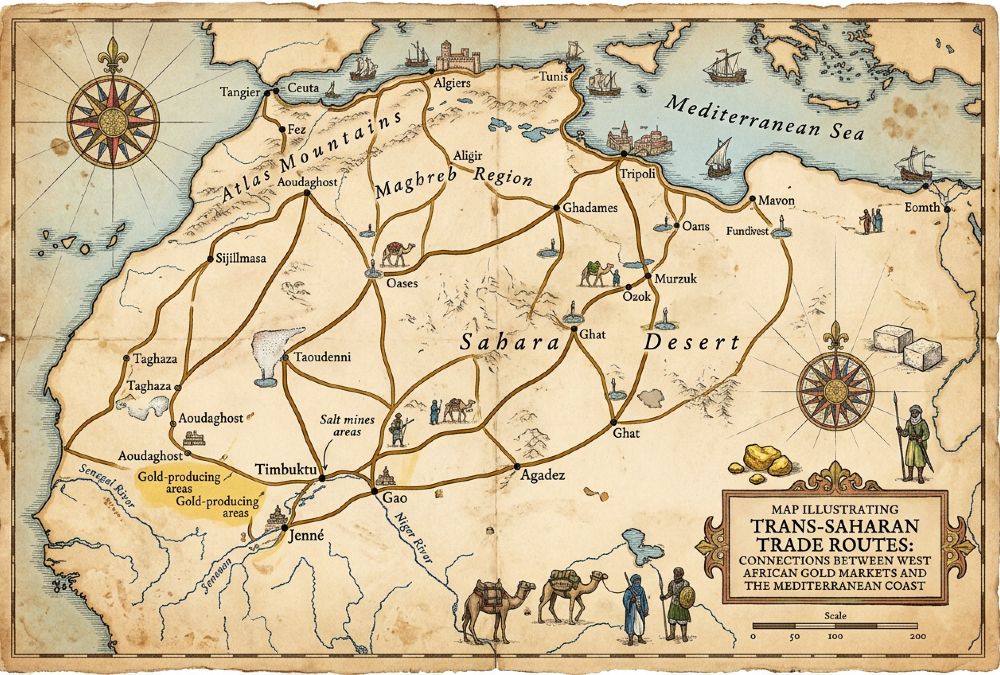
For centuries the Sahara was less a wall than a highway. Gold mined in West Africa traveled north. Salt dug from Saharan mines moved south. Between those two flows, merchants built trading networks that tied African kingdoms to markets across North Africa, the Mediterranean and beyond. The desert did not prevent commerce. It shaped it, priced it and, for those who mastered its wells and trails, made fortunes from it.
An Economy Built on Scarcity
The logic of the trade was elegant. West Africa’s forests and river valleys produced gold in abundance but lacked reliable sources of salt. The Sahara had salt in plenty but little else. Salt was no luxury: it preserved food in a hot climate and was essential to human health. Gold, meanwhile, was prized in markets from Cairo to the Mediterranean, where it helped finance coinage and trade.
Each side held what the other needed, and the price reflected it. Accounts from the period describe arrangements in which the two commodities were exchanged by weight. Historians rightly caution that such tales were sometimes embellished in the retelling, yet the underlying point stands: a commodity that sat cheaply in one place was worth a fortune in another, and entire economies rose on that gap.
Moving goods across such distances was an extraordinary logistical feat. Camel caravans, some of them very large, crossed thousands of kilometers (well over a thousand miles) of sand, rock and scorching heat. Success depended on knowledge of wells, seasons and routes, on credit and trust between merchants who might never meet, and on the protection of rulers who understood that taxing trade was more profitable than raiding it. These were not improvised journeys. They were institutions.
Cities That Grew Rich on the Desert’s Edge
Trade built places. Timbuktu, Gao and Djenné emerged as commercial hubs where caravans met river traffic and goods changed hands. Success in commerce funded success in learning. Timbuktu became renowned for its scholars, its mosques and its libraries, and manuscripts produced and collected there still serve as evidence of a rich intellectual life.
Merchants carried more than cargo. Languages, technologies, legal ideas and religious traditions moved along the same paths as gold and salt, and Islam spread through these networks alongside commerce. The routes were conduits of culture as much as of cash, which is part of why their legacy runs so deep across the Sahel and North Africa today.
Power followed wealth. Empires such as Ghana, Mali and Songhai prospered by taxing and protecting the trade. The fame of Mali’s ruler Mansa Musa, whose famous pilgrimage to Mecca in the 14th century reportedly dazzled the cities he passed through with its displays of gold, put West African wealth on the mental maps of Europe and the Middle East.
An Uncomfortable Ledger
A fair accounting must also acknowledge that gold and salt were not the only goods that crossed the desert. The same routes carried enslaved people, and the trade in human beings was a grim part of the Saharan economy for centuries. Celebrating the sophistication of these networks does not require romanticizing them. Commerce is a human enterprise, and it carries human vices along with human ingenuity.
Why the Story Matters Now
The deeper point is about how we narrate Africa’s place in the world economy. Too often the continent’s integration into global commerce is dated to the colonial era, or to the arrival of modern globalization, as though Africa were a passive recipient of connections made elsewhere. The Saharan trade refutes that framing. African merchants, rulers and scholars were building long-distance commercial systems centuries before European ships dominated the coastlines.
That history is not mere nostalgia. It bears on how policymakers and investors think about the continent today. Africa’s current efforts at deeper integration, notably the African Continental Free Trade Area, are often described as a bold experiment. In truth they echo an older tradition: a recognition that prosperity grows where markets are connected, where borders are porous to goods and ideas, and where the people who move them are trusted and protected.
The camel caravans are gone. The principles that sustained them are not. The Sahara was never the end of the map. It was one of its busiest roads, and it is time the story was told that way.
Dishant Shah is a partner at Legion Exim, a company specializing in facilitating the export of high-quality engineering products directly sourced from manufacturers in India to Africa. His areas of expertise include new business development and business management.
