
A Diaspora View of Africa
The Descent of Ethiopia’s International Standing

By Gregory Simpkins
When Abiy Ahmed became Prime Minister of Ethiopia in April 2018, the country had been ravaged by a protracted conflict with its neighbor, Eritrea, over a disputed border area. An international arbitration commission ruled in favor of Eritrea in 2002, but the Ethiopian government refused to accept the ruling.
After 16 years of “no war, no peace” between the two countries, Abiy broke the deadlock and accepted the decision. On September 2018, he and Eritrean President Isaias Afwerki signed a historic peace agreement.
Abiy also took part in other peace and reconciliation processes in and around the Horn of Africa. In his own country, he granted an amnesty to political prisoners and abolished press censorship.
I met with former political prisoners in Ethiopia at the time, and they and others were optimistic about Abiy’s prospects for his rule. He also focused on empowering women.
In a short time, the country’s president, Federal Supreme Court president and half of the ministers in his government were women, including the Minister of Peace.
This optimism was despite his having been considered an insider in the ruling party before taking office. The British Broadcasting Company (BBC) reported in an October 11 2021 article that he had been in the military where he rose to the rank of lieutenant colonel and was the founder and director of the country’s Information Network and Security Agency, which was responsible for cyber-security in a country where the government had exercised tight control over the internet.
That ruling party, the Ethiopian People’s Revolutionary Democratic Front (EPRDF), had been repressive and had earned international scorn for repeatedly declaring states of emergency, restricting political freedom and civil rights. Abiy Ahmed’s reform agenda was seen as offering hope for a genuine turnaround in the country.
As a result of the reforms he instituted initially, Abiy was awarded the Nobel Peace Prize in October 2019. However, a year later, that stellar reputation was seriously tarnished by his government’s response to the Tigray rebellion that blossomed into a full-scale war.
He passed his first electoral test in June 2021 with an apparent landslide victory, but the race was marred by a partial opposition boycott and postponements in parts of the country because of insecurity. Enthusiastic crowds and a number of visiting prominent African leaders who came out to celebrate his swearing-in in early October 2021 only masked deep divisions in the country.
Despite significant economic growth, many felt excluded from its benefits. This feeling of marginalization, particularly among the country’s largest ethnic group, the Oromo, fueled a wave of demonstrations even though the Prime Minister was an Oromo himself and was the first such high-ranking Oromo in government in quite some time.
In fact, this situation fed an Oromo opposition group – the Oromo Liberation Army-Oromo Liberation Front (OLF-OLA).
Abiy Ahmed’s government was accused of preventing humanitarian aid from reaching those in need in the Tigray region, looking the other way when ally Eritrea committed human rights abuses in the conflict and committing human rights abuses itself in the conflict, which involved the Ethiopian and Eritrean government forces, the Tigray rebels and Amhara militia. Of course, the Ethiopian government was the only one of the four against which the international community had significant leverage using sanctions.
Consequently, the United States suspended Ethiopia from the African Growth and Opportunity Act (AGOA) that had helped boost the country’s trade and economic development. Through Executive Order 14046, the US imposed sanctions related to Ethiopia in response to widespread violence, atrocities, and serious human rights abuse, including those involving ethnic-based violence, rape, and obstruction of humanitarian operations.
The Ethiopian government continues to press for the restoration of its access to AGOA benefits.
According to the Ethiopian Peace Observatory’s weekly report of September 17 2024, violence in the country decreased compared to the previous week, but battle events were reported in the Amhara region, and several abductions, including some resulting in civilian deaths, were also recorded in Oromia and South Ethiopia regions. Fano militias reported engaging in confrontations with security forces in different parts of the Amhara region.
Wider International Opposition for Ethiopia
The Grand Ethiopian Renaissance Dam (GERD), which straddles the Blue Nile River on Ethiopia’s north-western border with Sudan, has been hailed by the Ethiopian government as playing a vital role in the country’s development, providing large amounts of hydropower. However, it has proved highly controversial and has led to tensions with countries fed by the Nile, especially Egypt.
The BBC reported on June 7 2021 that one of the benefits of the project claimed by the Ethiopian government was that it prevents flooding downstream as it flows into Sudan although in 2020, following the initial filling of the dam reservoir in July of that year, the river downstream did flood.
“The floods in Sudan happened in August to September 2020. During that time, the GERD had no interference with the river flow or floods in Sudan,” said Mohammed Basheer, a researcher at the University of Manchester in the BBC interview. Water levels did initially drop in Sudan as the reservoir was filling up, but once the dam reached capacity, the river rose to its natural level again.
According to the news service, Sudan has generally been supportive of the project, but “the future impact of GERD on floods in Sudan depends on how the dam will be operated, and the level of co-ordination with Sudan,” said Basheer. But Egypt has been adamantly opposed to the GERD and the reduction of water from the Nile to Egypt, which could pose a serious problem to a mostly desert country.
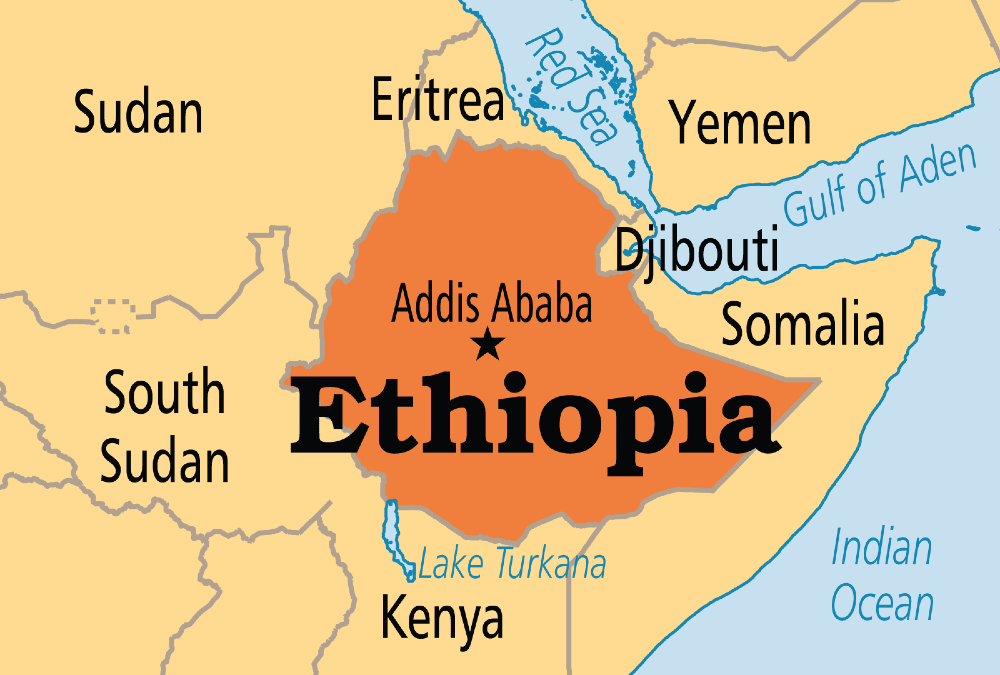
The impact of the GERD only added to Ethiopia’s regional opposition. Somalia has worked to deepen diplomatic relations and security cooperation with Eritrea and Egypt since Ethiopia signed a naval port deal with Somaliland earlier this year.
The January 2024 deal granted Ethiopia land in Somaliland for a naval base in return for recognizing Somaliland’s independence. The Somali Federal Government has strongly rejected the deal as unlawful and a violation of its territorial integrity, as it considers Somaliland to be part of its territory.
The Somali and Eritrean presidents met days after the port deal announcement to discuss ways to “strengthen ties and foster cooperation.” Somali media said the two-day visit was “impromptu,” suggesting it was in response to the deal.
The Africa File, an information collaboration between the American Enterprise Institute and the Institute for the Study of War, reported on October 17 of this year, that the presidents of Egypt, Eritrea, and Somalia formalized and deepened an anti-Ethiopian alliance during a trilateral summit on October 10. Egyptian President Abdel Fatah al Sisi, Eritrean President Isaias Afwerki, and Somali President Hassan Sheikh Mohamud met in Asmara, Eritrea, to bolster ties and coordinate regional security.
The presidents addressed “a wide range of regional and international issues.” They agreed to strengthen Somali state institutions and the Somali National Army to “confront various internal and external challenges,” according to a joint statement.
Somalia’s cooperation with Egypt in particular has accelerated since January. Egypt and Somalia signed a bilateral defense cooperation agreement in Cairo in August of this year.
Egyptian media said Egypt deployed 1,000 soldiers to Mogadishu between 27 and 29 August, while international media has reported on two arms shipments including ammunition, arms, artillery, and other weaponry since August.
The recent increase in Egyptian-Somali military cooperation ostensibly is meant to combat al-Shabaab but also threatens Ethiopia. Egypt’s foreign ministry spokesperson said in late September that its arms shipments aimed to support Somalia to “combat terrorism and preserve its sovereignty, unity and territorial integrity.”
The latter objective, according to the Africa File, suggests the shipment is at least in part to counter Ethiopia’s port deal with Somaliland.
But what stake does Ethiopia’s presumed ally Eritrea have in such an alliance? The U.S. Institute of Peace believes the historically fragile relationship between Ethiopia and Eritrea has deteriorated once again.
A seemingly momentous peace deal that brought the two sides together in 2018 now appears to have been a brief interlude in a longer arc of enduring rivalry. The sources of recent tension include Prime Minister Abiy Ahmed’s public posturing around sea access and dynamics embedded in the 2018 peace deal itself.
Neither side can afford escalation, the organization feels, but open conflict remains a possibility and even outcomes well short of direct hostilities – perhaps a return to the “no war, no peace” situation of preceding decades – would be disastrous for the two nations and the broader region.
So, Ethiopia seemingly has brought upon itself, through moves that seemed heedless to the regional impact and the potential of a military alliance against it, the possibility of a wider war with its neighbors. If that becomes the case, whose support will Ethiopia enlist on its behalf and what role will the international community play in preventing a destructive regional conflict?
From budding international star to the target of international sanctions and the possible focus of regional aggression, Ethiopia has seen its image crumble in less than a decade, posing a danger to itself, the Horn of Africa and the overall international order.
Gregory Simpkins, a longtime specialist in African policy development, is the Principal of 21st Century Solutions. He consults with organizations on African policy issues generally, especially in relating to the U.S. Government. He further acts as a consultant to the African Merchants Association, where he advises the Association in its efforts to stimulate an increase in trade between several hundred African Diaspora small and medium enterprises and their African partners.
