
A Diaspora View of Africa
Russia Losing Its Place In New Scramble for Africa

By Gregory Simpkins
Russia’s relationships with African nations fall into three main eras: pre-Soviet/imperial, Cold War Soviet, and post-Soviet/Russian Federation.
1. Before African independence – Imperial Russia and Forward, 1600s to 1950s
In 1674, there was a proposed Russia-Ethiopia alliance against the Ottoman Empire, based on shared Orthodox Christianity, but Moscow had little interest. In 1723, Russia’s Peter the Great sent two ships from Reval to Madagascar to establish trade and a colony as a stepping stone to India.
No “King of Madagascar” existed with whom to negotiate, so it failed.
The Communist International (abbreviated as Comintern) was a Marxist political international that advocated world communism and existed from 1919 to 1943. Comintern in 1919-1943 had low-level contacts with South African communists and pushed for an “independent aboriginal republic.”
Some African students studied in Moscow, and the Union of Soviet Socialist Republics (USSR) sent money to African communists, but it was considered “a drop in an ocean.”
Africa was an area of limited concern to the USSR until the mid-1950s.
Moscow had been occupied with Europe and WWII. The Soviets began fostering ties with Egypt, Ghana and Guinea under Premier Nikita Khrushchev. The Soviet public knew little about Africa.
2. During African independence movement and Cold War, 1960s-1991
The Soviet Union saw decolonization as key to victory over the West, its global rival. Diplomatic relations were established quickly after African independence.
For example, Uganda and USSR established ties in October 1962, resulting two years later in a USSR-Uganda trade and economic cooperation agreement with a 14-million-ruble loan.
Moscow provided crucial assistance to Africa’s fight against colonialism. More than 50,000 African students attended Soviet universities between the 1960s-2000s and tens of thousands more in Eastern Bloc countries.
Khrushchev initiated economic “show projects” but efforts foundered in what is now the Democratic Republic of the Congo in the early 1960s, Guinea in 1961 and Kenya in 1965 partly due to the inability to project military power to provide support. By 1969, the CIA reportedly assessed that the USSR was shifting: less reliance on radical leaders like Ghana’s Kwame Nkrumah, more diplomatic presence, and new aid/training for African militaries.
The USSR portrayed itself as a respectable and friendly great power but kept its subversion assets.
Key Regional Interventions
Algeria: Through relations from March 23 1962, the USSR supplied more than US$11 billion in arms until 1989 due to shared anti-colonialism positions.
Ethiopia & Somalia: The Soviets backed Mengistu Haile Meriam’s Marxist-Leninist Derg after the 1974 coup against the monarchy. The Soviets hailed Ethiopia as model “junior ally.” In the 1977 Ogaden War, the USSR airlifted US$1 billion in weapons to Ethiopia. Somalia then expelled all Soviet advisors
Angola: In 1975-1976, there were substantial arms shipments to the Popular Movement for the Liberation of Angola (MPLA) showing increasing Soviet resolve. By 1976, the USSR provided military aid to 17 African countries.
Anti-apartheid: The USSR was a key supporter of South Arica’s African National Congress (ANC) and liberation movements in Angola, Mozambique and Guinea-Bissau. However, African elites saw increasingly saw Soviet ideology as irrelevant and were culturally attuned to West, but eager for aid from any source. There were significant African Diasporas in Western countries, whereas African students in the USSR faced racism and organized a “League of Nations” in Kyiv to protest unequal treatment.
3. Since African independence/Cold War end – 1991 to 2026
The Soviet system’s collapse in 1990 made Russian commentators scornful of the Ethiopian regime. Relations cooled as Russia faced internal crisis. Many African states detached from the Soviet orbit at that point.
In 2001, the Russia-Algeria Strategic Partnership Declaration for military, economic and political ties was created, and two years later, the enhanced Strategic Partnership with Algeria was signed. Russia had become Algeria’s largest arms supplier and conducted joint military exercises.
Since the 2020 coups in Mali, Burkina Faso and Niger, juntas have aligned with Russia and ostensibly Wagner Group (succeeded by the Africa Corps). Mali cancelled military agreements with France and removed French as the official language.
Soviet-educated Africans established alumni unions and defended socialist ideas post-USSR, but Moscow’s approach had inherent contradictions, particularly supporting states while cultivating subversion. African states have become increasingly wary of foreign domination and nationalistic.
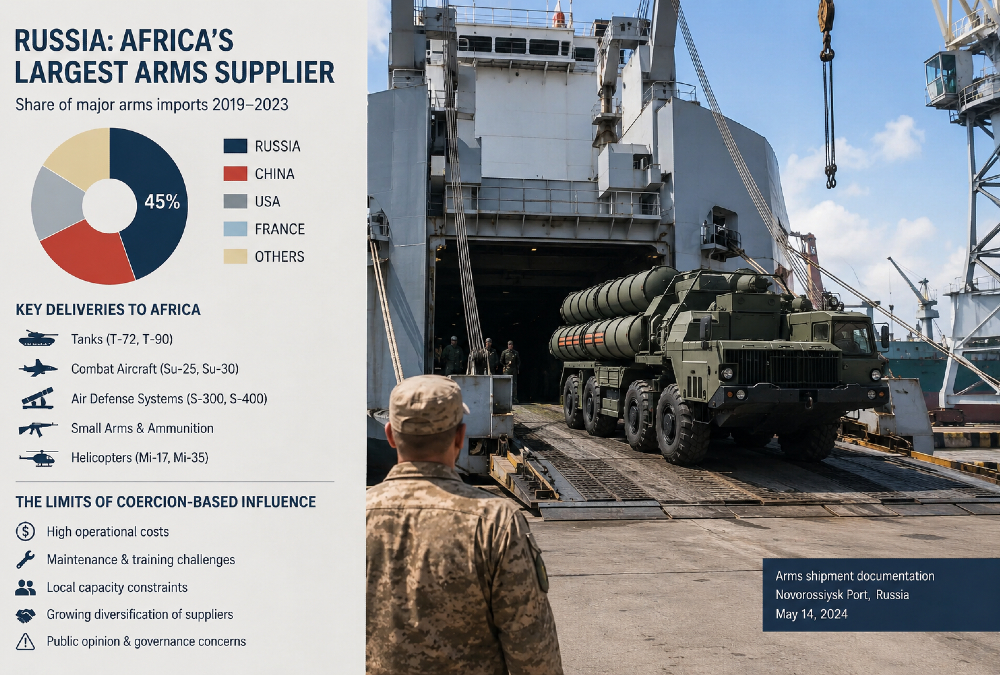
Across eras, Russia shifted from 18th-century colonial curiosity to Cold War ideological/military patron to 21st-century pragmatic partner focused on arms, security and countering Western influence. In its current strategy, Russian success in security is the key in its maintaining positive relationships in Africa, and this is where their relations are breaking down today.
The Robert Lansing Institute, an organization providing understanding of global challenges causing threats to democratic societies, is reporting that Russia’s recent military and political setbacks in Mali represent more than a tactical defeat by extremist elements in the Sahel region. The withdrawal of the Russian-controlled Africa Corps from key northern positions such as Kidal has exposed deep structural weaknesses in Moscow’s African strategy and has raised critical intelligence questions regarding the sustainability of Russian influence operations across the continent.
The events in Mali demonstrate that Russia’s model of influence in Africa – built around military juntas, mercenary structures, coercion, disinformation and resource extraction – may be reaching its operational limits. The defeat also has exposed vulnerabilities inside Russia’s intelligence architecture, including failures in local penetration, force protection, threat forecasting and strategic assessment.
The Institute questions whether Russia is losing the ability to act as Africa’s primary external security patron because its intelligence, military and hybrid influence model seems structurally incapable of stabilizing allied regimes.
Africans Fighting for Russia in Ukraine
As if the inability to stem the advance of extremist elements isn’t enough to sour relations with African countries, there are widespread reports that nearly 2,000 Africans from 36 countries are currently fighting in the Russian army in the war in Ukraine, as announced by Ukrainian Foreign Minister Andrii Sybiha on February 25. Ukrainian authorities confirmed last November that some 18,000 citizens from 128 countries are fighting in the Russian ranks.
The New York Times reported on May 6 the growing number of Africans who are ending up on the front lines of Russia’s war with Ukraine. Some go there willingly as mercenaries, but many more are young men lured by the promise of ordinary civilian jobs – from bodyguards to line cooks – only to be forced into joining Russian forces in battle.
A string of fly-by-night companies reportedly have been set up across the continent to recruit the men. The companies often appear as travel agencies or job placement firms and advertise on WhatsApp or Telegram.
The New York Times interviewed several victims and recruiters. The interviews suggest that the recruiters do not work directly with the Defense Ministry in Moscow. Contracts seen by The Times were in Russian, meaning the Africans could not read them.
Formal jobs in Africa are scarce, making the promise of work overseas a powerful magnet. And Africa has the fastest growing youth population on the planet. Many young people are unemployed, making the continent a prime target for the false recruitment of unwitting soldiers.
Several African governments are taking diplomatic and legal steps to address the recruitment of their citizens to fight in the war between Russia and Ukraine, amid growing concern over the exploitation of young Africans and the broader political implications of the conflict. Ghana has formally asked Ukraine to release two of its citizens captured while fighting alongside Russian forces, arguing that many Africans were deceived through online recruitment schemes.
The Ghanaian government also has announced plans to launch public awareness campaigns – during its upcoming presidency of the African Union – to counter trafficking networks that recruit African youth for foreign conflicts.
In South Africa, Africa-Eye.com states that reports have linked political figures to recruitment activities. Among those mentioned is Duduzile Zuma, daughter of former president Jacob Zuma, who has faced legal accusations related to recruiting young men for the Russian military.
The case has highlighted the political and security risks associated with the phenomenon and has sparked debate over the responsibility of governments to protect their citizens from exploitation.
Despite rising public criticism, some observers say the response from African governments remains limited. At the same time, Russia continues to deny any direct involvement in organized recruitment, insisting that foreign fighters sign voluntary contracts.
Nevertheless, recent initiatives from Kenya, Ghana and South Africa reflect growing awareness across the continent of the humanitarian, economic and political risks linked to the recruitment of Africans for foreign wars.
Utilizing Africans (along with other nationals) to boost its war against Ukraine indicates the inability of what had been considered a superpower to overcome a smaller, less capable neighbor is achieving what Western governments have wanted for some time – the weakening of Russia on the international stage.
Increasing Russian debt and its focus on the war in Ukraine highlight its inability to project its aims internationally. This demonstrated weakness is compounded by the shutoff of sanctions-busting oil supplies to Russia from Venezuela and Iran.
Some observers speculate that the limited military parade in Moscow recently, ostensibly from concern about potentially embarrassing Ukrainian drone attacks, and Russian President Vladimir Putin’s increasing resort to bunkers for protection demonstrate that the war in Ukraine, which is a Putin obsession, may be leading to the government’s unpopularity at home.
That doesn’t mean there will be an uprising among the Russian people, but military leaders don’t like to be embarrassed, and the Ukraine mess and the failures of outsourced security operations in Africa, can’t make the Russian military satisfied with their government’s leadership. If this situation continues, what will these military leaders do about it?
Gregory Simpkins, a longtime specialist in African policy development, is the Principal of 21st Century Solutions. He consults with organizations on African policy issues generally, especially in relating to the U.S. Government. He further acts as a consultant to the African Merchants Association, where he advises the Association in its efforts to stimulate an increase in trade between several hundred African Diaspora small and medium enterprises and their African partners.
