
A Diaspora View of Africa
International Community joins Africa in Debt Challenge

By Gregory Simpkins
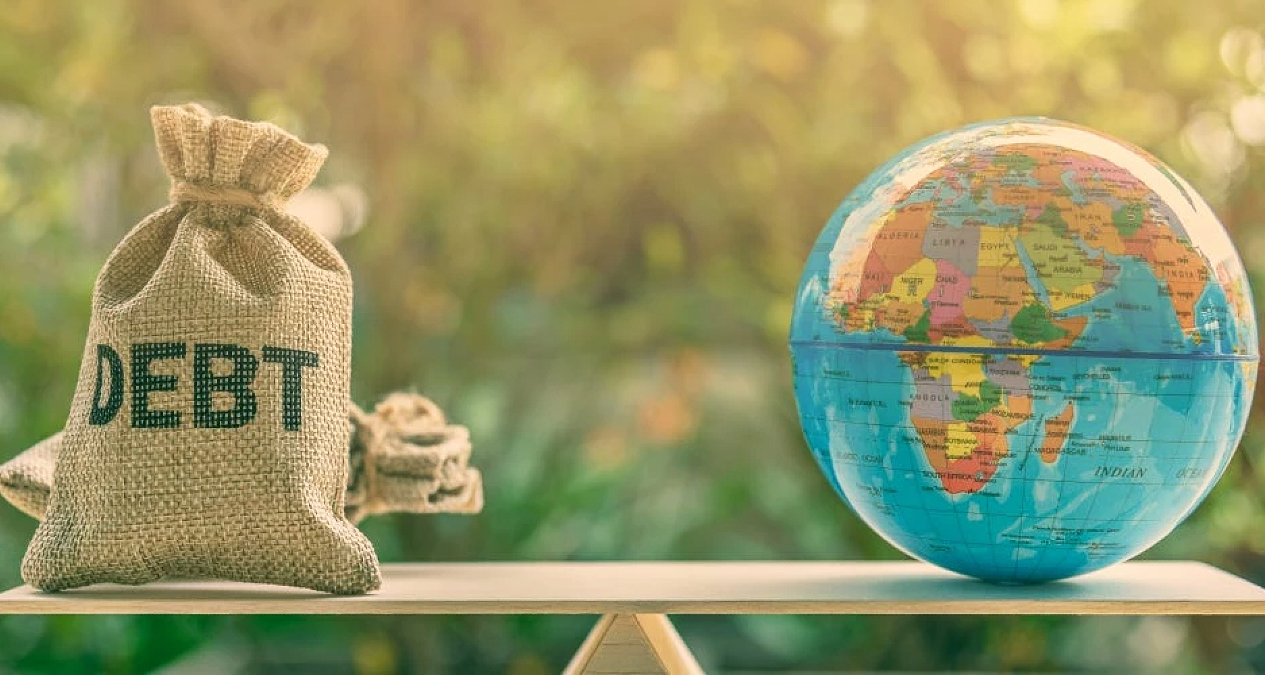
Debt is a cancer that eats away a government’s ability to manage its economic affairs. It prevents governments from providing required social services, security and economic development. It discourages foreign investment. It limits sovereignty when governments must look to economically stronger nations to bail them out of their debt.
It used to be developing nations such as those in Africa who were deep in debt and needed to request help from the international community were more broadly indebted, but now even developed governments are less able to help those who have been in need of debt relief far longer. According to the Institute of International Finance (IIF), global debt surged by more than US$15 trillion in 2023, following a decline of about US$7 trillion in 2022.
It has now reached a new record high of US$313 trillion. According to IIF’s Global Debt Monitor, approximately 55 percent of this increase originated from mature markets, mainly driven by the U.S., France, and Germany. In emerging markets, the debt accumulation was mostly concentrated in China, India, and Brazil.
By sector, generally governments saw the largest increases in the USD value of outstanding debt, followed by non-financial corporate entities. Debt outside the financial sector hit US$244 trillion, which is now at US$45 trillion above pre-pandemic levels.
The Congressional Research Service (CRS) reports that sustainability of US public debt has reappeared as a key financial risk to investors. After all, US Treasuries are the safe-haven asset against which most financial assets are priced and benchmarked.
The continent has been faced with several shocks that have arisen largely beyond its borders. Subsequently, the continent’s need to increase its resilience and independence from the rest of the world has taken on greater importance.
First the basics: CRS says US debt has risen from around 60 percent of gross domestic product during the global financial crisis to roughly 120 percent of GDP today – US$35 trillion and rising. While it’s impossible to quantify where a limit is in terms of where debt becomes explosive, some of the most commonly used forecasts today, including the Congressional Budget Office (CBO), show debt soaring well into the future.
Developed nations have made questionable economic choices and are suffering, but to a lesser extent than African governments have. So, what will the international community say about African debt now, and what will they do?
According to ONE, the organization founded in in 2004 by the musician Bono and other activists to promote fair development, Africa’s debt is at its highest level in more than a decade. As a result of COVID-19, the Russian invasion of Ukraine and soaring inflation, African countries have had to take on even more debt, and now 20 low-income African countries are either bankrupt or at high risk of debt distress.
- African countries owed US$655.6 billion to external creditors as of 2022.
- African countries will pay US$89.4 billion in external debt service in 2024.
- External debt owed by African countries is equivalent to 22.4 percent of their combined GDP in 2022.
ONE estimates that Africa’s external debt as a percentage of GDP rose quickly between 2014 and 2020. External debt decreased in the last two years and is 22.4 percent of African countries’ GDP (as of 2024 for countries with available data). Yet many individual countries have rates far higher.
Debt composition
The composition of African debt has changed significantly, ONE says. Previously, the majority of African external debt was owed to official creditors – high-income countries and multilateral lenders like the World Bank and International Monetary Fund. Now, China and private creditors make up a large proportion of debt stocks, meaning more debt is non-concessional.
China has become Africa’s biggest bilateral lender. Its public lenders hold almost US$63 billion of Africa’s external debt in 2022, and its private lenders more than US$24 billion of Africa’s external debt.
African external debt service payments have increased substantially in the past decade, in part due to higher interest payments on private loans. Debt service is interest plus principal payments on public and publicly guaranteed (PPG) debt, in USD million (current prices).
Even before the pandemic, more than 30 African countries spent more on debt service than on healthcare. Government expenditure refers to general government expense, net of acquisition of non-financial assets.
According to the UN Trade and Development agency (UNCTAD), a sequence of shocks beyond its borders diminished Africa’s ability to develop and led to fast increasing debt levels. With nearly 1.4 billion people, or approximately one-sixth of the world’s population, Africa’s importance in the global economy is growing.
Yet, since the turn of the century, the continent has been faced with several shocks that have arisen largely beyond its borders.
As a percentage of GDP, Africa’s share of external debt has risen from approximately 19 percent in 2010 to nearly 29 percent in 2022. Simultaneously, its external debt as a share of exports has risen from 74.5 percent to 140 percent over the same period.
Beginning with the global financial crisis of 2008 and, more recently, the COVID-19 pandemic and the war in Ukraine, Africa’s vulnerabilities have been brought to light. Subsequently, the continent’s need to increase its resilience and independence from the rest of the world has taken on greater importance.
Each of these recent crises has limited Africa’s growth potential and lowered its ability to climb up the development ladder, according to ONE. As a result, African debt, both continentally and nationally, has been rising.
And while debt serves a critical function for development, the rate at which debt is rising has constrained growth and limited many African countries’ ability to cope with future crises or invest for development.
In 2022, public debt in Africa reached US$1.8 trillion. While this is a fraction of the overall outstanding debt of developing countries, Africa’s debt has increased by 183 percent since 2010, a rate roughly four times higher than its growth rate of GDP in dollar terms.
Unsustainable
Nearly 40 percent of this debt is held by countries in Northern Africa, many of which have been confronted with higher food prices and lower availability of goods because of the conflict in Europe. Egypt, for example, which holds US$421 billion in public debt, received more than 75 percent of its wheat imports from Russia and Ukraine in 2021 – a dependency that combined with its already high debt has limited its ability to continue to source critical food and other imported products.
Still, Africa’s increased debt is not solely a result of the conflict in Europe. Indeed, the additional need to source personal protective equipment (PPE), pharmaceutical products, medicines, and vaccines, amongst other goods, during the COVID-19 pandemic became a major impetus for higher levels of debt.
In fact, in 2020 there were 27 countries in Africa with a ratio of debt to GDP above 60 percent, a level seen as a threshold for sustainability, compared to the year before the pandemic when 18 countries had debt levels above that threshold. While this number receded to 24 by 2022, compared to other developing countries, those in Africa have been slower to reduce their levels of debt.
From a regional perspective, Central Africa is the only region with an average debt level below the 60 percent threshold in 2022.
As the cost of servicing debt increases, so does the risk of debt becoming unsustainable, and as Africa’s debt continues to rise, the continent is being confronted with a global financial architecture that is misaligned with its needs. This is happening at a time when the amount it owes to creditors outside of its borders also has grown.
Having an increasing share of debt outside of its borders raises the risk of the burden of that debt becoming unsustainable as global financial pressures have weakened local currencies and increased the cost of servicing that debt in real terms.
As a percentage of GDP, Africa’s share of external debt has risen from approximately 19 percent in 2010 to nearly 29 percent in 2022. Simultaneously, its external debt as a share of exports has risen from 74.5 percent to 140 percent over the same period.
This latter point is important in Africa, ONE says, since many countries are reliant on exports, especially exports from the extractive industries with little value-added. The imbalance between debt and exports has made it more difficult for Africa to service its external debt as its ability to obtain foreign currency has grown at a rate lower than its debt-servicing costs.
Again, how will a financially weakened developed world address Africa’s ongoing debt issues and enable the financially troubled African countries to get themselves into a sustainable condition? In the past, the solution would have included African governments giving up control over natural resources, but governments on the continent are now asserting their sovereignty and canceling unfair resource deals and requiring new deals to be much fairer.
So, how will this new world order work? In an environment in which the transition to sustainable energy requires critical minerals largely found in Africa, hopefully, African governments will increase their determination to use their leverage to protect their resources and use extraction deals to reduce their debt burdens and provide for the needs of their citizens.
Gregory Simpkins, a longtime specialist in African policy development, is the Principal of 21st Century Solutions. He consults with organizations on African policy issues generally, especially in relating to the U.S. Government. He further acts as a consultant to the African Merchants Association, where he advises the Association in its efforts to stimulate an increase in trade between several hundred African Diaspora small and medium enterprises and their African partners.
