
A Diaspora View of Africa
How Will Critical Minerals Factor Into The New Scramble for Africa?

By Gregory Simpkins
The so-called Scramble for Africa refers to the cooperative effort by European powers to exploit the people and resources of the continent of Africa during the late 1800s. At the Berlin Conference beginning in 1884, these nations agreed to zones of control based on their interests without regard to the realities on the ground in Africa – creating borders to suit themselves and splitting up ethnic groups capriciously, leading to continued strife among Africans even after colonialism ended.
Colonial Expansion and Control
Portugal was the first European country to come to Africa to acquire territory and control resources. Even as late as the 1870s, European states still controlled only 10 percent of the African continent – all their territories being near the coast.
The most important holdings were in Angola and Mozambique, followed by the Cape Colony, held by the United Kingdom; and Algeria, held by France. By 1914, only Ethiopia and Liberia were independent of European control.
Africa’s natural resource wealth – first ivory, diamonds and cheap labor – today feature critical minerals that are so vitally in demand in today’s technological world. The demand for them rises continually as more people use computers, cell phones and other devices, including the technology used in the global march toward sustainable energy systems.
China’s Dominance in African Minerals
Recognizing that rare earths and other elements would be critical to the movement to leave behind fossil fuels and develop sustainable energy sources, China early on swooped in to corral the mining rights and subsequent processing of critical minerals and now have a virtual monopoly. The rest of the developed world is now scrambling to catch up and safeguard the supply of these elements from effective control by the Chinese, which can disrupt national economies by withholding supplies.
The Africa Policy Research Institute (APRI) states that China continues to be an avid buyer of metals and raw minerals globally and is in fact by far the world’s largest buyer. In 2020, it imported about a third of Africa’s minerals and metals exports worth US$16.6 billion (EUR 15 billion).
This was an increase of 28 percent from 2018, highlighting China’s increasing reliance on African minerals and providing an opportunity for African players to leverage these resources for greater benefits. China consumes more than a quarter of global supplies, including substantial portions of zinc, lead, refined copper, iron and steel and aluminum output.
Over the last two decades, China, mainly through state-owned enterprises, has come to dominate the African market in various sectors including mining, both in terms of investments and consumption. In 2022, China-Africa trade volume neared US$300 billion (EUR 270 billion), tripling the trade volume between the US and African countries.
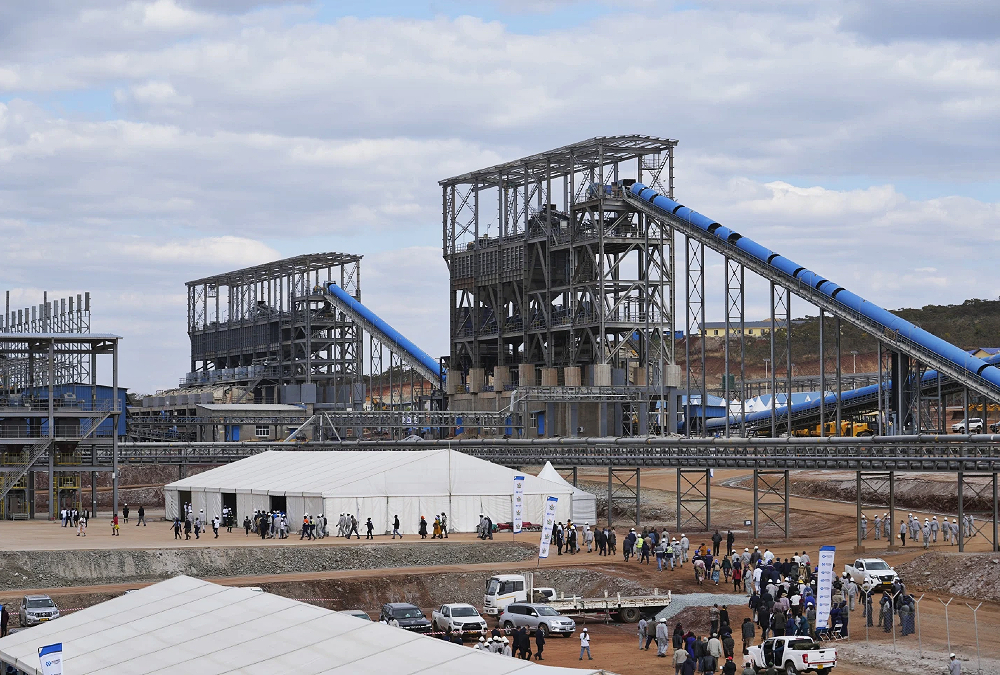
Chinese mining and battery companies have also invested US$4.5 billion (EUR 4 billion) in lithium mines in recent years, driving many lithium projects in countries like Namibia, Zimbabwe, and Mali. China’s investments in 15 out of 17 cobalt mining operations of the Democratic Republic of Congo (DR Congo), many linked to the Belt and Road Initiative, reflects this growing dominance.
While approximately 8 percent of Africa’s mining output goes to Chinese companies, 71 percent of African exports to China originate from just five countries: South Africa, Angola, DR Congo, Republic of Congo and Zambia. These exports are predominantly raw materials and minerals, with emerging African exporters like Guinea (iron ore), Zimbabwe (emerging in lithium), and Mozambique, contributing to the mix.
Global Competition and Strategic Alliances
There are, however, caches of unexploited resources on the continent.
According to the Carnegie Endowment for International Peace report: How the U.S. Can Stop Losing the Race for Clean Energy, India launched a Production Linked Incentive scheme a few years ago, while Japan, South Korea, and the European Union have since followed suit. Emerging and developing markets – including Gulf petrostates – are strategically positioning themselves in these new supply chains.
Meanwhile, the United States faces challenges in commercializing next-generation clean energy systems despite a strong innovation ecosystem. Many breakthrough technologies remain in pilot or demonstration phases and will require sustained public and private investment to reach market.
The report calls for the United States to integrate domestic industrial policy with international collaboration to build resilient supply chains and advance leapfrog technologies. Each of the fourteen supply chains assessed by the taskforce requires a tailored strategy:
- Onshore when existing U.S. strengths – such as an industrial base, skilled labor, or intellectual property – align with supply chain needs.
- Friend shore when domestic constraints limit production capacity, particularly in critical minerals, or when achieving competitive advantage would be impractical.
- Leapfrog when U.S. firms hold intellectual property that could bypass an incumbent technology and supply risks, especially on established technologies that China dominates.
This seems to be a sound strategy for growth in the critical minerals space for the United States and other developed countries. Still, it is likely that in the effort to catch up with China on critical mineral extraction, production and distribution that there must at some point be enhanced international collaboration.
The United States and Australia have begun a comprehensive economic and political collaboration driven in part by what is considered China’s recent unsafe and unprofessional encounters with naval vessels and aircraft that were exercising freedom of navigation and overflight, as established under international law. They committed to maintain the steady and long-term presence of Australian and U.S. aircraft and vessels in the Indo-Pacific, consistent with international law and in partnership with other states, to promote stability and security in the region’s vital international waterways, including the East and South China Seas.
Part of this cooperation is in creating a sustainable supply chain for critical minerals, which will increasingly focus on Africa.
Africa’s Role in the 21st Century Mineral Race
At some point, this partnership may well use their combined leverage to replace China as the lead in producing usable critical minerals for the 21st century economy. The question is: how will African nations respond to the 21st century competition for their resources?
APRI recommends that Africa needs to prioritize securing its own energy supply – leveraging international partnerships to develop key infrastructure projects can help boost domestic and intra-African energy consumption and increase its export capacity.
Second, expanding Africa’s energy production capacity for export globally without adding value through beneficiation can lead to unsustainable investments that may not benefit future generations.
Third, utilizing the continent’s reserves of critical raw materials can reduce its dependence on global superpowers and better navigate an increasingly polarized world.
At the Berlin Conference in 1884, there were no African representatives at the table. Will African governments safeguard their interests by being involved to the greatest extent possible when the international critical minerals competition heats up further?
Will they use their leverage to conclude mutually beneficial mining and processing deals that not only agree to allow for the foreign-involved extraction of these valuable resources, but also their processing in Africa to full value added status? Also, will the revenue gained be used to benefit African citizens?
Given the pullback of development aid – not only by the United States but other donors as well – it would behoove African governments to look out for their own national needs with the enhanced revenues their natural blessing have bestowed upon them. Donor fatigue has been a long time in coming, but now that it is here, African governments must themselves unite to create the collaborative leverage to compete with the developed world for mutually beneficial mining, processing and distribution deals.
This new Scramble for Africa offers the continent a second chance to gain the greatest benefit from its natural and human resources. If they fail to take advantage of this chance, there may not be a third one.
Gregory Simpkins, a longtime specialist in African policy development, is the Principal of 21st Century Solutions. He consults with organizations on African policy issues generally, especially in relating to the U.S. Government. He further acts as a consultant to the African Merchants Association, where he advises the Association in its efforts to stimulate an increase in trade between several hundred African Diaspora small and medium enterprises and their African partners.
