
A Diaspora View of Africa
Ethiopia Dam Crisis Just Beginning

By Gregory Simpkins
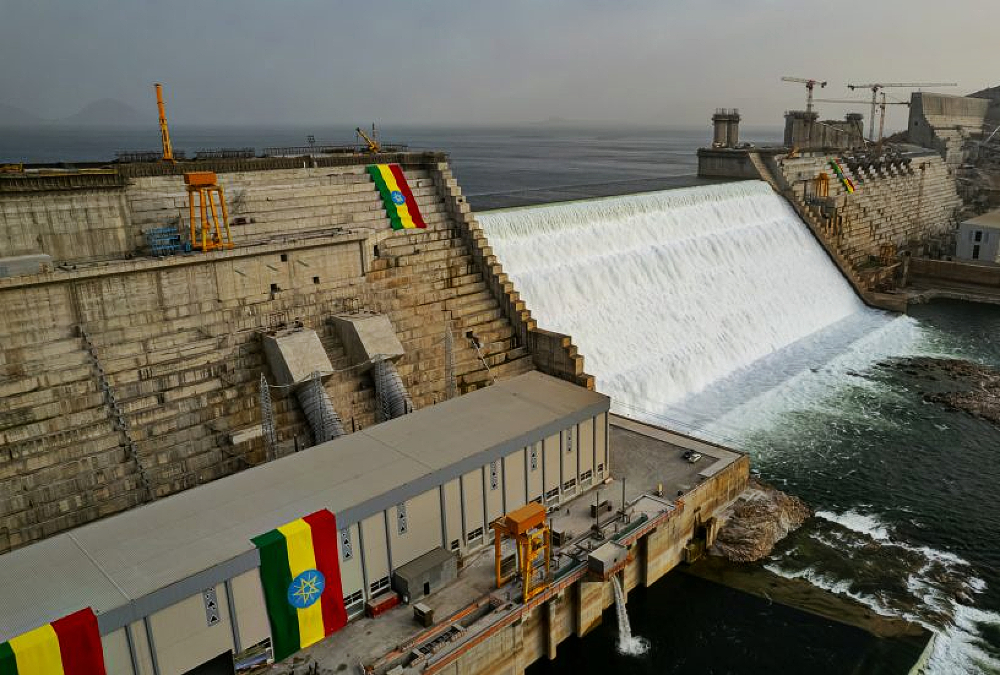
As written on our pages recently, Ethiopia officially inaugurated the Grand Ethiopian Renaissance Dam (GERD) in a landmark ceremony led by Prime Minister Abiy Ahmed and attended by several African heads of state and international dignitaries.
The event drew regional leaders including President Ismaïl Omar Guelleh of Djibouti, President Salva Kiir Mayardit of South Sudan, President Hassan Sheikh Mohamud of Somalia, President William Samoei Ruto of Kenya, Prime Minister Mia Amor Mottley of Barbados, and Prime Minister Russell Mmiso Dlamini of Eswatini.
Also in attendance were Moussa Faki Mahamat, former Chairperson of the African Union Commission, Claver Gatete, United Nations Under-Secretary-General and Executive Secretary of the United Nations Economic Commission for Africa (UNECA), as well as senior Ethiopian government officials. The ceremony was broadcast live across Ethiopia and beyond.
A Symbol of Sovereignty: Ethiopia’s Self-Financed Engineering Triumph
Unlike many large-scale infrastructure projects on the continent, the GERD stands out for being financed almost entirely by the Ethiopian people. Citizens contributed through bond purchases, fundraising campaigns, and personal donations – an approach hailed as a model of financial independence in Africa.
Prime Minister Abiy emphasized that the dam represents not just an engineering achievement, but also a symbol of Ethiopia’s sovereignty and determination to chart its own development path.
The GERD straddles the Blue Nile River on Ethiopia’s north-western border with Sudan and has been hailed by the Ethiopian government as playing a vital role in the country’s development, providing large amounts of hydropower. However, it has proved highly controversial and has led to tensions with countries fed by the Nile, especially Egypt.
The BBC reported on June 7 2021 that one of the benefits of the project claimed by the Ethiopian government was that it prevents flooding downstream as it flows into Sudan, although in 2020, following the initial filling of the dam reservoir in July of that year, the river downstream did flood.
“The floods in Sudan happened in August to September 2020. During that time, the GERD had no interference with the river flow or floods in Sudan,” said Mohammed Basheer, a researcher at the University of Manchester in the BBC interview.
Water levels did initially drop in Sudan as the reservoir was filling up, but once the dam reached capacity, the river rose to its natural level again.
According to the news service, Sudan has generally been supportive of the project, but “the future impact of GERD on floods in Sudan depends on how the dam will be operated, and the level of co-ordination with Sudan,” said Basheer. However, Egypt has been adamantly opposed to the GERD and the reduction of water from the Nile to Egypt, which could pose a serious problem to a mostly desert country.
It is notable that no high-ranking Egyptian official attended the GERD inauguration ceremonies.
Egypt has been accused of not efficiently using its water sources, which are vital to the increasing marketing of specialty cotton from the country.
Regional Fractures: From Nile Tensions to Diplomatic Realignment
The impact of the GERD only added to Ethiopia’s regional opposition. Somalia has worked to deepen diplomatic relations and security cooperation with Eritrea and Egypt since Ethiopia signed a naval port deal with Somaliland in early 2024.
The January 2024 deal granted Ethiopia land in Somaliland for a naval base in return for recognizing Somaliland’s independence. The Somali Federal Government has strongly rejected the deal as unlawful and a violation of its territorial integrity, as it considers Somaliland to be part of its territory.
The Somali and Eritrean presidents met days after the port deal announcement to discuss ways to “strengthen ties and foster cooperation.” Somali media said the two-day visit was “impromptu,” suggesting it was in response to the deal.
Anti-Ethiopian Axis: Egypt, Eritrea, and Somalia Forge a New Alliance
The Africa File, an information collaboration between the American Enterprise Institute and the Institute for the Study of War, reported on October 17 of 2024, that the presidents of Egypt, Eritrea, and Somalia formalized and deepened an anti-Ethiopian alliance during a trilateral summit on October 10. Egyptian President Abdel Fatah al Sisi, Eritrean President Isaias Afwerki, and Somali President Hassan Sheikh Mohamud met in Asmara, Eritrea, to bolster ties and coordinate regional security.
The presidents addressed “a wide range of regional and international issues.” They agreed to strengthen Somali state institutions and the Somali National Army to “confront various internal and external challenges,” according to a joint statement.
Somalia’s cooperation with Egypt in particular has accelerated since January 2024. Egypt and Somalia signed a bilateral defense cooperation agreement in Cairo in August of last year.
Egyptian media said Egypt deployed 1,000 soldiers to Mogadishu between 27 and 29 August 2024, while international media has reported on two arms shipments including ammunition, arms, artillery, and other weaponry since August.
The recent increase in Egyptian-Somali military cooperation ostensibly is meant to combat al-Shabaab but also threatens Ethiopia. Egypt’s foreign ministry spokesperson said in late September that its arms shipments aimed to support Somalia to “combat terrorism and preserve its sovereignty, unity and territorial integrity.”
The latter objective, according to the Africa File, suggests the shipment was at least in part to counter Ethiopia’s port deal with Somaliland.
But what stake does Ethiopia’s presumed ally Eritrea have in such an alliance? The U.S. Institute of Peace believes the historically fragile relationship between Ethiopia and Eritrea had deteriorated once again.
A seemingly momentous peace deal that brought the two sides together in 2018 now appeared to have been a brief interlude in a longer arc of enduring rivalry. The sources of recent tension include Prime Minister Abiy Ahmed’s public posturing around sea access and dynamics embedded in the 2018 peace deal itself.
A Continent Under Water Stress: GERD in the Broader Climate Crisis
As I have written about previously, access to water is a wider issue on the continent, as many as four billion people globally experience water shortages for at least one month a year, expected to rise to five billion by 2050. Currently, 25 percent of the population lives in countries facing extremely-high water stress.
Climate change is exacerbating the problem, intensifying floods and droughts, shifting precipitation patterns and fueling sea level rise.
An estimated 1.5 billion people will live in African cities by 2050, more than double the number today. African cities – including unplanned urban areas and informal settlements – are already facing staggering challenges: poverty, the need for more and better jobs, and a lack of housing and basic infrastructure, all of which will be compounded by rapid urban growth.
The World Resources Institute in a May 11 2021 report presented as an example the city of Dire Dawa in Ethiopia, which is frequently hit by floods claiming the lives of hundreds, while most of its inhabitants have no access to clean water, and the drought in 2020 in Bulawayo, Zimbabwe, that pushed some families to sleep overnight in water queues, making it hard to adhere to pandemic guidelines for not only handwashing but also social distancing during the height of the COVID pandemic.
So, it is understandable that the effects of GERD on East Africa is a concern to the region.
Gregory Simpkins, a longtime specialist in African policy development, is the Principal of 21st Century Solutions. He consults with organizations on African policy issues generally, especially in relating to the U.S. Government. He further acts as a consultant to the African Merchants Association, where he advises the Association in its efforts to stimulate an increase in trade between several hundred African Diaspora small and medium enterprises and their African partners.
