
Zina’s Youth View on Africa
Ethiopia and Russia Cement Strategic Partnership Amid Shifting Global Alliances

By Godfred Zina
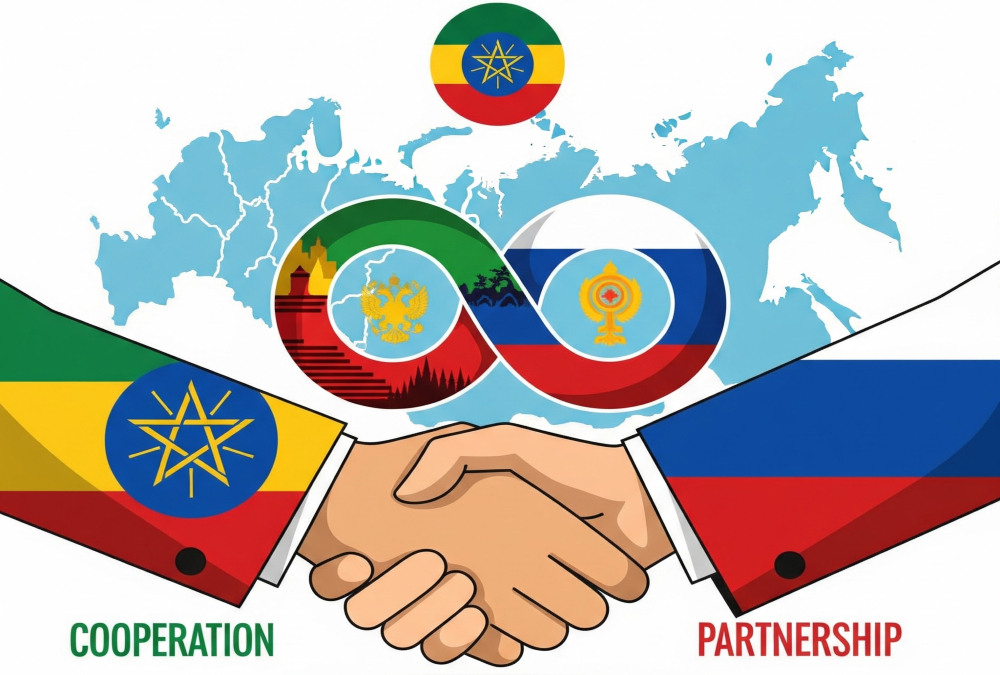
As Russia expands its footprint in East Africa, Ethiopia and the Russian Federation are forging a closer strategic relationship that spans defense, economics, and multilateral diplomacy.
In May 2025, high-level defense officials from both nations convened in Moscow to deepen military cooperation, enhance regional security coordination, and strengthen professional communication channels between their armed forces. The talks also highlighted growing economic ties, including initiatives to facilitate currency trade, reinforce mutual commitments to regional stability, and improve bilateral defense dialogue.
In recent years, Ethiopian-Russian relations have warmed significantly. A key milestone came when the Kremlin authorized Ethiopian banks – alongside those in Nigeria and Tunisia – to participate in cross-border currency trading within Russia.
This move has opened new financial avenues for Ethiopia amid evolving global economic dynamics.
A Strategic Step Toward Multipolar Finance
Adding momentum to this partnership, Ethiopia formally announced in April 2025 its intention to join the BRICS New Development Bank (NDB), positioning itself as the fourth African nation to seek membership. Ethiopian Ambassador to Brazil, Leulseged Tadese Abebe, confirmed the country’s application, emphasizing Ethiopia’s support for a more multipolar world order in both financial and geopolitical spheres.
So what does this mean?
This shift signals a growing Russian presence in East Africa, potentially complicating Western military and diplomatic strategies in the region. Neighboring countries may reassess their own defense and economic partnerships, prompting a broader realignment of regional alliances and security frameworks.
Moreover, Ethiopia’s move reflects a larger trend among Global South nations seeking alternative financial mechanisms outside the traditional Western-dominated system. As countries increasingly explore de-dollarization and new development financing models, Ethiopia’s participation in the NDB could serve as a blueprint for others aiming to reduce dependency on institutions like the IMF and World Bank.
If successful, Ethiopia’s pivot could unlock significant development funding while reinforcing its strategic autonomy. It may also encourage other developing nations to pursue greater independence by building new alliances and reshaping the contours of global governance.
Godfred Zina is a freelance journalist and an associate with DefSEC Analytics Africa – a consulting agency specializing in the provision of accurate data and assessments on security, politics, investment, trade, and other risks within Africa. He is based in Accra, Ghana.
