
A Diaspora View of Africa
Does the Diaspora Accept African Heritage?

By Gregory Simpkins
I recently read an article that peaked my interest in examining Diaspora connections to Mother Africa and her people. Writing in the Worcester Telegram & Gazette on February 15, Owura Sarkodieh, a former mayoral candidate in that city, lamented the lack of Diaspora connection to the African continent and its people.
“In recent conversations across social media, community forums and even academic spaces, a troubling contradiction has become impossible to ignore. Some African Americans – rightly vocal about racism and exclusion in the United States – simultaneously distance themselves from Africa and Africans, often with open disdain. This posture is not only historically inconsistent; it is strategically self-defeating,” he stated.
Sarkodieh regards this disconnection as highly ironic.
“Africa is not a metaphor, an insult or a costume to be worn when convenient. It is history, ancestry, culture and identity.
To reject it while demanding racial justice is to argue for dignity with one hand while discarding the foundation of that dignity with the other. No amount of assimilation, education, wealth or patriotism has ever fully shielded Black Americans from racial exclusion,” he wrote.
Even before I began a long career analyzing and attempting to impact US policy on Africa, I developed friendships with Africans living in America. This fortunately allowed me to overcome the longstanding miseducation about Africa and its people.
As I developed my abiding interest in the continent, its history and its people, I was constantly questioned about why I was so interested by those for whom Africa and Africans held no curiosity.
I experienced racism on the part of Black Americans towards those of us from Africa or those who still reside there. Too many of us learned the concept of supremacy and have lorded our privileged situation over those of people elsewhere in the Diaspora.
Even some of those who have worked on Diaspora issues have done so with a savior spirit, i.e., they attempt to “save” Africans because of the erroneous belief that they cannot save themselves. That was the spirit evidenced by some of the leaders who went to post-apartheid South Africa and was the cause of great resentment toward Black Americans in that country.
The lack of truthful, comprehensive education about Africa has meant that Americans of all races tend to think of Africans as backward and self-destructive
The Roots of Miseducation and the Path to Reconnection
After being released from a long imprisonment in the 1990s, the late South African leader Nelson Mandela came to the United States but had to cancel a calendar arranged for him by those who failed to get his approval for what I’m sure they thought was a kind act of scheduling. That same lack of consultation has been seen in many international efforts to contribute to the development of the continent.
People too often think they know what’s best for Africans more than Africans themselves.
The lack of truthful, comprehensive education about Africa has meant that Americans of all races tend to think of Africans as backward and self-destructive, especially given the negative media coverage of the continent and its people. Unless one proactively researches African history, the all too popular view is that Africa and Africans need help and cannot provide it for themselves.
The great African empires, scholars, scientists and their contributions to the world are not presented in what constitutes world history in most classrooms. Therefore, Africa is easily portrayed as an undeveloped land with people who desperately need outside help to survive.
There has been a largely successful colonial effort to cripple Africa by turning its people against one another to unravel advancements and allow European assertion of control and covering up developments there that contradicted the narrative of a backward land raised from nothing by nations brining technology to a continent that first taught the world about technology and religion to a continent where Christianity spread before it reached Europe.
Neocolonial control maintains this sham, although this illusion is now fading due to strong African leaders asserting control over their countries’ resources, communications technology that allows ideas to escape the control of those who have long presented an adverse narrative and a Diaspora that has awakened to the truth about our ancestors – both their accomplishments and the capabilities of their descendants.
We at The Habari Network have strived to show the reality of African people worldwide for 15 years, and we are proud to contribute to the unveiling of the reality of Africa – yesterday and today. But will this be enough to change the negative image of Africa and its people among its descendants worldwide?
While comprehensive data on Black American emigration specifically remains limited, experts tracking expatriate trends report a noticeable spike in Black Americans seeking citizenship abroad.
Back to Africa?
Since the 1700s, the pan-African movement, led by members of the Diaspora in the Western Hemisphere, have promoted independence and freedom for the people and nations on the African continent. Pan-African leader Dr. Ibbo Mandaza has told us in interviews conducted over two years that this movement has successfully galvanized many.
Mandaza reported that not only the activists he has encountered at international conferences but also many average Black people now realize their connection to Africa.
So fortunately, the Diaspora disconnection to Africa seems to be reversing itself.
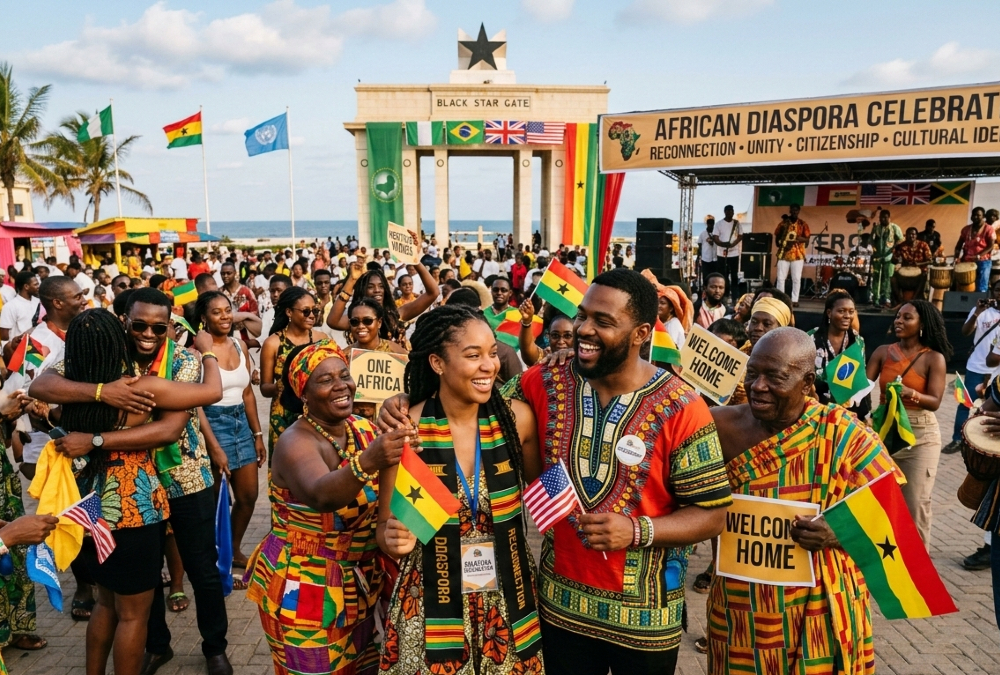
According to an February 18 article in the Washington Informer (from an earlier report by Word in Black). In November 2024, Ghana granted citizenship to 524 members of the African Diaspora, more than four times the number granted in 2019, bringing Ghana’s total to more than 950 Diaspora citizens since the country’s historic “Year of Return” campaign.
That 2019 initiative, commemorating 400 years since the first enslaved Africans arrived in America, attracted 1.13 million visitors to Ghana and generated US$1.9 billion in tourism revenue.
But Ghana isn’t alone, the report stated. In 2024, Benin enacted groundbreaking legislation granting citizenship to descendants of enslaved people who can provide DNA proof of Sub-Saharan African ancestry.
Guinea-Bissau, under its “Decade of Return” initiative launched in 2021, began granting citizenship to individuals with verified ancestral ties to ethnic groups such as the Balanta, Fula, and Mandinka.
In January 2025, Burkina Faso followed suit with an executive order granting citizenship to the descendants of enslaved Africans with minimal bureaucratic barriers. According to recent polling data, the Informer article stated, 34 percent of Americans expressed a desire to live abroad in 2024, up dramatically from just 10 percent in 1974.
While comprehensive data on Black American emigration specifically remains limited, experts tracking expatriate trends report a noticeable spike in Black Americans seeking citizenship abroad.
Thanks to internet sources, such as YouTube, Diaspora members and others are seeing the genuine state of Africa today. I work with the William O. Lockridge Community Foundation on the US Foreign Service Initiative, a program aimed at presenting to young people in Washington, DC, potential opportunities in international careers.
It has been gratifying to note their surprise when we present photographs and videos demonstrating that Africa is much more than the poverty- and conflict-stricken area of the world so often represented in media presentations. The Foundation takes young people to Africa to see for themselves what Africa offers, and some of them are indeed pursuing ongoing connections with those living on the continent.
At the Leron H. Sullivan Foundation, where several of us as the Lockridge Foundation once worked, we had established a relationship with African Ancestry, a DNA testing service that has linked hundreds of Black people to their ethnic kin on the continent. Still, there were those who refused to take the test, apparently concerned at it might undermine their identity as Americans or limit their embrace of Africa as a whole.
In his article, Sarkodieh warns that such short-sighted thinking endangers the rightful connection those in the Diaspora have to Africa and those who live there.
“Acknowledging Africanness does not erase the unique experience of Black Americans shaped by slavery, segregation and resistance in the United States.
Those experiences matter deeply and deserve distinct recognition. But they do not cancel African origins; they sit alongside them. Identity is not a zero-sum equation. More importantly, respect on the global stage is rarely granted to people who reject themselves,” he said.
Gregory Simpkins, a longtime specialist in African policy development, is the Principal of 21st Century Solutions. He consults with organizations on African policy issues generally, especially in relating to the U.S. Government. He further acts as a consultant to the African Merchants Association, where he advises the Association in its efforts to stimulate an increase in trade between several hundred African Diaspora small and medium enterprises and their African partners.
