
Opinion
Context, Not Code, Will Drive Africa’s Mobility Revolution
While Detroit, Stuttgart and Shenzhen chase autonomy and luxury, the continent is building a transport future of its own: smaller, tougher and cleverer.

By Des H. Rikhotso
Every few months, a new prototype of a self-driving, all-electric sedan glides across a stage in California or Munich, and the world’s automotive press swoons. Almost none of it is meant for Lagos at rush hour. A vehicle that depends on pristine lane markings, a dense network of fast chargers and a flawless power grid is a fine product for Norway. For the roughly 1.5 billion people of Africa, it is a rumor.
The continent’s carmakers, entrepreneurs and regulators have drawn the obvious conclusion. Africa will not import the automotive future so much as rewrite it. The result is likely to be less glamorous than the global vision and far more consequential for the people who actually move through African cities every day.
Two-Wheeled Electrification
The West imagines electrification as a passenger-car story. In Africa, it is a motorbike story. Commercial motorcycles, known as boda-bodas in East Africa and okadas in Nigeria, together with three-wheeled tuk-tuks, carry an enormous share of daily trips and last-mile deliveries. They are also commercial assets, not lifestyle purchases. A rider who earns a living on one counts every shilling spent on fuel.
That arithmetic explains why companies such as Spiro, Ampersand and Roam have built their businesses around electric two- and three-wheelers rather than sedans. Batteries for a motorbike cost a fraction of those for a car, and the payback period, measured against a petrol bill that never stops, is short enough to persuade even a cautious operator. When the customer is a business of one, a compelling return on investment is a better marketing tool than any badge.
Swap, Don’t Wait
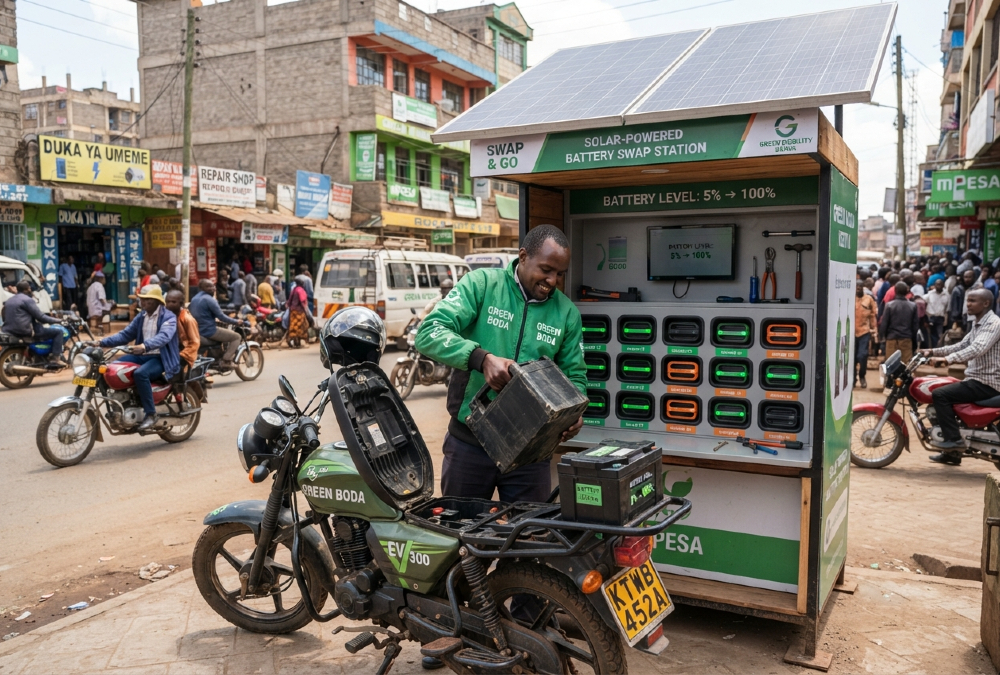
The second adaptation is a business model, not a machine. Fast-charging infrastructure is expensive and slow to build, and it presumes a stable grid that many African cities cannot yet guarantee. So the continent’s startups have sidestepped it. Their answer is battery-as-a-service: a rider pulls into a neighborhood kiosk, hands over a depleted battery and rides away with a charged one in minutes.
The idea is quietly radical. By separating the battery, the most expensive component, from the vehicle, swapping networks cut the upfront price of going electric. The rider buys a motorbike and rents the energy. It is, in effect, a subscription to a fuel tank, and it turns a capital-expenditure problem into an operating expense that a daily earner can manage.
Power supply is the final piece. Where national grids stumble, as South Africa’s rolling blackouts have shown so painfully, charging hubs are increasingly pairing solar microgrids with onsite storage. Early examples are emerging in South Africa, Kenya and Rwanda. Africa may be the first region where electric mobility and decentralized energy are designed together from the start, rather than bolted on after the fact.
Minibus Network
Global “mobility as a service” platforms tend to imagine a world of ride-hailing apps and tidy timetables for buses and trains. African cities run on something messier and more resilient: privately owned minibuses. South Africa has its minibus taxis, Kenya its matatus, Nigeria its danfos. These informal systems move millions of people daily, with no published maps, no fixed schedules and few official records.
For years, that invisibility made them an afterthought in transport planning. Now data is catching up. Startups such as WhereIsMyTransport and GoMetro deploy local data collectors to map routes, stops and fares that conventional navigation services miss. Once a route exists on a map, it can be analyzed, optimized and eventually integrated with other modes of transport.
Payment is the other frontier. Fares are overwhelmingly paid in cash, which is slow, hard to audit and a headache for fleet owners. Mobile money, pioneered by Kenya’s M-Pesa, and tap-to-pay cards designed for low-data environments and tiny transactions are bringing these fares into the digital economy. The point is not to replace the minibus with something shinier. It is to make the existing system legible, accountable and bankable.
Built for Real Roads
A car engineered for the autobahn can suffer on an African road. Punishing surfaces, heavy dust and overloaded loads chew through suspensions and filters designed for European or North American conditions. Real localization therefore means reinforced suspension, higher ground clearance, heavy-duty air filtration and, crucially, simpler electronics.
That last requirement is often overlooked. A vehicle that can be fixed only with a proprietary diagnostic computer is a liability in a market where repair is performed by resourceful local mechanics, often beside the road. Technology that cannot be maintained locally is not advanced; it is fragile.
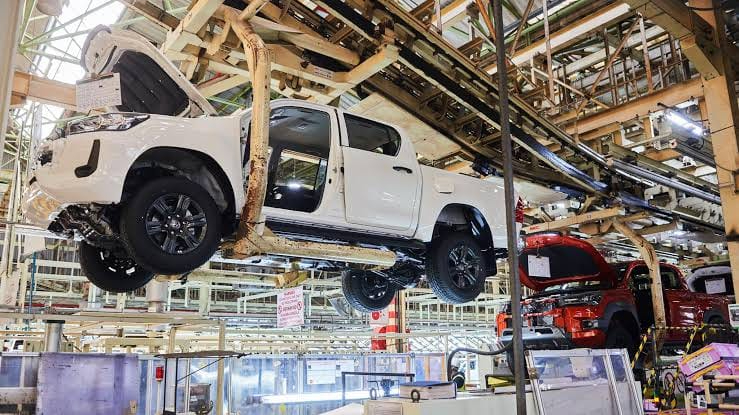
Industrial policy points the same way. Steep import tariffs on fully built vehicles have pushed manufacturers toward semi-knocked-down assembly, in which kits are shipped in and assembled locally. Volkswagen has taken this route in Rwanda and Ghana, while BAIC and Toyota operate in South Africa. The jobs created are modest, but they build skills, supplier relationships and, eventually, the foundations of a genuine manufacturing base.
Used Cars: Problem and Opportunity
Any honest account of African motoring must confront the secondhand market. In many countries, the great majority of imported vehicles are used, discarded by richer markets and absorbed by poorer ones. Localization that ignores this reality is a seminar topic, not a strategy.
The pragmatic response is to modernize the fleet already on the road. In Nigeria, a push to convert petrol vehicles to run on compressed natural gas is gaining momentum, offering cheaper and cleaner running costs without requiring anyone to buy a new car. Elsewhere, entrepreneurs are retrofitting older vehicles with electric drivetrains. Neither approach is as photogenic as a gleaming new EV. Both stand a far better chance of reaching the mass market.
Financing: The Real Engine
None of this works without credit, and traditional banks have little appetite for lending to informal workers with irregular incomes and no collateral. Mobility providers have therefore become, in effect, fintech companies.
The pay-as-you-go model is the clearest example. Vehicles are fitted with internet-connected immobilizers, allowing a financier to lease a motorbike or minibus to a driver in small daily or weekly installments. If payments lapse, the vehicle can be disabled remotely. That is a harsh enforcement mechanism, and it raises fair questions about consumer protection and fairness. But it has unlocked vehicle ownership for people the formal banking system long ignored. The technology has made lending to the unbanked affordable, and the discipline it imposes is the reason the model scales.
What the World Can Learn
It is tempting to read all this as a story of catching up. It is closer to the reverse. Africa’s mobility entrepreneurs are solving problems that the rest of the world will soon face: grids strained by electrification, households priced out of new cars, cities that must move millions of people without building new highways. Swappable batteries, solar-backed charging and digitized informal transit are not stopgaps for poor countries. They are prototypes for resource-constrained cities everywhere.
The lesson for global automakers is humbling. The next billion customers will not be won by exporting the latest flagship. They will be won by building for the road, the grid and the wallet that actually exist. For African policymakers, the lesson is equally plain: back the unglamorous things, such as reliable power, sensible tariffs, mobile-payment rails and open transport data, and let the entrepreneurs do the rest.
The driverless car may arrive in Africa eventually. For now, the future is a young rider in Kampala swapping a battery at a roadside kiosk, paying by phone, and getting on with the day. It is not the future the carmakers advertised. It is a better one.
Des H Rikhotso (PgDip-BA, MBL) is a seasoned C-suite Multi-Industry business executive with 25+ years of Business Leadership Experience across the South, East and Western Sub-Sahara Africa Region. Based in Kampala, Uganda he serves as East Africa Region Business Executive, driving Business Strategic Growth and Operational Excellence – contributing his Leadership Voice and Clarity to the Region. Des has held Business Leadership roles at BMW Group Africa, Volkswagen Group Africa, Peugeot Motors South Africa, Toyota/Lexus South Africa, Nissan Group of Africa, G.U.D Holdings (Africa Exports Operations Division) and The HDR Group of Companies. He holds Under-Graduate and Post-Graduate business degrees from the University of the Western Cape, Wits University (Wits Business School) and the University of South Africa.
