
Opinion
Africa’s Six-Decade Quest for Economic Independence
Seventeen countries won their freedom in 1960. More than six decades on, the harder fight is for economic sovereignty.

By Dishant Shah
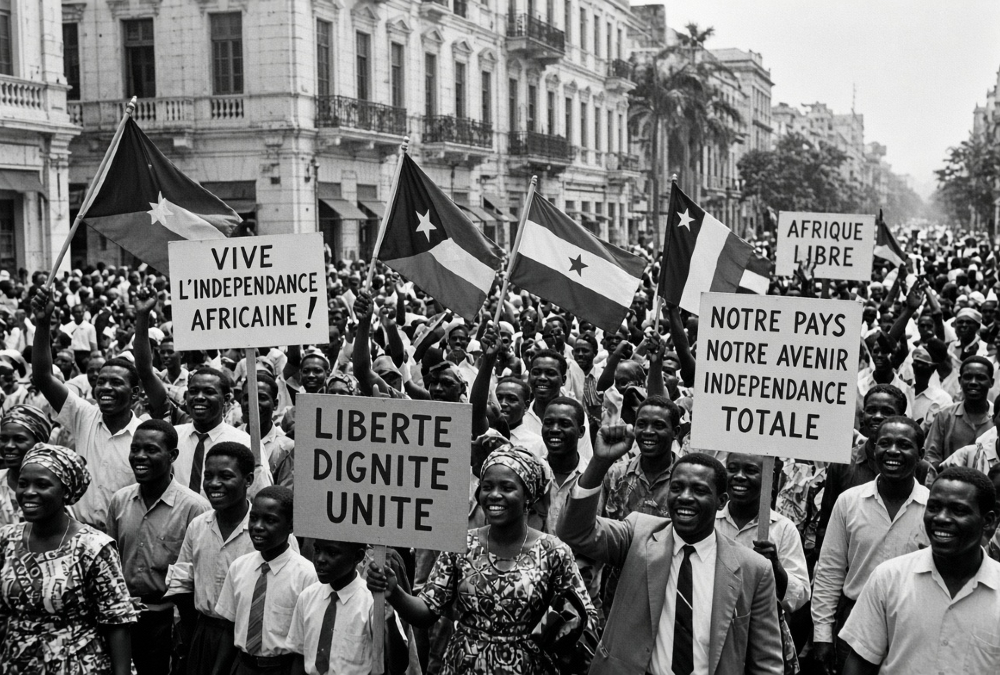
In February 1960, Harold Macmillan told South Africa’s parliament that a “wind of change” was blowing through the continent. The British prime minister was being generous with his metaphors, and rather modest about the scale of the storm. Within twelve months, seventeen African nations had hoisted new flags, the largest single burst of decolonization in modern history. The political map of the world was redrawn, and the old imperial order never recovered.
Yet the more important question for Africa today is not how it won its independence. It is what independence has delivered.
A Wave Decades in the Making
The year 1960 did not arrive from nowhere. After the Second World War, Europe’s colonial powers were bankrupt, bruised and increasingly unable to justify their rule to their own voters, let alone to their subjects. Britain and France had spent a generation fighting for freedom abroad while denying it at home in their empires, a contradiction that African leaders were quick to exploit.
Across the continent, the pressure came from every direction. Trade unions organized strikes. Students, many educated in the very capitals they now defied, built nationalist movements. Farmers, market traders and veterans of imperial armies joined them. They shared a simple demand: the right to govern themselves.
Ghana’s independence in 1957 proved it could be done, and Kwame Nkrumah’s famous exhortation to “seek ye first the political kingdom” became a rallying cry. Guinea’s defiant break from France in 1958 showed the price of refusing a gentler transition. By 1960, the dam had burst.
The Year Everything Changed
The roll call is striking. Cameroon, Togo, Madagascar and Somalia became sovereign states. So did the former French colonies of West and Central Africa, from Senegal and Mali to Chad and Gabon. The Democratic Republic of the Congo broke free from Belgium on June 30, in a transition so ill-prepared that it dissolved almost immediately into crisis. Nigeria, the continent’s most populous country, followed on October 1.
For millions of people, the symbolism was immense. Colonial subjects became citizens, liberation movements became governments, and flags that had been banned became anthems sung in stadiums.
Freedom Without a Foundation
But raising a flag is easier than building a state. The new governments inherited a thin and awkward legacy.
The borders had been drawn in European conference rooms, with scant regard for the communities they divided or forced together. The economies had been engineered to ship raw materials out, not to build industries within. Cocoa, copper, cotton and crude oil flowed to distant factories, where the profits and the skilled jobs stayed. The institutions were designed to extract and control, not to represent or to serve.
Leaders also faced the delicate task of forging national identities among peoples with different languages, histories and loyalties. In many places, the nation had to be invented after the state.
The decades that followed were a study in contrasts. There were bold industrial ambitions and ambitious infrastructure projects, along with early experiments in regional cooperation. There were also coups, civil wars, Cold War proxy contests and fiercely competing economic models, from state-led socialism to market-oriented capitalism. The results varied enormously. Some countries built durable institutions and diversified their economies. Others stalled, and a few fell apart. The idea that Africa has a single postcolonial story is as lazy as the colonial maps themselves.
Political Power Is Not Economic Power
This is what makes 1960 such a useful reference point. It marked a change in who held political authority. It did not, and could not, change overnight who controlled capital, technology, markets and the terms of trade.
Consider the pattern that persists in much of the continent. Many African economies still depend heavily on exporting unprocessed commodities, leaving them hostage to price swings set in faraway markets. Africa accounts for only a small share of global trade, and trade among African countries remains strikingly low compared with other regions. A manufacturer in one African capital often finds it easier and cheaper to ship goods to Europe than to a neighbor a few hundred miles away. Some former French colonies still use currencies tied to the euro and backed by a European treasury, a reminder that formal sovereignty and monetary independence are not the same thing.
Progress is real, and it deserves credit. The African Continental Free Trade Area, which began trading in 2021, is the most ambitious attempt yet to turn fifty-odd fragmented markets into one of the world’s largest. A young, urbanizing population, a booming technology sector and growing manufacturing hubs offer genuine reasons for optimism. But promises are not yet prosperity, and a free-trade agreement on paper is only as good as the roads, ports, power grids and customs officers that make it work.
What Economic Independence Really Requires
The lesson of the past six decades is that political freedom is necessary but not sufficient. Turning sovereignty into prosperity demands a harder, less glamorous list of ingredients:
- Strong, accountable institutions that protect property, enforce contracts and resist capture by narrow elites.
- Productive economies that add value at home, processing minerals, crops and energy rather than merely exporting them.
- Deep regional trade, with the infrastructure and rules to move goods and people across borders efficiently.
- Investment in people, from schools to skills to the health of a workforce that will be among the world’s largest.
- Fairer access to finance, so that African firms and governments are not penalized by perceptions of risk that outrun reality.
None of these is easy, and none can be delivered by outsiders. That is perhaps the cruelest irony of the postcolonial era: the work of economic liberation must be done by the very states that were handed the least to work with.
The Question That Remains
The generation of 1960 won the political kingdom. They did it against long odds, often at great personal cost, and the world is better for it. But Nkrumah’s famous formula was always the first step of a longer journey, not the last.
More than six decades later, then, the question hangs over the continent like the harmattan haze. How much of Africa’s original independence agenda has translated into economic independence? The honest answer is: some, but not nearly enough. The next chapter will be written not in the language of liberation, but in the language of factories, trade routes, institutions and opportunity.
Dishant Shah is a partner at Legion Exim, a company specializing in facilitating the export of high-quality engineering products directly sourced from manufacturers in India to Africa. His areas of expertise include new business development and business management.
